

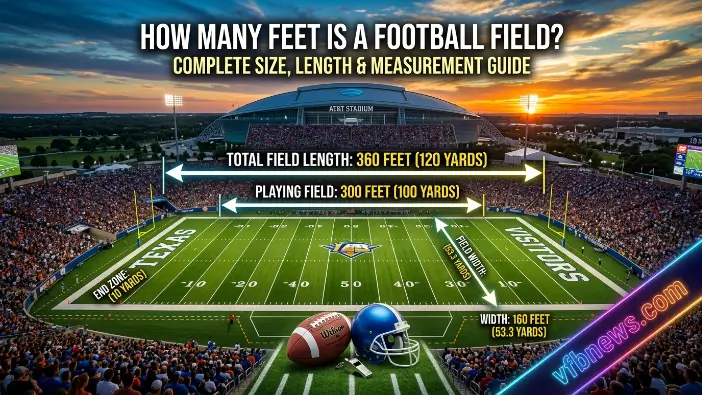
Welcome to VFB News. A common question among sports fans, students, and people who want to understand the basics of the game is how many feet is a football field. A standard American football field has a total length of 360 feet and a width of 160 feet, including both end zones. The main playing area between the two goal lines is 300 feet long, while each end zone adds an additional 30 feet, making the complete field 360 feet from one end line to the other.
Understanding football field dimensions is important because every part of the field has a specific purpose during the game. The yard lines, end zones, sidelines, and goalposts help players, coaches, and officials measure distances, create strategies, and follow the rules accurately. In this guide, we will explore the complete football field size, explain the purpose of each section, and compare football measurements with other popular sports fields to make the dimensions easier to understand.
How Many Feet Is a Football Field?
A standard American football field is 360 feet long from one end line to the other when both end zones are included. The field is also 160 feet wide, following official American football field measurements used in professional, college, and most organized football games.
The main playing area between the two goal lines is 100 yards long, which equals 300 feet because one yard is equal to three feet. In addition to the playing area, each end zone measures 10 yards or 30 feet. Since there are two end zones, they add another 60 feet to the total field length, making the complete football field 120 yards or 360 feet long.
Here is a simple breakdown of the standard football field in feet:
| Area | Measurement |
| Total Length | 360 feet |
| Playing Area | 300 feet |
| Width | 160 feet |
| Each End Zone | 30 feet |
Many people refer to a football field as being 100 yards long because they are usually talking about the playing area where most of the action happens. However, the complete field includes the two end zones, which extend the total length to 120 yards. Converting these measurements into feet makes it easier to understand the actual size of the field.
For example:
- 100 yards × 3 = 300 feet of playing area
- 120 yards × 3 = 360 feet, including end zones
These standard football field dimensions remain almost identical across professional, college, and high school football. While some smaller details, such as markings and hash marks, may change depending on the level of competition, the overall field size follows the same measurement system.
Read Also: How to draw a football
Understanding Football Field Dimensions and Layout
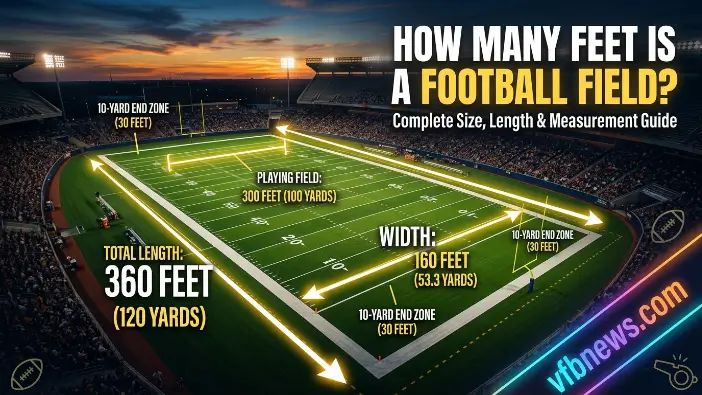
A football field is designed with specific measurements and markings that help players, coaches, and officials understand the position of the ball, distance to the goal line, and scoring opportunities during the game. Every part of the field has a specific purpose, including the playing area, end zones, sidelines, yard lines, hash marks, numbers, and goalposts. Together, these features create a clear structure that allows the game to be played fairly and strategically.
Playing Field Length and Width
The main playing area of an American football field is 100 yards long and 53⅓ yards wide. When converted into feet, this equals:
- Length: 300 feet
- Width: 160 feet
This area is where most of the action happens, including running plays, passing, and defensive movements. The field is divided into two halves, with yard lines, sidelines, and hash marks helping players and officials track distances, place the ball correctly, and create effective game strategies.
End Zone Dimensions
At both ends of the football field, there are two end zones located behind the goal lines. Each end zone measures:
- Length: 10 yards
- Feet: 30 feet
The end zones are the areas where teams score touchdowns. When a player successfully carries the ball into the opponent’s end zone or catches a pass while inside it, the team earns points.
Although each end zone is smaller than the main playing area, it is one of the most important sections of the field because it determines scoring opportunities. Together, both end zones add 60 feet to the total length of the field, creating the standard 360-foot football field size.
Goalposts and Field Markings
Goalposts are located at the back of each end zone and are used when teams attempt field goals or extra-point kicks. Along with goalposts, several other markings help organize the field and guide gameplay.
Important field markings include:
- Yard numbers: Show the distance from each goal line and help players understand their location.
- Yard lines: Mark every five-yard section to measure movement across the field.
- Hash marks: Show where the ball should be placed before each play.
- Sidelines: Mark the official boundaries and determine when a player or ball is out of play.
These features make the football field layout easy to understand and allow players, coaches, and officials to track every movement accurately throughout the game.
Why Is a Football Field Measured in Yards Instead of Feet?
Although how many feet is a football field is a common question, football is traditionally measured in yards because this system makes gameplay easier to understand. Yards provide a simpler way for players, coaches, and commentators to describe distances and track progress during a game.
Since one yard equals three feet, converting between yards and feet is easy. Here is how common football field measurements convert:
- 1 yard = 3 feet: A single yard on the field is equal to three feet in distance.
- 10 yards = 30 feet: A first down requires a team to move 10 yards, which equals 30 feet.
- 100 yards = 300 feet: The main playing area between both goal lines measures 100 yards or 300 feet.
- 120 yards = 360 feet: The complete football field, including both end zones, measures 120 yards or 360 feet.
Instead of saying a team needs to move 30 feet for a first down, football uses the more familiar term of 10 yards. The football field yardage system also helps organize the game, as yard lines show player positions and the distance remaining to reach the goal line.
Football Field Measurements Compared to Other Sports Fields
Different sports use different field sizes depending on their rules, playing styles, and strategies. Comparing sports field dimensions helps you understand the actual size of an American football field and how it differs from other popular sports areas.
| Sport | Approximate Length |
| American Football | 360 feet |
| Soccer | Varies by field |
| Basketball | 94 feet |
| Baseball | Different measurement systems |
An American football field is much larger than a basketball court because football requires more space for running plays, passing, and defensive movements. Soccer fields can be similar in length to football fields, but their dimensions can vary, and they are usually wider. Basketball courts are much smaller because the game focuses on fast movement and close-range action on a limited indoor surface.
These comparisons make it easier to visualize the overall football field size and understand how large the playing area is compared with other sports.
How to Calculate Football Field Measurements Yourself
Calculating football field measurements becomes simple once you understand how yards and feet are connected. Since football fields are officially measured in yards, converting those measurements into feet helps you better understand the actual size of the field and compare it with other distances.
Converting Yards Into Feet
The basic conversion formula is:
1 yard = 3 feet
This means every yard on a football field equals three feet. By multiplying the number of yards by three, you can easily calculate the measurement in feet.
For example:
- 100 yards × 3 = 300 feet
The playing area of a football field, from one goal line to the other, is 100 yards long, which equals 300 feet. - 120 yards × 3 = 360 feet
The complete football field, including both 10-yard end zones, measures 120 yards, which equals 360 feet.
So, when someone asks how many feet is a football field, simply multiply the total yard measurement by three. For a standard field:
120 yards × 3 = 360 feet
Measuring a Football Field
If you want to measure a football field or compare its size with another area, you can use several simple methods:
- Use a measuring tape: This is the most accurate method for measuring smaller distances or confirming field dimensions.
- Use online map tools: Digital maps can help estimate the size of large fields, stadiums, or outdoor areas.
- Compare with known distances: A football field can be used as a reference point to estimate the size of other spaces.
For example, if someone says a building is “about two football fields long,” it means the distance is roughly equal to 720 feet. Using a football field as a comparison makes large measurements easier for people to visualize.
Interesting Facts About Football Field Size
The size of a football field plays an important role in creating the right balance between speed, strategy, and physical competition. The standardized football field dimensions allow players to understand distances, plan plays, and adjust their movements during every game.
Here are some interesting facts about football field size:
- A standard football field covers approximately 57,600 square feet. This includes the entire playing area with both end zones, showing just how large the field is compared to many other sports surfaces.
- The complete field measures 120 yards from end line to end line: This includes the 100-yard playing area and two 10-yard end zones, making the total length 360 feet.
- Professional and college football fields follow similar official dimensions. This consistency allows players to compete in different stadiums without needing to adjust to major size changes.
- Yard lines help teams track progress during every possession: These markings show how far a team has moved and how many yards remain to reach the next first down or score.
- Field size influences offensive strategies, defensive formations, and player movement: The large playing area affects passing plays, running routes, defensive coverage, and overall game planning.
Because the dimensions remain consistent, players can quickly adapt when playing in different stadiums. The standardized football field measurements also help fans better understand distances during games, such as the length of a quarterback’s throw or the space covered by a running back during a play.
Common Mistakes When Understanding Football Field Measurements
Many people misunderstand football field measurements because football uses both yards and feet to describe the size and distance of the field. Since the field is usually measured in yards, people often get confused when converting these measurements into feet and understanding the difference between the playing area and the complete field size.
Confusing Playing Field With Total Field Length
One of the most common mistakes is thinking that the entire football field is 360 feet long, as the playing area. In reality, the main playing area between the two goal lines is only 300 feet long, which equals 100 yards.
The remaining 60 feet comes from the two end zones, with each end zone adding 30 feet to the total length. When these areas are included, the complete football field measures 360 feet from one end line to the other.
Understanding this difference helps you accurately identify the size of the playing area versus the full field.
Mixing Feet and Yards
Another common mistake is confusing yards and feet when talking about football distances. Since football fields are usually measured in yards, remembering the conversion formula is important:
- 1 yard = 3 feet: Every yard on the field equals three feet.
- 100 yards = 300 feet: This represents the main playing area between the goal lines.
- 120 yards = 360 feet: This represents the complete field, including both end zones.
Using the correct conversion makes it much easier to understand football field dimensions and calculate distances during the game.
Comparing Football and Soccer Fields Incorrectly
Football and soccer fields can look similar at first glance, but their measurements are not the same. American football fields follow a fixed size with specific markings, while soccer fields have more flexible dimensions that can change depending on the level of competition and stadium requirements.
Because of these differences, comparing the two fields only by appearance can lead to incorrect assumptions. Understanding their separate measurement systems gives a more accurate idea of each sport’s playing area.
Frequently Asked Questions
How much land is needed to build a football field?
A standard football field requires enough space for the playing area, end zones, and safety areas around the sidelines. The total space needed can be larger than the field itself because stadiums include additional areas for players and officials.
Why do football fields have numbers painted on them?
The numbers help players, coaches, and officials quickly identify their location on the field. They make it easier to understand distance, plan plays, and track movement during the game.
Does weather affect the size or markings of a football field?
Weather does not change the official size of a football field, but conditions like rain, snow, or extreme heat can affect how the surface looks and how players perform on it.
How long does it take to maintain a football field?
The maintenance time depends on the type of field surface, usage, and weather conditions. Professional fields often require regular care to keep the grass, markings, and playing surface in good condition.
Can a football field be used for other sports?
Yes, many football fields are designed as multi-purpose sports areas and can also be used for activities such as soccer, training sessions, and community events.
Conclusion
Understanding how many feet is a football field helps you clearly visualize the size and structure of an American football field. A standard field measures 360 feet long and 160 feet wide, including both end zones. The main playing area is 300 feet long, while the extra 60 feet comes from the two end zones. Knowing these measurements makes it easier to understand how players move, how plays are planned, and how distances are calculated during a game.
The football field dimensions are designed to create a balanced playing environment where speed, strategy, and teamwork all matter. Whether you are a football fan, student, or someone learning about sports measurements, understanding the difference between yards and feet gives you a better idea of the game’s layout. These standard measurements also help players and fans compare football fields with other sports fields more easily.
