

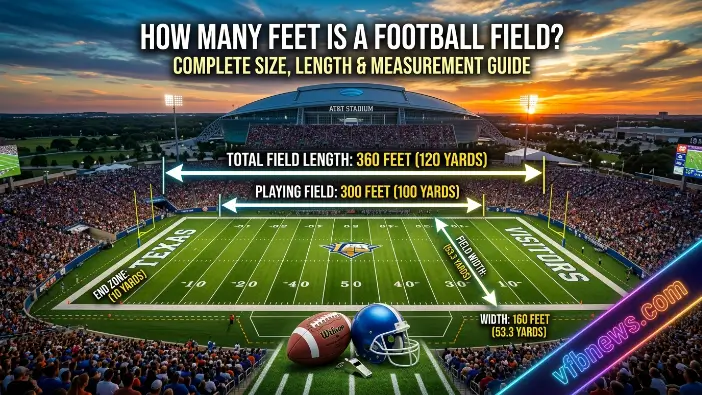
Welcome to VFB News! One of the most frequently asked questions among sports enthusiasts, students, and football fans is how many feet long is a football field. A standard American football field measures 360 feet in total length and 160 feet in width, including both end zones. The main playing area between the goal lines is 300 feet long, while the two end zones add 30 feet each, bringing the field’s overall length to 360 feet.
Understanding football field dimensions helps explain how the game is organized and played. Every section, including the yard lines, sidelines, end zones, and goalposts, serves a specific purpose in gameplay. These markings help players, coaches, and officials measure distances, develop strategies, and ensure the rules are followed correctly. In this guide, we’ll break down the complete football field size, explain the function of each section, and compare its measurements with those of other popular sports fields for a clearer understanding.
How Many Feet Is a Football Field?
A standard American football field measures 360 feet in total length, including both end zones, and 160 feet in width. These dimensions follow the official American football field measurements used in professional, college, and most organized football games.
The playing area between the two goal lines is 100 yards long, equivalent to 300 feet, since one yard equals three feet. Each end zone measures an additional 10 yards, or 30 feet. With two end zones adding 60 feet altogether, the full field reaches 120 yards (360 feet) in length.
Here is a simple breakdown of the standard football field in feet:
| Area | Measurement |
| Total Length | 360 feet |
| Playing Area | 300 feet |
| Width | 160 feet |
| Each End Zone | 30 feet |
Many people refer to a football field as being 100 yards long because they are usually talking about the playing area where most of the action happens. However, the complete field includes the two end zones, which extend the total length to 120 yards. Converting these measurements into feet makes it easier to understand the actual size of the field.
For example:
- 100 yards × 3 = 300 feet of playing area
- 120 yards × 3 = 360 feet, including end zones
These standard football field dimensions remain almost identical across professional, college, and high school football. While some smaller details, such as markings and hash marks, may change depending on the level of competition, the overall field size follows the same measurement system.
Read Also: How to draw a football
Understanding Football Field Dimensions and Layout
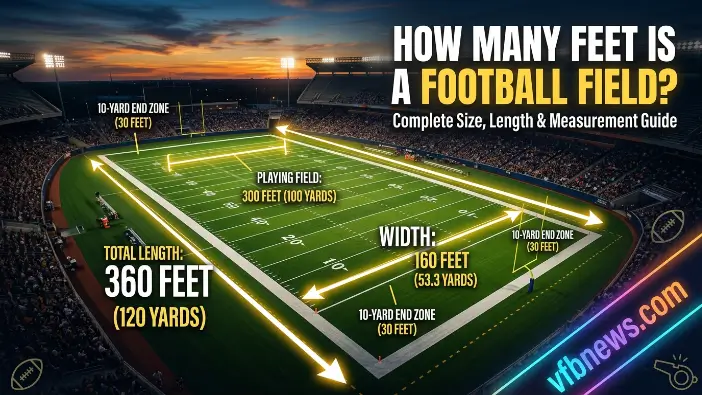
An American football field features carefully defined dimensions and markings that help players, coaches, and officials track the ball’s position, measure distances to the goal line, and identify scoring opportunities. Each section serves a distinct purpose, from the main playing area and end zones to the sidelines, yard lines, hash marks, field numbers, and goalposts. Together, these elements create an organized playing surface that supports fair competition, accurate decisions, and effective game strategies.
Playing Field Length and Width
The main playing area of an American football field is 100 yards lon The main playing area of an American football field measures 100 yards long and 53⅓ yards wide.
When converted into feet, these dimensions equal:
- Length: 300 feet
- Width: 160 feet
This is where most of the action takes place, including running plays, passing attempts, and defensive movements. The field is divided into two halves, while yard lines, sidelines, and hash marks help players and officials measure distances, determine the ball’s placement, and develop effective game strategies.
End Zone Dimensions
At both ends of the football field, there areAn American football field includes two end zones, one located at each end of the field beyond the goal lines. Each end zone measures:
- Length: 10 yards
- Length in feet: 30 feet
End zones are the designated scoring areas where teams earn touchdowns. A touchdown is scored when a player carries the ball into the opponent’s end zone while maintaining possession or catches a pass in the end zone under the rules of the game. Each end zone plays an essential role in determining scoring opportunities and the outcome of a match.
Goalposts and Field Markings
Goalposts are located at the back of each end zone and are used when teams attempt field goals or extra-point kicks. Along with goaIn addition to the goalposts, several important markings help organize the football field and ensure smooth gameplay.
Key field markings include:
- Yard numbers: Indicate the distance from each goal line, helping players identify their position on the field.
- Yard lines: Mark the field at five-yard intervals, making it easier to measure progress during a play.
- Hash marks: Identify the designated positions where the ball is placed before each play.
- Sidelines: Define the boundaries of the field and help officials determine when a player or the ball is out of bounds.
Together, these markings make the football field layout easier to understand and help players, coaches, and officials monitor the action accurately throughout the game.
Why Is a Football Field Measured in Yards Instead of Feet?
Although how many feet is a football field is a common question, football is traditionally measured in yards because this system makes gameplay easier to understand. Yards provide a simpler way for players, coaches, and commentators to describe distances and track progress during a game.Since one yard equals three feet, converting between yards and feet is easy.
Here is how common football field measurements convert:
- 1 yard = 3 feet: A single yard on the field is equal to three feet in distance.
- 10 yards = 30 feet: A first down requires a team to move 10 yards, which equals 30 feet.
- 100 yards = 300 feet: The main playing area between both goal lines measures 100 yards or 300 feet.
- 120 yards = 360 feet: The complete football field, including both end zones, measures 120 yards or 360 feet.
Instead of saying a team needs to move 30 feet for a first down, football uses the more familiar term of 10 yards. The football field yardage system also helps organize the game, as yard lines show player positions and the distance remaining to reach the goal line.
Football Field Measurements Compared to Other Sports Fields
Sports fields vary in size depending on the rules, playing styles, and strategies of each game. Comparing different sports field dimensions provides a better understanding of the overall size of an American football field and highlights how it differs from other popular sports venues. By looking at their lengths and widths, you can easily see how each playing surface is designed to meet the specific needs of its sport.
| Sport | Approximate Length |
| American Football | 360 feet |
| Soccer | Varies by field |
| Basketball | 94 feet |
| Baseball | Different measurement systems |
These comparisons make it easier to visualize the overall football field size and understand how large the playing area is compared with other sports.
How to Calculate Football Field Measurements Yourself
Converting football field measurements from yards to feet is straightforward once you know the basic conversion rule. Since one yard equals three feet, multiplying the measurement in yards by three gives you the equivalent distance in feet. This simple calculation makes it easier to understand the actual dimensions of an American football field and compare its size with other familiar distances.
Converting Yards Into Feet
The basic conversion formula is:
1 yard = 3 feet
This means every yard on a football field equals three feet. By multiplying the number of yards by three, you can easily calculate the measurement in feet.
For example:
- 100 yards × 3 = 300 feet
The playing area of a football field, from one goal line to the other, is 100 yards long, which equals 300 feet. - 120 yards × 3 = 360 feet
The complete football field, including both 10-yard end zones, measures 120 yards, which equals 360 feet.
So, when someone asks how many feet is a football field, simply multiply the total yard measurement by three. For a standard field:
120 yards × 3 = 360 feet
Measuring a Football Field
If you want to measure a football field or compare its size with another area, you can use several simple methods:
- Use a measuring tape: This is the most accurate method for measuring smaller distances or confirming field dimensions.
- Use online map tools: Digital maps can help estimate the size of large fields, stadiums, or outdoor areas.
- Compare with known distances: A football field can be used as a reference point to estimate the size of other spaces.
For example, if someone says a building is “about two football fields long,” it means the distance is roughly equal to 720 feet. Using a football field as a comparison makes large measurements easier for people to visualize.
Interesting Facts About Football Field Size
The dimensions of a football field are essential for maintaining the right balance between speed, strategy, and physical competition. Standardized football field dimensions help players judge distances, develop effective plays, and position themselves correctly throughout the game. These measurements also ensure consistency across organized competitions, allowing teams to compete under the same field conditions.
Here are some interesting facts about football field size:
- A standard football field covers approximately 57,600 square feet: This includes the entire playing area with both end zones, showing just how large the field is compared to many other sports surfaces.
- The complete field measures 120 yards from end line to end line: This includes the 100-yard playing area and two 10-yard end zones, making the total length 360 feet.
- Professional and college football fields follow similar official dimensions. This consistency allows players to compete in different stadiums without needing to adjust to major size changes.
- Yard lines help teams track progress during every possession: These markings show how far a team has moved and how many yards remain to reach the next first down or score.
- Field size influences offensive strategies, defensive formations, and player movement: The large playing area affects passing plays, running routes, defensive coverage, and overall game planning.
Because the dimensions remain consistent, players can quickly adapt when playing in different stadiums. The standardized football field measurements also help fans better understand distances during games, such as the length of a quarterback’s throw or the space covered by a running back during a play.
Common Mistakes When Understanding Football Field Measurements
Many people find football field measurements confusing because the field’s dimensions and distances are expressed in both yards and feet. Since the field is primarily measured in yards, converting these figures into feet can be challenging. It is also important to understand the difference between the playing area and the total field size, including the end zones.
Confusing Playing Field With Total Field Length
One of the most common misconceptions about football field dimensions is that the entire field’s playing area is 360 feet long. However, the main playing field between the two goal lines measures 300 feet, or 100 yards. The additional 60 feet comes from the two end zones, each measuring 30 feet in length. Including both end zones, the total football field length is 360 feet, measured from one end line to the other.
Mixing Feet and Yards
Another common mistake is confusing yards and feet when talking about football distances. Since football fields are usually measured in yards, remembering the conversion formula is important:
- 1 yard = 3 feet: Every yard on the field equals three feet.
- 100 yards = 300 feet: This represents the main playing area between the goal lines.
- 120 yards = 360 feet: This represents the complete field, including both end zones.
Using the correct conversion makes it much easier to understand football field dimensions and calculate distances during the game.
Comparing Football and Soccer Fields Incorrectly
American football and soccer fields may look similar at first, but their dimensions differ significantly. American football fields have standardized measurements and clearly defined markings, while soccer fields allow more flexibility in length and width depending on competition rules and stadium requirements.
These differences mean that judging field sizes by appearance alone can be misleading. Understanding the specific measurement standards for each sport provides a clearer and more accurate comparison of their playing areas.
Frequently Asked Questions
How much land is needed to build a football field?
A standard football field requires enough space for the playing area, end zones, and safety areas around the sidelines. The total space needed can be larger than the field itself because stadiums include additional areas for players and officials.
Why do football fields have numbers painted on them?
The numbers help players, coaches, and officials quickly identify their location on the field. They make it easier to understand distance, plan plays, and track movement during the game.
Does weather affect the size or markings of a football field?
Weather does not change the official size of a football field, but conditions like rain, snow, or extreme heat can affect how the surface looks and how players perform on it.
How long does it take to maintain a football field?
The maintenance time depends on the type of field surface, usage, and weather conditions. Professional fields often require regular care to keep the grass, markings, and playing surface in good condition.
Can a football field be used for other sports?
Yes, many football fields are designed as multi-purpose sports areas and can also be used for activities such as soccer, training sessions, and community events.
Conclusion
Understanding how many feet a football field measures makes it easier to visualize the size and layout of a standard American football field. The entire field is 360 feet long and 160 feet wide, including both end zones. The main playing area between the goal lines measures 300 feet in length, while the two end zones add another 60 feet to the total. Knowing these dimensions helps explain player movement, game strategies, and how distances are measured during a match.
Standard football field dimensions provide a consistent playing environment where speed, strategy, and teamwork are essential. Whether you are a football fan, student, or simply interested in sports measurements, understanding the conversion between yards and feet offers a clearer picture of the field’s layout. These standardized measurements also make it easier to compare American football fields with playing areas used in other sports.
