

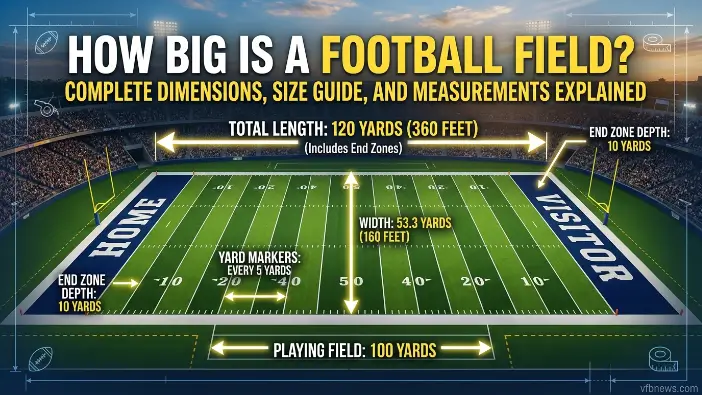
Welcome to VFB News. Many people wonder how big is a football field when watching games or seeing stadiums on television. A standard American football field has specific measurements that define the playing area, including its length, width, end zones, and markings. Understanding these dimensions helps explain how players use the space during a game.
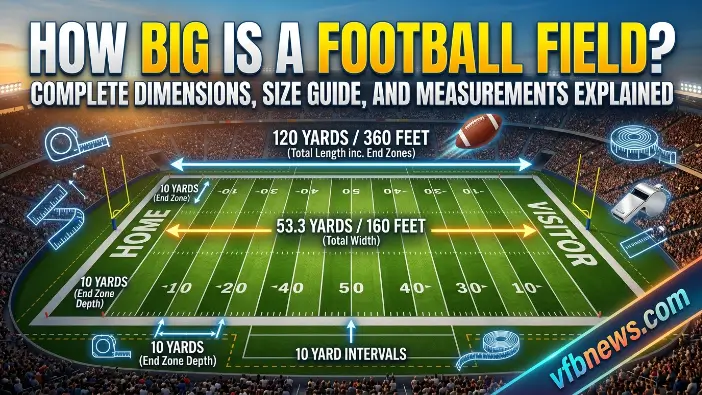
A regulation football field size is 120 yards long and 53⅓ yards wide, including two end zones. Whether you are comparing an NFL football field, a college field, or a high school field, the basic measurements remain almost identical. This guide explains complete football field dimensions in yards, feet, meters, and acres.
What Are the Standard Dimensions of a Football Field?
A regulation American football field follows official measurement standards used in professional, college, and most high school competitions. A complete football field includes the main playing area, two end zones, sidelines, and important field markings that help players and referees maintain consistent gameplay. The standard football field measurements are designed so that every team competes on a field with the same size and layout.
| Measurement | Size |
| Total length | 120 yards |
| Playing area | 100 yards |
| Each end zone | 10 yards |
| Width | 53⅓ yards |
| Total area | 57,600 square feet |
The main playing area between the two goal lines measures 100 yards, which is the section where most offensive and defensive plays happen. However, when measuring the complete field size, both 10-yard end zones must also be included. This makes the total length of a regulation football field 120 yards.
In simple terms, a football field consists of a 100-yard playing area plus two 10-yard end zones, one at each end of the field. These end zones are where teams score touchdowns, making them an important part of the overall field design.
Football Field Length and Width Measurements
The length of a football field is measured from one end line to the opposite end line, including the playing area and both end zones. A regulation field contains:
- A 100-yard playing field
- Two 10-yard end zones
- Goal lines separating the playing area from scoring zones
The width of a standard football field is 53⅓ yards, which equals approximately 160 feet. This distance is measured from one sideline to the opposite sideline and provides enough space for different offensive formations, passing plays, and defensive strategies.
The official regulation field dimensions ensure that professional, college, and high school teams can compete under similar conditions. Whether a game is played in a large stadium or a local field, these standardized measurements help maintain fairness and consistency throughout the sport.
Football Field Size in Feet and Meters
Understanding football field size in different measurement systems makes it easier to visualize the actual dimensions of a regulation field. Although American football fields are officially measured in yards, converting these measurements into feet and meters helps explain the exact size more clearly.
A standard football field measures:
- 360 feet long – This includes the 100-yard playing area along with both 10-yard end zones.
- 160 feet wide – This is the distance between both sidelines of the field.
- 109.7 meters long – The complete length of the field when converted from yards into the metric system.
- 48.8 meters wide – The total width of a regulation football field in meters.
The 100-yard playing section equals 300 feet, while each end zone adds another 30 feet to the total length. Together, these sections create the complete 360-foot-long football field used in official games.
| Measurement System | Football Field Size |
| Yards | 120 yards × 53⅓ yards |
| Feet | 360 feet × 160 feet |
| Meters | 109.7 meters × 48.8 meters |
These measurements represent the complete American football field dimensions used in official competitions. Whether measured in yards, feet, or meters, the field follows the same standardized layout for professional, college, and most high school games.
Read Also: How many yards is a football field
How Many Acres Is a Football Field?
A common way to understand how big is a football field is by comparing its size with land measurements. A complete regulation American football field, including both end zones, covers approximately 1.32 acres of land. Since an acre is a commonly used unit for measuring large outdoor spaces, this comparison makes it easier to visualize the actual size of a football field when compared with properties, parks, or other areas.
Football Field Square Footage Explained
The total area of a regulation football field is:
- 57,600 square feet – This includes the complete playing surface, both end zones, and the full field area.
- Approximately 6,400 square yards – This is the total area when measured using square yards.
- About 1.32 acres – This shows the field’s size compared with common land measurements.
The calculation includes the entire football field area, not just the 100-yard playing section. The two end zones are included because they are an important part of the official field used during games.
To better visualize this space, a football field is large enough to fit:
- Several residential houses – The total area is comparable to the space covered by multiple homes and their surrounding yards.
- Multiple tennis courts – A football field can hold several standard tennis courts because of its large surface area.
- Many smaller recreational spaces – The field provides enough room for various outdoor activities and sports areas.
Understanding the football field size in acres helps people appreciate how much space professional athletes use during a game. The large playing surface allows teams to create different strategies, run complex plays, and use both the length and width of the field effectively.
Does an NFL Football Field Have Different Dimensions?
Many fans wonder whether an NFL football field is larger than college or high school football fields. The answer is no. The standard football field dimensions are almost the same across professional, college, and most high school levels. Official rules maintain these measurements to ensure that teams compete on a consistent playing surface, regardless of the stadium or competition level.
NFL vs College Football Field Size
An NFL field and a college football field follow the same basic measurements:
- 120 yards long – This includes the 100-yard playing area and two 10-yard end zones.
- 53⅓ yards wide – The distance between both sidelines remains the same.
- 100 yards of playing area – This is the section where most gameplay takes place.
- Two 10-yard end zones – These scoring areas are located at both ends of the field.
The main differences between NFL and college fields are not related to overall size but to certain field features and game rules, such as:
- Hash mark placement – The position of hash marks differs between NFL and college fields.
- Game rules – Some playing rules and strategies vary between the two levels.
- Player regulations – Professional and college competitions have different player requirements.
- Field markings – Some visual markings may change depending on the competition.
The NFL football field dimensions remain consistent because professional teams need a standardized environment where players can compete fairly.
High School Football Field Dimensions
Most high school football fields follow the same general measurements as professional and college fields. A typical high school field includes:
- 120 yards total length – Including both end zones.
- 53⅓ yards width – Measuring from one sideline to the other.
- 100-yard playing area – The main section used during gameplay.
However, some older high school facilities may have slight variations because of available space, stadium construction, or local regulations. These differences are usually minor and do not significantly change the overall playing experience.
| Level | Length | Width |
| NFL | 120 yards | 53⅓ yards |
| College | 120 yards | 53⅓ yards |
| High School | Usually 120 yards | Usually 53⅓ yards |
Overall, the standard American football field size remains consistent across different levels, allowing players to understand the field layout and compete using familiar dimensions.
How Big Is a Football Field Compared to Other Things?
Understanding how big is a football field becomes easier when comparing it with familiar objects and spaces. A regulation football field covers a large area of about 57,600 square feet, which can be difficult to imagine without a real-world comparison. These comparisons help visualize the actual scale of a football field and show how much space players use during a game.
Football Field Compared to a Soccer Field
A soccer field size can vary more than an American football field because international soccer rules allow a range of field dimensions. Some soccer fields can be longer or wider depending on the competition and available space.
Compared with a football field, a soccer field is:
- More flexible in size – Soccer fields do not always follow one exact measurement.
- Similar in overall space – Both sports require large outdoor playing areas.
- Different in layout – Football fields have fixed yard lines and end zones, while soccer fields have different markings and goal areas.
Although both fields are large, their designs are created for different styles of gameplay.
Football Field Compared to a Basketball Court
A regulation basketball court is much smaller than a football field. A complete football field can fit approximately 14 basketball courts within its total area.
This comparison shows the huge difference in scale between the two sports. While basketball is played on a smaller indoor surface, American football requires a much larger outdoor area for running plays, passing, and defensive formations.
Football Field Compared to a City Block
Comparing a football field to a city block can also help people understand its size. However, city block dimensions vary depending on the location, city planning, and surrounding buildings. In some areas, a football field may be similar in size to a large city block, while in others, city blocks can be much smaller or larger.
Because of these variations, this comparison only provides a general idea of the field’s scale. These real-world examples make football field dimensions easier to visualize and help explain why such a large playing area is required for professional and competitive games.
Understanding Football Field Markings and Layout
A football field is not just an open area covered with grass or artificial turf. Every line, marking, and section has a specific purpose that helps players, coaches, and officials understand the game. These football field markings provide important information about player positions, scoring areas, ball placement, and game progress.
End Zones
The end zones are located at both ends of the field and measure 10 yards each. These areas are where teams score touchdowns by carrying or catching the football inside the opponent’s scoring area.
Important features of end zones include:
- Goal lines – Mark the boundary between the playing field and the end zone.
- Team markings – Display team names, logos, or colors.
- Scoring areas – The designated zones where touchdowns are completed.
The end zones are an essential part of the complete football field layout because they determine where teams can score points.
Yard Lines and Hash Marks
Yard lines help players and officials measure distance and track progress during the game. They show how far a team has moved and how much distance remains to achieve a first down.
Important field markings include:
- 5-yard lines – Help measure movement across the field.
- Numbered yard markers – Show the exact yard position for players and referees.
- Hash marks – Indicate where the ball is placed before each play.
- Goal lines – Mark the area where scoring begins.
These yard lines on a football field allow referees to accurately determine ball placement, measure progress, and maintain fair gameplay throughout the match.
Goal Posts and Playing Boundaries
Goal posts are positioned behind each end zone and are used during field goal attempts and extra-point kicks. Players must kick the ball between the posts to score points during these situations.
The field also includes important boundary features:
- Sidelines – Mark the edges of the playing area.
- End lines – Mark the back limits of each end zone.
- Boundary markers – Help officials determine whether the ball or players are in or out of play.
Together, these features create the official playing area and ensure that games are played according to standard rules. The organized layout of a football field allows players, coaches, and referees to manage every play accurately.
Why Are Football Fields 100 Yards Long?
The 100-yard football field length comes from the historical development of American football. The sport evolved from earlier games such as rugby, where different field sizes and measurement systems were used. As football became more organized, sports organizations introduced standardized rules to ensure that teams across different locations played on fields with consistent dimensions.
The 100-yard playing field became the accepted standard because it provides enough space for different styles of gameplay, including:
- Running plays – Gives players enough room to create strategies and advance the ball.
- Passing strategies – Allows quarterbacks and receivers to execute long-distance plays.
- Defensive formations – Provides defenders enough space to position themselves and respond to offensive movements.
- Competitive gameplay – Creates a balanced field where both teams have equal opportunities.
The additional 20 yards from the two 10-yard end zones complete the full 120-yard football field. These scoring areas provide equal opportunities for both teams to reach the end zone and create exciting offensive plays while maintaining a balanced game structure.
Common Mistakes When Measuring a Football Field
When measuring football field size, many people make mistakes because they only consider the main playing area and forget other important sections of the field. A regulation football field is made up of several parts, including the playing area, end zones, sidelines, and field boundaries. Understanding these sections is important for getting the correct measurement and avoiding confusion.
Forgetting End Zones
One of the most common mistakes is saying that a football field is only 100 yards long. The 100 yards refer only to the playing area between the two goal lines, where most of the game action takes place.
However, a complete football field also includes two end zones, with one located at each end of the field. Each end zone measures 10 yards, adding an extra 20 yards to the total length. Therefore, the full length of a regulation football field is 120 yards, not just 100 yards.
Confusing Football With Soccer Fields
Another common mistake is confusing American football fields with soccer fields. Although both sports are played on large outdoor fields, their measurements, markings, and layouts are different.
A soccer field size can change depending on the competition and available space, meaning there is more flexibility in its dimensions. In contrast, American football fields follow stricter standards, with fixed measurements for length, width, end zones, and yard markings.
Measuring Only the Playing Area
Many people calculate the size of a football field by measuring only the 100-yard playing area. However, this does not represent the complete football field dimensions.
A proper measurement should include:
- End zones – These 10-yard scoring areas are located at both ends of the field and are part of the official field size.
- Full sidelines – The sidelines determine the total width of the field and mark the boundaries where players must stay during plays.
- Entire playing surface – The complete field area includes all sections used during official games.
Ignoring these areas can result in an inaccurate measurement. To correctly understand how big is a football field, always consider the entire layout, including the playing field, end zones, and boundary areas.
Frequently Asked Questions
How much space does a football field need for construction?
A complete football field requires enough land to cover the playing surface, safety areas, and surrounding space for players, officials, and spectators. Stadium designs often need additional space beyond the field itself.
What type of surface is used on a football field?
Football fields can use either natural grass or artificial turf. The choice depends on factors such as weather conditions, maintenance requirements, and the level of competition.
How long does a football field remain the same size?
The standard size of a football field has remained consistent for many years because official rules require uniform dimensions for fair competition across different teams and leagues.
Why do football fields have numbered lines?
Numbered lines help players, coaches, and officials quickly identify field positions and understand how far a team has moved during a play.
Can a football field be used for other sports?
Yes, many football fields are designed as multi-purpose sports areas and can also be used for activities such as soccer, track events, and community sports programs.
Conclusion
Understanding how big is a football field helps you visualize the true size and structure of one of the most important playing areas in sports. A regulation football field includes a 100-yard playing area, two 10-yard end zones, and specific markings that guide players and officials during the game. These standard football field dimensions remain consistent across professional, college, and most high school competitions.
The size of a football field is more than just a measurement. Every section, from the yard lines to the end zones and boundaries, has an important role in creating a fair and organized game. Whether measured in yards, feet, meters, or acres, understanding the complete layout gives a clearer picture of how much space athletes use during every match.
