

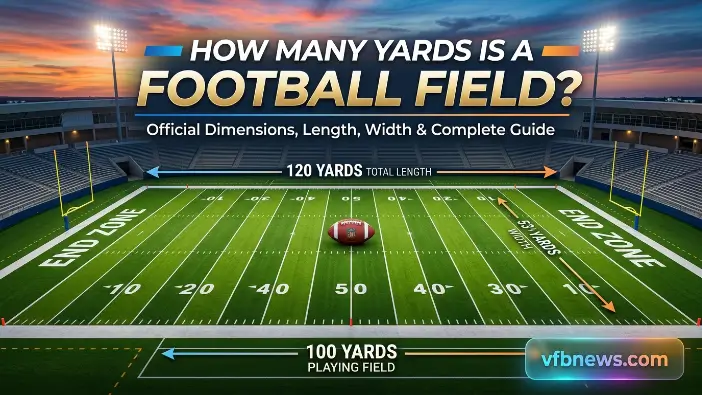
Welcome to VFB News. If you’ve ever wondered how many yards is a football field, the simple answer depends on what you’re measuring. The actual playing field is 100 yards long, but when you include both end zones, the total length becomes 120 yards. This distinction often confuses fans, students, and even new players.
You’ll learn the official football field dimensions, including its length, width, measurements in feet and meters, and the purpose of every major field marking. We’ll also compare NFL, college, and high school football fields, explain why fields are measured in yards, and answer the most common questions about American football field size.
How Many Yards Is a Football Field?
Understanding the total length of a football field is simple once you know the difference between the playing field and the end zones. The playing field measures 100 yards between the goal lines, but a regulation football field also includes two 10-yard end zones. Together, these add 20 yards, making the total length of the football field 120 yards.
The Short Answer
The official playing field in American football measures 100 yards from one goal line to the other. This is the area where teams move the ball, gain first downs, and compete throughout the game.
At each end of the playing field is an end zone that measures 10 yards deep. Since there are two end zones, they contribute an extra 20 yards, making the total length of a regulation football field 120 yards.
Here’s the official breakdown:
| Field Section | Measurement |
| Playing Field | 100 yards |
| One End Zone | 10 yards |
| Two End Zones | 20 yards |
| Total Football Field | 120 yards |
So, the correct answer depends on what you’re measuring:
- The playing field is 100 yards long.
- The entire football field, including both end zones, is 120 yards long.
These dimensions are standardized and used by the NFL, NCAA, and most high school football organizations, ensuring consistency across all levels of the game.
Why People Get Confused
It’s common to hear both 100 yards and 120 yards used when describing a football field, which can be confusing if you don’t know what each number represents.
Most television broadcasts, commentators, and game statistics focus on the 100-yard playing field because that’s where the ball is advanced during normal play. On the other hand, official field diagrams, construction plans, and rulebooks measure the entire field, including the two end zones, resulting in a total length of 120 yards.
The confusion usually comes from these differences:
- The playing field excludes the end zones.
- The complete football field includes both 10-yard end zones.
- Game commentary often references the 100-yard playing surface.
- Official measurements for stadium design include the full 120-yard field.
A simple way to remember the difference is:
- 100 yards = Playing field
- 120 yards = Entire football field (including end zones)
Once you understand this distinction, it becomes much easier to follow football games, interpret field position, understand scoring plays, and answer the question, “How many yards is a football field?” with confidence.
Read Also: Where to watch auburn tigers football vs alabama crimson tide football
Official Football Field Dimensions
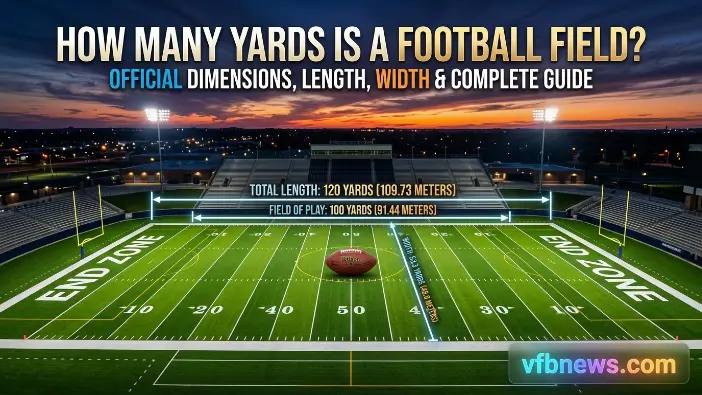
The dimensions of an American football field are carefully standardized to ensure every game is played under the same conditions. Whether you’re watching an NFL game, a college matchup, or a high school championship, the field follows nearly identical measurements. This consistency creates a level playing field for athletes and allows coaches, officials, and fans to easily understand field position and game strategy. Knowing these official football field dimensions also makes it easier to visualize how the game is played and why every yard matters.
Length
The official playing field measures 100 yards from one goal line to the other. This is the main area where offensive and defensive plays take place, and teams work to gain yards and score points.
In addition to the playing field, there is a 10-yard end zone at each end. These end zones are included in the total field length because they are official scoring areas where touchdowns, extra points, and some defensive plays occur. When both end zones are added, the complete football field measures 120 yards from end to end.
Here are the official measurements in different units:
| Measurement | Value |
| Playing Length | 100 yards |
| Total Length | 120 yards |
| Playing Length in Feet | 300 feet |
| Total Length in Feet | 360 feet |
| Playing Length in Meters | Approximately 91.44 meters |
| Total Length in Meters | Approximately 109.73 meters |
These standardized measurements are used in nearly every regulation American football game, ensuring consistency across different leagues and stadiums.
Width
While the field’s length often gets the most attention, its width is just as important for gameplay. A regulation football field is 53⅓ yards (or 160 feet) wide, which gives players enough room for passing plays, running lanes, defensive coverage, and special teams formations.
The official width is:
- 53⅓ yards
- 160 feet
- Approximately 48.8 meters
Maintaining the same width across all regulation fields ensures teams can use the same strategies regardless of where they play.
Total Area
Because a football field is both long and wide, it covers a significant amount of space. Including the two end zones, a regulation field has a total area of approximately 57,600 square feet, which is about 1.32 acres or 5,351 square meters.
Here are the approximate totals:
| Measurement Type | Size |
| Total Field Area | 57,600 square feet |
| Playing Area Only | 48,000 square feet |
| Approximate Acres | 1.32 acres |
| Total Area in Square Meters | About 5,351 square meters |
These figures represent only the official playing surface. Most football stadiums occupy a much larger area because they also include sidelines, team benches, safety zones, coaching boxes, media areas, locker room access, and spectator seating, all of which are essential for hosting professional and amateur football games.
Football Field Measurements Conversion Chart
Whether you’re comparing football field dimensions internationally or converting units for school projects, sports discussions, or construction purposes, this chart provides a quick reference to the official measurements. It shows the regulation size of an American football field in yards, feet, and meters, making it easier to understand regardless of which measurement system you use.
| Measurement | Yards | Feet | Meters |
| Playing Field Length | 100 yards | 300 feet | 91.44 meters |
| Total Field Length (Including End Zones) | 120 yards | 360 feet | 109.73 meters |
| Field Width | 53⅓ yards | 160 feet | 48.77 meters |
| One End Zone | 10 yards | 30 feet | 9.14 meters |
These measurements are the official standard for the NFL, NCAA, and most high school football fields. Whether you use the imperial or metric system, this conversion chart makes it easy to visualize the size of a regulation football field.
Understanding the Different Parts of a Football Field
Knowing how many yards is a football field is only part of understanding the game. A regulation football field is divided into several sections, and each one has a specific purpose. From marking scoring areas to helping officials determine field position, every line and marking plays an important role. Understanding these parts makes it easier to follow the rules, strategies, and flow of an American football game.
Goal Lines
The goal lines mark the end of the 100-yard playing field and the beginning of each 10-yard end zone. They are exactly 100 yards apart and play a crucial role in determining when a team has scored a touchdown.
The goal lines also help determine:
- Whether a team has scored: A touchdown is awarded when the ball crosses the opponent’s goal line under player control.
- Where drives begin: Goal lines serve as key reference points for starting or ending offensive possessions.
- Goal-line situations: Teams often use special offensive and defensive strategies near the goal line.
- Short-yardage plays: Officials use the goal line to judge whether a team has gained the required distance.
Although the goal line separates the playing field from the end zone, it is officially considered part of the end zone for scoring purposes.
End Zones
Each end zone is 10 yards deep, adding a combined 20 yards to the football field’s total length. These are the designated scoring areas where teams earn touchdowns and complete many game-winning plays.
The end zones feature:
- Team names or logos: Most stadiums display team branding inside the end zones.
- Goalposts: Positioned at the back of each end zone for field goals and extra points.
- Boundary lines: These define whether a touchdown catch or play is in bounds.
- Safety markings: Extra space behind the end zone helps improve player safety.
Without the end zones, the football field would only be 100 yards long. Including them increases the total length to 120 yards.
Yard Lines
The yard lines are white lines placed every 5 yards across the field. Along with smaller one-yard markings, they help measure field position and the distance needed for first downs.
Yard lines are essential for:
- Measuring first downs: Officials use them to determine whether a team has gained 10 yards.
- Tracking field position: Players and coaches always know where the ball is located.
- Planning strategies: Teams adjust their play-calling based on their position on the field.
- Spotting the football: Referees use yard lines to place the ball accurately after each play.
The 50-yard line, located at midfield, divides the playing field into two halves.
Hash Marks
Hash marks are short lines located near the center of the field. They indicate where the football should be placed after most plays, ensuring every play starts from the correct position.
Their spacing differs by level of competition:
- NFL: Narrow hash marks create a more balanced field.
- College football: Wider spacing gives offenses more room for certain plays.
- High school football: The widest spacing changes kicking angles and offensive strategies.
These differences influence how teams design plays and position their players.
Sidelines
The sidelines run along both sides of the football field and mark the outer boundary of the playing area. If a player steps on or beyond a sideline while carrying the ball, the play immediately ends.
The sidelines also include areas for:
- Team benches: Where players rest between plays.
- Coaches: Used to communicate strategies and substitutions.
- Medical personnel: Ready to assist injured players when needed.
- Officials and chain crews: Responsible for enforcing rules and measuring first downs.
- Media representatives: Cover the game from designated sideline areas.
These spaces help keep the game organized while ensuring player safety.
Goalposts
The goalposts stand at the back of each end zone and are used for field goals and extra-point attempts. A successful kick must travel over the crossbar and between the two upright posts.
Teams can score using the goalposts in several ways:
- 3 points: Awarded for a successful field goal.
- 1 point: Earned by kicking the extra point after a touchdown.
- 2 points: Scored through a successful two-point conversion instead of an extra-point kick.
Because the goalposts are located behind the goal line, teams must first move the ball into scoring range before attempting a kick.
Are NFL, College, and High School Football Fields the Same Size?
Many people believe that football field dimensions vary depending on the level of competition. However, that’s a common misconception. Whether you’re watching an NFL game, a college matchup, or a high school championship, the official field size remains almost identical. The main differences are found in the rules, hash mark spacing, and gameplay rather than the actual dimensions.
NFL
The NFL uses the standard regulation football field, ensuring every professional game is played on the same-sized surface regardless of the stadium.
Key dimensions include:
- Playing field – 100 yards: This is the distance between the two goal lines where all regular gameplay takes place.
- Total length – 120 yards: Adding the two 10-yard end zones increases the overall field length to 120 yards.
- Width – 53⅓ yards: This standard width provides enough space for offensive and defensive formations.
- End zones – 10 yards each: These are the official scoring areas where touchdowns are recorded.
The NFL also uses narrower hash marks, which create a more balanced playing area and influence passing, kicking, and offensive strategies.
NCAA
College football follows nearly the same field dimensions as the NFL, making it easy for players to adapt as they move to higher levels of competition.
Official NCAA measurements include:
- Playing field – 100 yards: The distance between the goal lines remains the same as in the NFL.
- Total field length – 120 yards: This includes the two 10-yard end zones.
- Width – 53⅓ yards: College fields maintain the same regulation width.
- End zones – 10 yards each: Each end zone provides the official scoring area for touchdowns.
The main difference is the wider hash mark spacing, which gives offenses more room to run plays and changes kicking angles.
High School
Most high school football fields also use regulation dimensions, allowing young players to compete on fields that closely match those used in college and professional football.
Standard measurements include:
- Playing field – 100 yards: The main playing area remains consistent across all levels.
- Total length – 120 yards: Including both end zones, the total field length stays the same.
- Width – 53⅓ yards: Players have the same amount of playing space as in higher-level football.
- End zones – 10 yards each: The scoring areas follow the same official dimensions.
While the field size is standardized, stadium facilities such as seating, lighting, scoreboards, and playing surfaces can vary from one school to another.
Key Differences
Although the field dimensions remain the same, a few important differences affect gameplay.
| Feature | NFL | NCAA | High School |
| Playing Length | 100 yards | 100 yards | 100 yards |
| Total Length | 120 yards | 120 yards | 120 yards |
| Width | 53⅓ yards | 53⅓ yards | 53⅓ yards |
| End Zones | 10 yards | 10 yards | 10 yards |
| Hash Mark Spacing | Narrow | Wider | Widest |
Overall, the field size doesn’t change between the NFL, NCAA, and high school football. Instead, differences in hash mark spacing, playing rules, and coaching strategies create unique styles of play at each level while maintaining the same regulation field dimensions.
Why Football Fields Are Measured in Yards
American football fields are measured in yards because the sport was developed in the United States, where the imperial measurement system has traditionally been used. Since the early days of the game, yards have been the standard unit for measuring field dimensions, player progress, and game statistics. Even today, every major level of American football, including the NFL, NCAA, and most high school leagues, continues to use yards as the official measurement.
Historical Background
When American football rules were first established in the late 19th century, the United States primarily used the imperial system instead of the metric system. As a result, every part of the game, from field dimensions to scoring and player statistics, was based on yards.
Over time, these measurements became an essential part of football terminology. Familiar phrases like the 10-yard line, 50-yard line, and first-and-10 are now recognized by players and fans around the world. Although many countries use meters for sports, official American football rules continue to measure the field in yards, with metric conversions often provided for international audiences.
Importance During the Game
Yards are much more than a unit of measurement; they are at the heart of how American football is played. Every drive is based on gaining yardage, as teams must advance at least 10 yards within four downs to earn another set of downs. Coaches, players, officials, and commentators constantly use yardage to evaluate field position and make strategic decisions throughout the game.
Using yards also helps with:
- Tracking player performance: Passing, rushing, and receiving statistics are all recorded in yards.
- Measuring offensive progress: Teams must gain specific yardage to achieve first downs and continue their drive.
- Calculating field-goal distance: The total kick distance is based on the line of scrimmage and end zone measurements.
- Planning game strategy: Coaches choose plays based on the number of yards needed and the team’s field position.
Without the yard-based measurement system, many of football’s rules, statistics, and strategies would be far more difficult to understand and apply consistently.
Football Field Compared to Other Sports Fields
Although an American football field has standardized dimensions, other sports use playing surfaces that vary in size and layout. Comparing a football field with soccer, rugby, baseball, and track and field helps highlight its unique design and explains why each sport requires a different type of playing area.
Soccer Field
Unlike American football, a soccer field does not have a single fixed size. FIFA allows a range of dimensions, although professional fields are typically 100 to 130 yards long and 50 to 100 yards wide.
Compared with an American football field:
- Soccer fields are often longer: Many professional soccer pitches extend beyond the 120-yard length of a football field.
- They are usually wider: The extra width provides more space for continuous movement and passing.
- Their dimensions can vary: Field size depends on the competition, stadium, and governing rules.
Rugby Field
A rugby field looks similar to a football field because both sports use goal lines and scoring areas. However, rugby fields are measured in meters rather than yards and can have different overall dimensions.
Some key differences include:
- Longer playing area: Rugby fields can measure up to 100 meters in length before the in-goal areas.
- In-goal areas: Like football’s end zones, these are used for scoring tries.
- Different field markings: Rugby uses unique lines and markings that match its own rules and style of play.
Baseball Field
A baseball field is very different from a football field because it does not have a fixed rectangular shape. While the infield dimensions are standardized, the outfield size varies from one stadium to another.
Unlike football:
- Outfield distances vary: Every stadium can have different fence distances.
- Diamond-shaped layout: Baseball uses a diamond instead of a rectangular playing surface.
- No standard overall size: This makes direct field-size comparisons more difficult.
Track and Field
A standard outdoor running track measures 400 meters for one complete lap. Many schools and universities build football fields inside the oval track, allowing multiple sports to share the same venue.
Some notable differences include:
- Oval versus rectangular design: Running tracks surround the football field instead of replacing it.
- Different purpose: Tracks are designed for running events, while football fields are built for team competition.
- Shared facilities: Many educational institutions use one stadium for football games, athletics, and community events.
Overall, while many sports use large playing areas, the American football field stands out because of its standardized dimensions, clearly marked yard lines, and consistent layout across nearly every level of competition.
Common Misconceptions About Football Field Length
When people search how many yards is a football field, they often come across different answers, leading to confusion. Some sources mention 100 yards, while others say 120 yards. The reason is simple: people are often referring to different parts of the football field. Understanding the difference between the playing field and the end zones makes it much easier to know which answer is correct.
Is It 100 or 120 Yards?
This is one of the most common questions about football field dimensions, and the answer depends on what you’re measuring.
- 100 yards: This refers to the playing field between the two goal lines, where the majority of offensive and defensive plays take place.
- 120 yards: This measures the entire regulation football field, including the two 10-yard end zones at each end.
So, if you’re talking about the playing surface, the answer is 100 yards. If you’re referring to the complete football field, the correct measurement is 120 yards.
Do End Zones Count?
Yes, end zones are an official part of a regulation football field and should be included when measuring the total field length.
Each end zone is 10 yards deep, adding a combined 20 yards to the field. Besides increasing the overall length, they are also the designated scoring areas where teams earn touchdowns, attempt extra points, and complete two-point conversions. Without the end zones, the field would only measure 100 yards, not the official 120 yards.
Does Every Football Field Have the Same Dimensions?
In almost every level of American football, the official field dimensions remain the same. This standardization ensures players, coaches, and officials experience consistent playing conditions, whether the game is played in the NFL, college football, or most high school leagues.
The standard measurements are:
- 100-yard playing field: The main area where teams compete during regular gameplay.
- Two 10-yard end zones: Official scoring zones located at each end of the field.
- 120-yard total length: The combined length of the playing field and both end zones.
- 53⅓-yard width: The regulation width used across nearly all competitive levels.
Although the field dimensions remain consistent, stadiums themselves can look very different. Seating capacity, playing surface (natural grass or artificial turf), lighting systems, scoreboards, and other facilities often vary depending on the league, stadium, or school.
Tips for Remembering Football Field Measurements
Remembering the official football field dimensions doesn’t have to be difficult. With a few simple memory tricks, you can quickly recall the field’s length, width, and key markings whenever you need them.
- Remember 100 yards for the playing field: This is the distance between the two goal lines where regular gameplay takes place.
- Add two 10-yard end zones: Each end zone is 10 yards deep, increasing the total field length by 20 yards.
- Think 120 yards in total: Once you include both end zones, the complete football field measures 120 yards.
- Memorize the width as 53⅓ yards: This is the official regulation width used in the NFL, NCAA, and most high school games.
- Use 360 feet as a reference: If you’re more familiar with feet than yards, remember that the entire football field is 360 feet long.
A simple phrase to remember is:
“100 to play, 120 all the way.”
Another helpful trick is to picture the 50-yard line at the center of the field. Once you remember the midpoint, it’s much easier to visualize the remaining distances and understand overall football field measurements.
Frequently Asked Questions
Is a football field exactly 100 yards?
The playing field is exactly 100 yards long. When you include the two end zones, the total length becomes 120 yards.
How many feet long is a football field?
The playing field measures 300 feet, while the complete football field, including both end zones, measures 360 feet.
How wide is an NFL football field?
A regulation NFL football field is 53⅓ yards wide, which equals 160 feet or approximately 48.8 meters.
Are college football fields the same size?
Yes. NCAA football fields use the same overall dimensions as NFL fields, although the spacing of the hash marks differs.
How many acres is a football field?
A regulation football field, including the end zones, covers approximately 1.32 acres.
Conclusion
The answer to how many yards is a football field depends on whether you’re referring to the playing surface or the entire field. The playing area measures 100 yards, while the complete regulation football field, including two 10-yard end zones, measures 120 yards.
Understanding these official football field dimensions makes it easier to follow games, interpret statistics, and appreciate the design of American football. Whether you’re a student, coach, player, or fan, remembering the difference between the 100-yard playing field and the 120-yard total length will help you answer this common question with confidence.
