

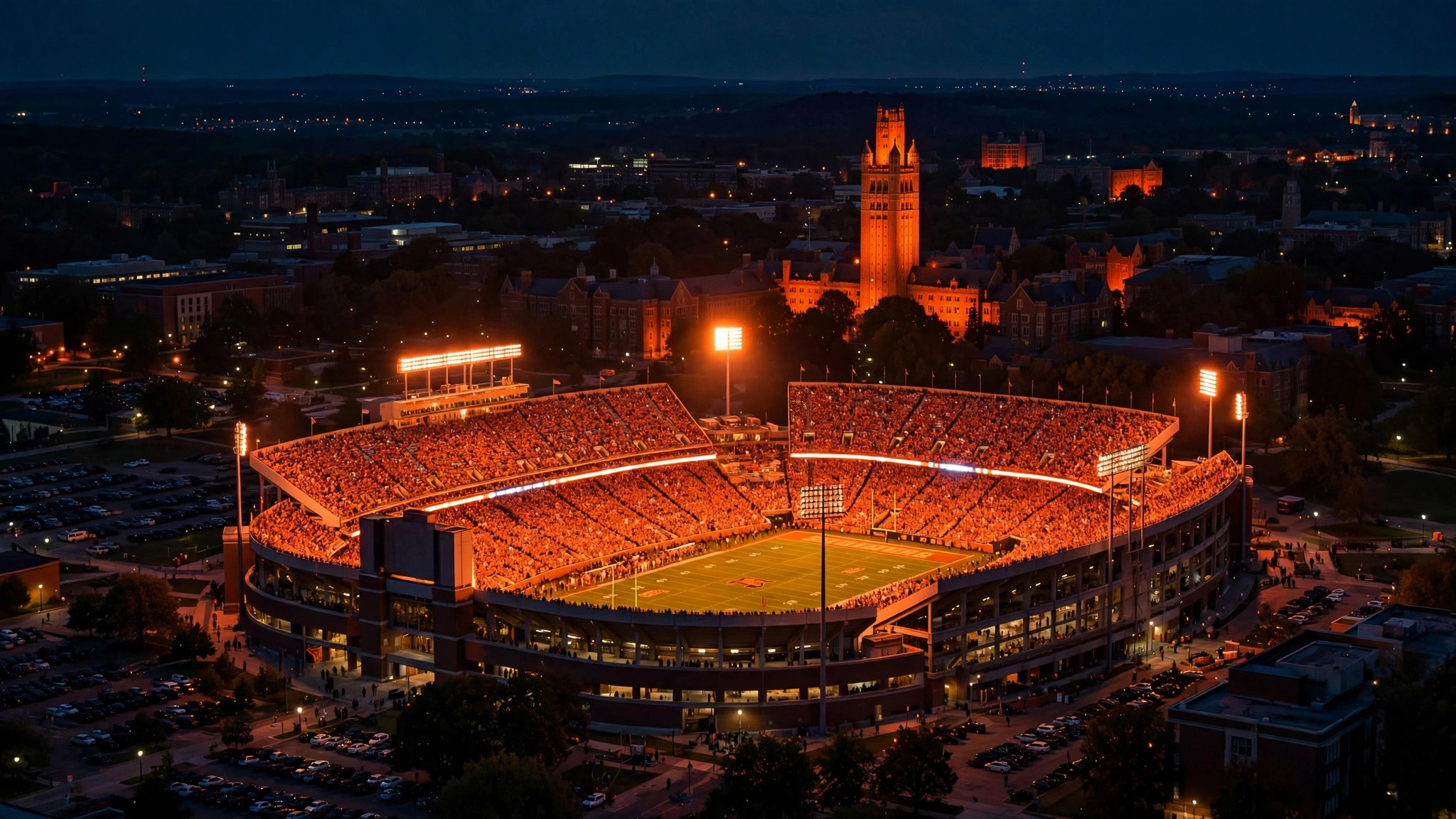
Texas football operates at a scale few programs can match. The Longhorns have the brand, the budget, the stadium and now an SEC schedule to test it all. This guide covers the pillars of the modern program: the roster, the schedule, the players who matter and the traditions that make Saturdays in Austin an event.
Under head coach Steve Sarkisian, Texas has returned to the national championship conversation, reaching the College Football Playoff in the program’s final Big 12 season and carrying that standard into the SEC. The Longhorns’ identity under Sarkisian is balance: a pro-style offense with NFL talent at the skill positions, and a defense rebuilt to survive the SEC’s weekly line-of-scrimmage battle.
Texas Football Roster
The Texas football roster is where every season analysis begins. Texas recruits at a national top-five level, and the two-deep is typically stacked with former four- and five-star prospects. The question is rarely talent; it is how the pieces fit, who stays healthy, and which young players are ready for SEC Saturdays.
Positions that define a Texas season:
- Quarterback, the most scrutinized job in the state, with a lineage that runs from Bobby Layne through Vince Young and Colt McCoy to the present
- The offensive line, where Texas has invested heavily to match SEC defensive fronts
- Wide receiver and tight end, stocked with NFL-caliber pass catchers in Sarkisian’s system
- The defensive front and secondary, tested weekly by the league’s passing attacks
Roster management is now a year-round discipline. Between high school signing days, the transfer portal windows and NFL draft decisions, the roster Texas fields in September is assembled in stages. Spring practice offers the first honest look, and the depth chart that emerges from fall camp tells you how the staff really rates its options.
Arch Manning’s time as the Longhorns’ quarterback has drawn attention the way few college players ever have, carrying the most famous surname in the sport. Around him, Texas has built the kind of supporting cast that turns a famous quarterback into a winning team: veteran linemen, explosive receivers and a running back room deep enough to survive injuries.
Texas Football Schedule
The Texas football schedule is now an SEC schedule, with all the weight that carries. Eight conference games in the league rotation, headlined by Oklahoma at the Cotton Bowl and the revived Texas A&M series, plus nonconference dates that Texas traditionally fills with at least one national showcase.
How the Longhorns’ season is structured:
- September nonconference tests, which have recently included trips to face the likes of Michigan and Alabama
- The Red River Rivalry against Oklahoma in Dallas in mid-October, played at the State Fair
- The SEC grind through October and November, with road trips to the league’s loudest stadiums
- The Texas A&M game, restored as a regular fixture after the Aggies and Longhorns spent a decade apart
The A&M rivalry’s return deserves emphasis. Played for generations on Thanksgiving weekend, the series paused after 2011 when A&M left for the SEC. Its revival as an SEC game instantly became one of the sport’s biggest annual events, with Kyle Field and DKR alternating as hosts.
For a sense of how Texas performs on the biggest stages, our Texas vs Ohio State match player stats breakdown examines a recent heavyweight meeting in detail.
Texas Longhorn Football
Texas Longhorn football history is measured in eras. Darrell Royal built the modern program between 1957 and 1976, winning three national championships and making the burnt orange a national brand. His 1969 team, which beat Arkansas in the “Game of the Century” and then Notre Dame in the Cotton Bowl, remains the program’s defining squad.
Mack Brown’s tenure brought the other summit: the 2005 team, led by Vince Young, went undefeated and beat USC in a Rose Bowl for the ages to win the national title. Young’s scramble on fourth down in the closing seconds is the single most replayed moment in school history.
Between and around those peaks, the names pile up: Earl Campbell, the 1977 Heisman winner whose running style still defines Texas power; Ricky Williams, the 1998 Heisman winner; Colt McCoy, the winningest quarterback of his era. The standard in Austin is set by these ghosts, and every roster is measured against them.
Longhorn Football
Longhorn football culture is its own world. Bevo, the live longhorn steer, has anchored the sideline for generations. “The Eyes of Texas” and the Hook ’em Horns sign are woven into daily life far beyond the stadium. The Longhorn Band’s Big Bertha drum and the cannon fired after scores complete a game-day sensory overload.
Game day at Darrell K Royal–Texas Memorial Stadium, which holds more than 100,000 fans, is a production:
- The tower lit orange after victories, visible across the city
- Tailgating that turns the campus and downtown into a burnt-orange festival
- The walk through crowds that treat the team like rock stars
- Night games under the lights, when DKR is at its loudest
Official schedules, rosters and ticket information live at Texas’s athletics website, the source to trust for kickoff times as television selections are made.
Texas Football Players to Watch
Every Texas season produces a set of players the whole country learns. The pattern is consistent: a quarterback in the Heisman conversation, receivers who become first-round draft picks, and linemen whose development determines whether the offense’s talent translates against SEC defenses.
What to watch when evaluating the Longhorns:
- Whether the offensive line gives the passing game time against elite fronts
- The running game, which Sarkisian treats as the offense’s foundation rather than its accessory
- Edge rushers and corners who can hold up in single coverage
- The kicking game, an underappreciated factor in the SEC’s close games
Our Texas vs Georgia watch guide shows how the Longhorns’ biggest games are framed nationally, and the Michigan vs Texas watch guide covers another of the cross-conference showcases Texas schedules.
Texas Football Game Day at DKR
A Texas home Saturday is one of the sport’s great productions. Darrell K Royal–Texas Memorial Stadium rises over the east side of campus, and on game days the surrounding streets become a burnt-orange river of tailgates, marching band music and barbecue smoke. The stadium has stood in some form since 1924, and its expansions have kept pace with the program’s ambitions.
Signature elements of the experience:
- Bevo’s entrance, as the massive longhorn is led to his place near the field
- The Longhorn Band’s pregame show, anchored by the Big Bertha bass drum
- The “Texas Fight” chant rolling down from the student section
- The postgame tower lighting, when the UT Tower glows orange after a win
Austin itself is part of the draw. Few college towns offer the same combination of live music, food and nightlife, and visiting fans routinely rank the Texas trip among the SEC’s best. Book early for the biggest dates, especially the A&M and Oklahoma-adjacent weekends, and give yourself a Friday night in the city before the game takes over Saturday.
Texas Football Recruiting Machine
Texas recruiting is an industry. The Longhorns sit in the middle of the deepest high school football state in America, and their brand carries nationally in a way few programs can imitate. The result is a signing class that regularly ranks near the top of the national lists, built from Texas blue-chips and national targets at quarterback, receiver and the lines.
The machine runs on visibility: the schedule’s showcase games double as recruiting events, with sidelines full of prospects for Oklahoma week and the A&M game. Sarkisian’s staff sells a clear product — an NFL-style offense, a path to the draft and the biggest stages in the sport, all in Austin.
The portal era has added a finishing layer. Texas uses transfers surgically, adding veteran starters where the roster has a hole rather than rebuilding through it. The combination of elite high school classes and targeted portal work is why the roster rarely has an obvious weakness when September arrives, and why the Longhorns’ floor has risen so sharply.
Texas Football Tickets and Season Planning
Attending a Texas game requires planning on a Texas scale. With more than 100,000 seats, DKR is one of the largest stadiums in the country, yet the biggest dates — Oklahoma week is in Dallas, but the A&M game, Georgia-type visitors and ranked SEC opponents — sell at a premium. Season tickets are tied to the Longhorn Foundation’s donor system, and single-game buyers should watch the official on-sale windows the moment the schedule drops.
Practical advice for a home Saturday:
- Book Austin hotels early; the city’s event calendar stacks concerts and festivals on top of football weekends
- Use the campus shuttle and rideshare zones rather than fighting for parking near the stadium
- Give yourself Friday in Austin — the city is half the trip
- Check the bag policy and mobile-ticketing rules before game day
For road games, the Longhorns travel as well as any fan base in the SEC. Texas sections appear in every stadium the team visits, and the A&M game at Kyle Field has instantly become one of the toughest tickets in the sport’s history.
The Longhorns’ NFL Pipeline
Texas sells the draft as hard as it sells Saturdays, because the evidence is everywhere. Longhorns populate NFL rosters at running back, receiver, defensive line and in the secondary, and the program’s recent classes have restored a pipeline that thinned during the lean years. Bijan Robinson’s rise to NFL stardom became a recruiting billboard all by itself: come to Austin, star in this offense, and the league will find you.
That pipeline loops back into the roster conversation. Recruits watch where Texas players get drafted and how they are developed, and Sarkisian’s pro-style system is marketed as the bridge. When a Texas underclassman weighs the draft against another college season, he is weighing it against a track record his coaches can print out. Few recruiting tools are stronger, and few programs wield it better than the Longhorns right now.
Texas Football in the SEC
The move to the SEC, completed in 2024 alongside Oklahoma, was the defining decision of modern Texas athletics. The money, exposure and competition all stepped up at once. Early returns suggest Texas belongs: the Longhorns contended immediately, and their playoff run in the last Big 12 season announced that the program’s revival was real rather than nostalgic.
Sustaining it is the challenge. The SEC offers no recovery weeks, and the Longhorns’ recruiting, facilities and support must match programs that have been living this grind for decades. Texas has every resource required, which is precisely why expectations in Austin allow no excuses.
However the seasons unfold, Texas football will remain one of the sport’s central stories: the biggest brand, the deepest pockets, the loudest debates. The roster, schedule and players change yearly. The standard never does.
