

Some schedules are documents. The Kentucky football schedule for 2026 is a dare. Seven of the Wildcats’ twelve opponents opened the season ranked in the AP Top 25, ESPN’s metrics graded the slate among the four hardest in the country, and a first-year head coach with the SEC’s youngest résumé volunteered to run it. The Kentucky football schedule is the Will Stein era’s opening argument — and the whole league is reading it.
This guide walks the calendar end to end: how it is built, the dates that decide the season, the television windows, and how to plan a fall around Kroger Field’s biggest year in memory.
kentucky football schedule
The Kentucky football schedule follows the SEC’s modern structure: twelve regular-season games, nine of them inside the conference in the league’s division-free format, with nonconference dates framing September and the rivalry finale. The league releases the full slate of dates and opponents in advance; kickoff times and networks arrive in the familiar stages — the first three weeks announced in late spring, the rest on twelve-day windows through the fall.
Kentucky’s first three weeks of 2026 showed the machine at work. The opener: Youngstown State at Kroger Field on September 5, a 1 p.m. Eastern kickoff streamed on SECN+ as part of the league’s streaming initiative, and a 45-13 win that opened the Stein era. Week two brought the season’s first giant to Lexington: Alabama, September 12, a 3:30 p.m. Eastern kickoff on ABC. Week three sent the Wildcats to College Station to face Texas A&M, again in the 3:30 window on ESPN or ESPN2. Three weeks, three time slots, three networks — the modern schedule in miniature, and a template for how the rest of the fall’s windows would fill in.
uk football schedule
Read the UK football schedule in tiers and the season’s logic appears. The first tier is the proving stretch: September’s ranked visitors and road tests, which in 2026 included top-ten opponents in consecutive weeks and told the country within a month whether the Stein hire was inspired or merely interesting. The second tier is the SEC’s middle — the winnable conference games, home and away, where bowl eligibility and the season’s floor are actually decided. The third tier is November, when the schedule’s cruelty concentrates: ranked opponents stack the closing month, and the Wildcats’ depth gets its annual examination.
Sprinkled through are the bye weeks — the league typically grants two in the expanded calendar — and the flex possibilities every fan must respect: marquee SEC games can move days for television, and a Saturday date printed in the summer is a strong intention rather than a guarantee until the twelve-day picks land. The structure is the same one that governs the LSU football schedule, Kentucky’s fellow traveler in the SEC’s permanent gauntlet.
football schedule for university of kentucky
For fans searching the football schedule for University of Kentucky games with a planner’s eye, the home-road split is the detail that matters. Kroger Field hosts the season’s biggest single date — Alabama in week two — and the closing Governor’s Cup against Louisville, with the road slate carrying the trips to Texas A&M and the SEC’s other cathedrals. In the league’s rotation model, every program eventually plays everywhere; Kentucky’s 2026 draw simply front-loads the spectacle.
A practical way to use the schedule:
- September is for statements. The Alabama home game and the Texas A&M trip grade the new era before the league race begins in earnest.
- October is for accumulation. The middle tier of the SEC decides whether November is about seeding or survival.
- November is for legacy. Ranked opponents, the Tennessee game among them, and then Louisville on Thanksgiving weekend — the stretch that defines how the season is remembered in Lexington.
The Key Games That Decide the Season
Four dates tower over the Kentucky football schedule each year, and 2026 is no exception. Alabama at Kroger Field is the season’s biggest home Saturday — the kind of game the program schedules to measure itself, in front of a crowd that arrived believing an upset was a plan rather than a prayer. The trip to Texas A&M, against a preseason top-ten team at Kyle Field, is the road equivalent: the SEC’s loudest classroom.
Tennessee, a fixture of the Wildcats’ autumn for generations, remains the conference rivalry with the deepest roots — Kentucky’s last win over a ranked opponent at home before the Stein era came in these border wars’ long shadow, and the series’ next chapter carries a ranked Volunteers team. And the Governor’s Cup finale against Louisville — ranked, in-state, and coached on the Kentucky sideline by a Louisville native who once quarterbacked the Cardinals — is the single game the state’s fans would choose if they could only keep one. Comparing rivalry finales across the league, the Penn State football schedule shows how every program’s calendar bends toward its own version of the same argument.
TV Channels, Kickoff Windows and How to Watch
Kentucky games distribute across the SEC’s partner networks: ABC and ESPN for the featured windows, ESPN2 and ESPNU for the middle tier, the SEC Network as the league’s home channel, and SECN+ for the designated streaming exclusive each school plays annually. The league’s staged announcement system means most October and November kickoffs are set only twelve days out, with a handful held to six days for the biggest national windows.
The fan routine that survives the uncertainty: confirm the window the Monday of game week, authenticate the ESPN app in advance if the game lands on a streaming window, and keep the UK Sports Network radio call as the universal backup — it reaches every corner of the Commonwealth and streams worldwide. The official, always-current schedule with times and channels lives at Kentucky Wildcats athletics.
Tickets and the Kroger Field Dates
Kroger Field’s 61,000 seats have become one of the SEC’s better values and, in 2026, one of its hotter markets. The Alabama and Louisville dates anchor the premium tier; the season-ticket base, swollen by the program’s rise and the new era’s energy, absorbs most of the building. Fans targeting a single home Saturday should work from the schedule’s shape: the ranked visitors sell first, the October conference dates offer the best combination of stakes and availability, and the Governor’s Cup — whenever it is played in Lexington — is the toughest ticket in the state’s sporting year.
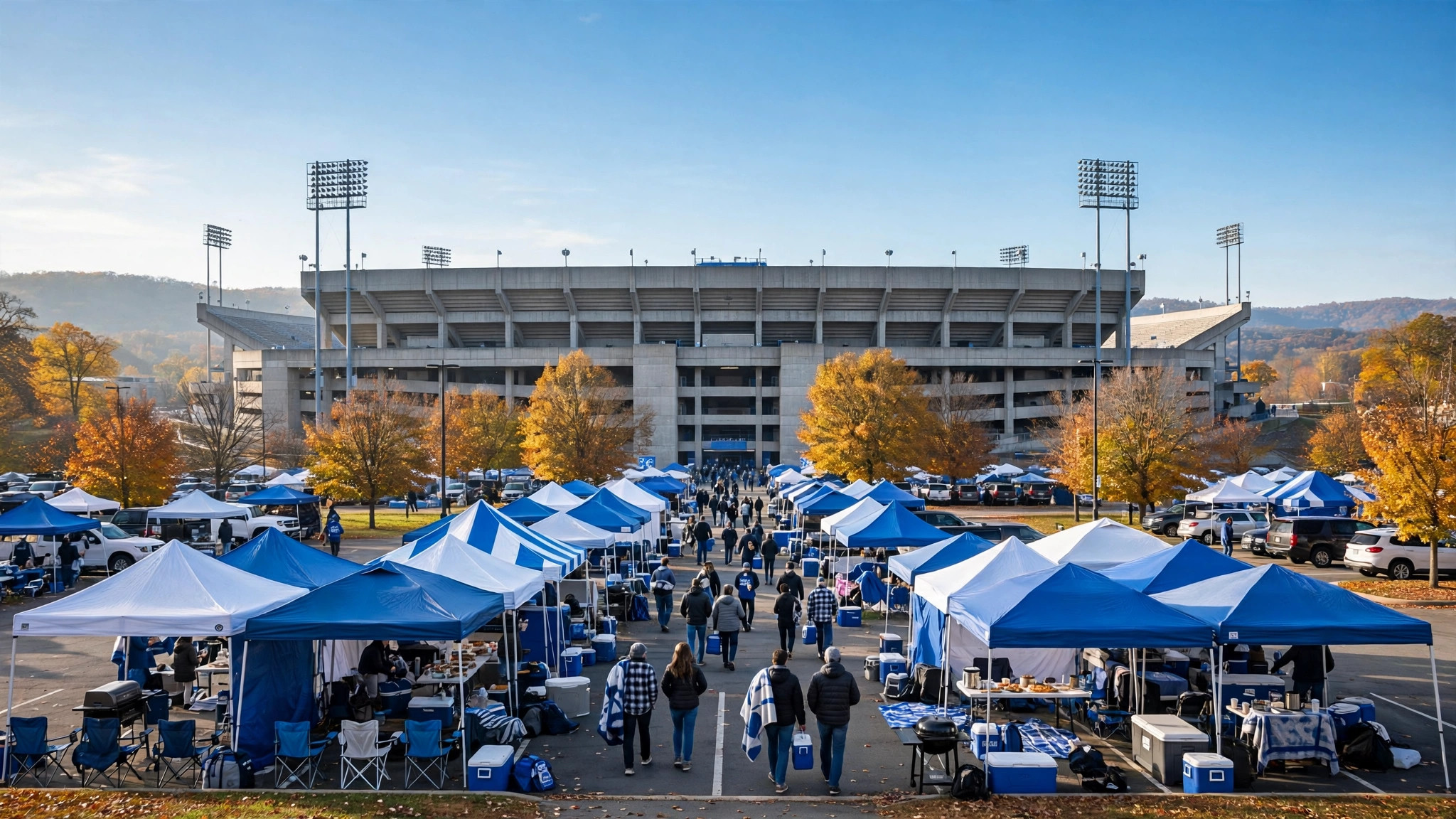
Game-day logistics reward early arrivals: the Cat Walk, the tailgate lots in full horse-country dress, and a stadium district that now treats big Saturdays as civic events. It is a long way from the years when Kentucky’s home schedule was a basketball appetizer, a transformation fans can measure against the calendars of peer programs in our Auburn football schedule coverage.
Bye Weeks, Flex Windows and the Fine Print
Two features of the modern Kentucky football schedule deserve a fan’s attention before any travel is booked. The first is the bye placement: in the expanded-calendar era the SEC typically builds in two open dates, and where they fall shapes a season — Kentucky’s staff will value an open week before a ranked road trip as highly as any recruiting win, because rest and a healthy two-deep are the underdog’s real weapons in November.
The second is the flex window. Beyond the twelve-day selections, the league and its partners can shift select games to Thursday or Friday nights or move kickoffs between windows as late storylines demand. A printed Saturday is therefore a plan, not a contract, until the window locks. The fans who survive this system happiest are the ones who book refundable travel for the season’s biggest road dates and treat the official schedule page as a weekly check-in rather than a one-time download. Kentucky’s own history supplies the cautionary tales: more than one generation of Wildcats fans has driven to the wrong city on the right weekend because a rivalry date moved conferences’ hands.
Planning Your Fall Around Kroger Field
For fans building a season in person, the home calendar sorts naturally into three trips worth circling:
- The Alabama game — the season’s spectacle, a top-fifteen visitor in September, and the toughest home ticket of the year.
- The best October Saturday — a conference game with stakes on both sides, the purest Kroger Field experience the schedule offers.
- The Governor’s Cup — when Louisville visits Lexington, it is the state’s championship game and the building’s loudest afternoon.
Each delivers a different version of the same product: a program and a fan base ascending together, in a stadium that has learned to sound like the big time.
The schedule also deserves credit for one underappreciated feature: its honesty as a measuring instrument. Kentucky’s athletic department has never hidden its football team from competition, and the 2026 slate is the philosophy at maximum strength — a schedule that will produce an unambiguous verdict. If the Wildcats finish with eight or nine wins against this calendar, the whole country will have to re-rank what the program is. If the gauntlet wins, the record will say so plainly, and the rebuild’s timeline adjusts with evidence rather than excuses. Either way, nobody will wonder what the numbers mean.
One more way to read the calendar: as a recruiting document. Every Kentucky home date is staged for the visitors on the sideline — the recruits the staff is courting — and the 2026 home slate, with Alabama in September and a ranked Louisville in November, amounts to a season-long open house for the program Stein is selling. The schedule’s difficulty is the pitch: come play in these games, in this league, in front of this crowd, right away. It is a harder sell at programs with softer calendars, and Kentucky has decided its gauntlet is a feature. The early returns from the trail suggest the pitch is landing.
December: Bowl Math and What the Schedule Builds Toward
Every Kentucky football schedule is ultimately a twelve-game argument for December. Six wins brings bowl eligibility; seven and eight move the destination up the SEC’s ladder; and the Stein era’s stated ambition — a New Year’s-stage game in a playoff-expanded world — requires surviving November with a résumé the committee respects. The schedule’s design makes the math honest: with seven ranked opponents, a strong Kentucky record cannot be dismissed as a soft-slate artifact.
That is the final way to read this calendar. It is not a list of obstacles; it is a list of opportunities, arranged in ascending order of difficulty and meaning, ending with the game the whole state watches. The Wildcats asked for a schedule that could make them matter. The SEC obliged. What Stein’s team does with it — Saturday by ranked Saturday — is the story of Kentucky’s season, and the reason this particular schedule release felt less like paperwork and more like a starting gun.
