

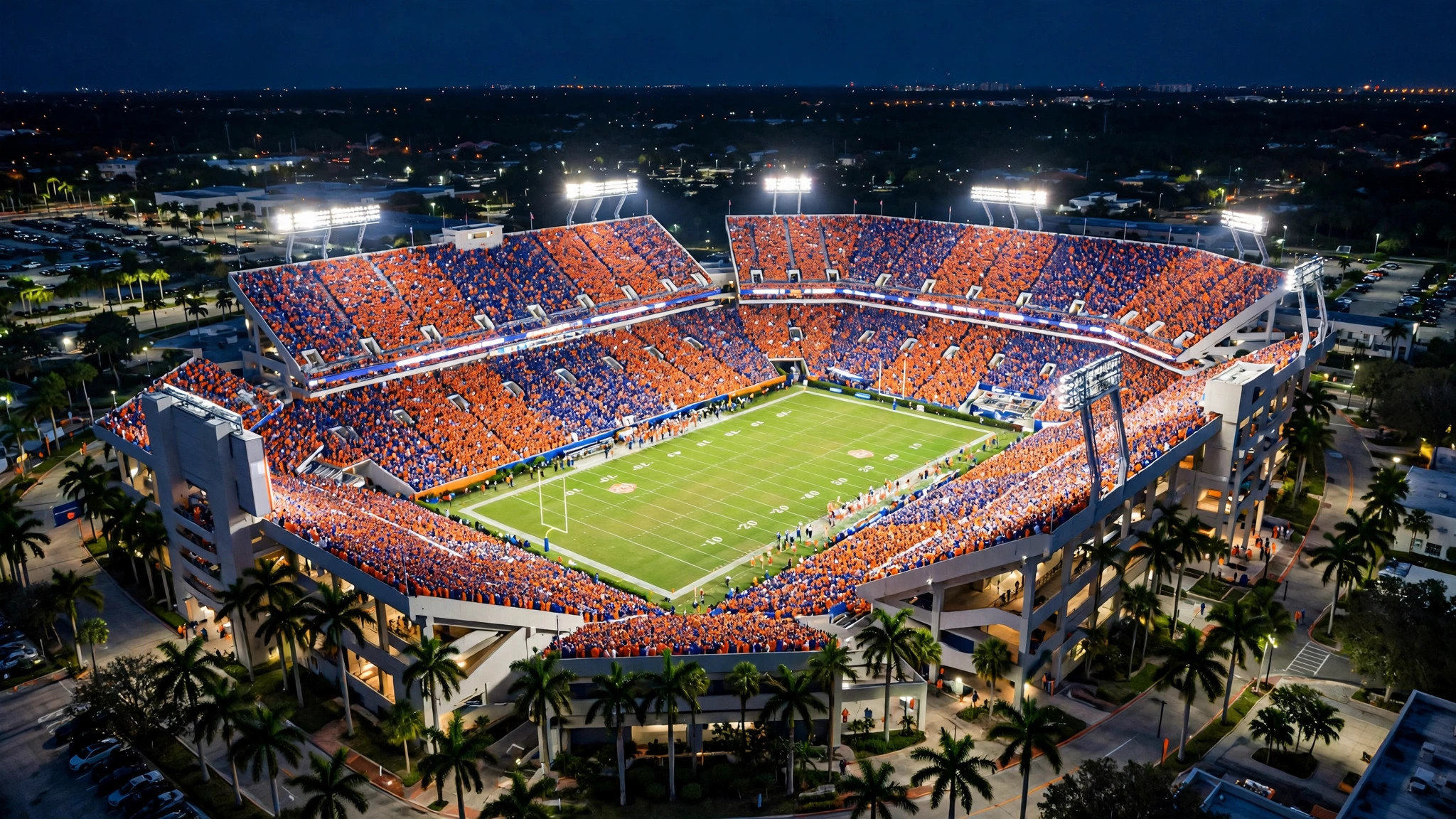
Florida Gators football is one of the defining brands of the Southeastern Conference: three national championships, three Heisman Trophy winners, and a stadium — The Swamp — that visiting teams describe the way sailors describe weather. The program enters a new chapter under head coach Jon Sumrall, hired from Tulane after the Billy Napier era ended during the 2025 season, and the 2026 season has already delivered the kind of October afternoon at Texas that reminds the country what this program is supposed to look like.
This guide covers the whole picture: the schedule and roster, the new coaching era, tickets and game day in Gainesville, and the history that makes the standard in the Swamp so unforgiving.
florida gators football
Florida Gators football represents the University of Florida in Gainesville, competing in the SEC since the league’s founding era and playing at Ben Hill Griffin Stadium — Steve Spurrier Field — since 1930. The program’s modern identity was forged in two golden ages: Steve Spurrier’s Fun ‘n’ Gun 1990s, which delivered the 1996 national championship, and Urban Meyer’s 2005-2010 run, which added titles in 2006 and 2008 behind Tim Tebow.
That history is the point. Florida does not measure seasons against bowl eligibility; it measures them against championship banners, and the fan base — Gator Nation, one of the largest in the sport — applies the standard weekly. The Sumrall hire was made in that image: a rising coach from Tulane’s playoff program, brought in to restore the edge rather than manage the decline.
florida football
Florida football in 2026 is a rebuild with a pulse. Sumrall’s first season opened with a 4-0 start, survived a humbling midseason stretch, and produced a signature 27-24 win at No. 7 Texas in October — backup quarterback Tramell Jones Jr., making his first career start, outplaying the moment in Austin while starter Aaron Philo was sidelined. Running back Jadan Baugh has been the offense’s engine, earning midseason All-America recognition as a sophomore workhorse.
The broader story is structural. Florida’s roster is being rebuilt through the portal and high school recruiting simultaneously, in a conference that offers no soft Saturdays. The remaining home dates — Oklahoma and Vanderbilt visiting Gainesville in November — and the Georgia game will grade the first year more honestly than September did. Fans comparing SEC calendars will find the same gauntlet shape on the LSU football schedule, Florida’s annual cross-division measuring stick.
florida gators
The Florida Gators brand extends beyond the football field in ways few programs match. The school’s colors — orange and blue — and the Gator Chomp are instantly recognizable on any broadcast. Albert and Alberta, the costumed alligators, work the sidelines of a stadium whose playing surface carries Spurrier’s name. And in the most famous footnote in sports science, Gatorade was invented at the University of Florida in 1965, developed by a team led by Dr. Robert Cade to help the football team survive the Gainesville heat — an invention born, quite literally, on the Gators’ practice field.
That word — heat — belongs in every description of the place. Early-season games in The Swamp are endurance events for visitors: humidity, noise and a defense that knows the conditions are on its side.
Game Day in The Swamp: A Fan’s Checklist
For fans making the trip to Gainesville, the essentials fit on one list:
- Hydrate like it matters, because it does. September in The Swamp is the hottest ticket in the SEC in every sense — water first, everything else second.
- Arrive for the Gator Walk. The team’s arrival through the crowd sets the afternoon’s temperature two hours before kickoff.
- Stay in your seat for the third-quarter break. The Tom Petty singalong is the stadium’s signature moment and the one visiting fans talk about afterward.
- Plan around University Avenue. Gainesville’s game-day traffic funnels through a handful of arteries; the experienced fans eat downtown afterward and let the grid clear.
The stadium’s design does the rest. Steep stands, a sunken field and a crowd that understands its role in the defense’s success make The Swamp a home-field advantage measured in false starts and timeouts burned by visiting quarterbacks.
Why the Gators’ Ceiling Is Always a Championship
It is worth stating plainly what separates Florida from most programs that have endured a long title drought: the infrastructure never left. The recruiting footprint — Florida produces more elite high school talent than any state in the union in most years — the facilities, the brand and the stadium are all championship-grade, which is why every Florida rebuild is judged as a restoration rather than a construction project. Coaches do not get five years in Gainesville because the program believes, with evidence, that the right coach can win immediately; Spurrier won the SEC in his second season, Meyer won a national title in his.
That impatience is the job’s burden and its gift. Sumrall, a former Tulane coach who built a Group of Five program into a playoff team, was hired explicitly as a restorer, and the early 2026 evidence — a ranked road win, a running game with an identity, a defense that traveled — suggests the restoration is ahead of the typical schedule. The measure, as always in Gainesville, will be November and the banners. But for the first time in several years, the Swamp sounds like a place that expects them again.
gator football
Gator football has an offensive accent that survives every coaching change: speed. Spurrier’s passing game turned the SEC into a track meet; Meyer’s spread option weaponized Tebow and Percy Harvin; and every staff since has been judged by whether its offense plays fast, scores in bunches and attacks vertically. When Florida’s offense crawls, the Swamp gets restless — the standard is entertainment with the wins.
Defensively, the program’s best teams paired that speed with NFL defensive lines, and restoring that front is the clearest marker of whether the current rebuild is real. The 2006 and 2008 champions both won their titles with defenses that dominated championship games. It is no accident that the Texas win in October 2026 — the moment the season turned — was built on the defense rediscovering its bite.
uf football
UF football game day is an institution with its own liturgy. The Mr. Two Bits tradition, begun by George Edmondson in 1949 and now carried on by honored stand-ins, leads the crowd’s signature cheer. Since 2017, the end of the third quarter belongs to Tom Petty — a Gainesville native — as the stadium sings “I Won’t Back Down” under the lights, one of the sport’s great modern traditions. The Gator Walk delivers the team through the fans hours before kickoff.
The stadium itself explains the nickname Spurrier gave it in 1992: “The Swamp is where Gators live,” he said, “and only Gators get out alive.” Nearly 90,000 fans compressed into a sunken bowl below street level produce a noise that opposing offenses have failed against for three decades. For visitor logistics and tickets, start with the official home at Florida Gators athletics.
gators football
Gators football is defined by its rivalries as much as its banners. Georgia is the annual centerpiece — the rivalry traditionally staged in Jacksonville, with the 2026 edition moved to Atlanta on October 31 while Jacksonville’s stadium undergoes renovation, a one-off detour in one of the sport’s great neutral-site traditions. Florida State closes the regular season in the Sunshine Showdown, a game that decided national-title races through the 1990s. Tennessee, LSU and Miami round out a rivalry portfolio few programs can match.
Those games explain the schedule’s cruelty and its glamour: Florida plays more nationally relevant Saturdays than almost anyone, which is why the program’s ceiling is a championship and its floor is a national argument. Fans tracking the rivalry calendar nationally will recognize the same stacked shape across the SEC — the Auburn football schedule carries its own version of the same gauntlet.
gators
The Gators’ trophy case holds the essentials: national championships in 1996, 2006 and 2008; eight SEC championships between 1991 and 2008; and three Heisman Trophies — Spurrier in 1966, Danny Wuerffel in 1996 and Tebow in 2007, making Florida one of the few programs whose coach also won the award as a player. The 2008 team, which beat Oklahoma for the title, is still cited in greatest-team arguments.
The drought since 2008 is the program’s open wound and its motivation. Florida has played in SEC championship games and major bowls since, but the fan base’s patience is calibrated to banners, which is precisely the energy the Sumrall era has been hired to satisfy.
gator
A word about the singular: in Gainesville, “Gator” is an identity before it is a mascot. Alumni introduce themselves by it; the chomp is performed at weddings; the program’s standard — Gator Standard is the internal phrase used across eras — travels with its people. Students learn it in their first week on campus, when the freshman class packs the stadium to learn the cheers, and they carry it into a lifetime of Saturdays: the Swamp in the fall is one of the great alumni reunions in American sports, a place where three generations of the same family can stand in the same section their grandparents stood in, singing the same songs at a new team wearing the same colors.
That continuity is the program’s quiet advantage. Coaches change, conferences realign, and the sport reinvents itself every few years — but the identity in Gainesville does not move, and every new staff inherits a fan base that needs no convincing to believe a championship is possible. The belief has been right three times. The whole enterprise, from the recruiting trail to the third-quarter singalong, is organized around being right a fourth. The 2026 season’s early returns suggest the identity is being reconnected to results: a team that fights on the road, a coach unafraid of a microphone, and a fan base that senses the turn before it can prove it.
The road ahead is the SEC’s usual toll road — Georgia in Atlanta, the November home dates, and a finale against Florida State that needs no stakes to matter. But the point of a Florida season guide is simpler than the standings: this is a program with a championship past, a restless present, and a stadium that turns September heat into home-field advantage. In the Swamp, only Gators get out alive — and the rest of the league has started circling Gainesville on the calendar again, the way it did in the program’s best years. Fans who follow the rivalries can see how the other half lives in our where to watch Tennessee vs Georgia guide, the matchup that frames Florida’s own October every year.
