

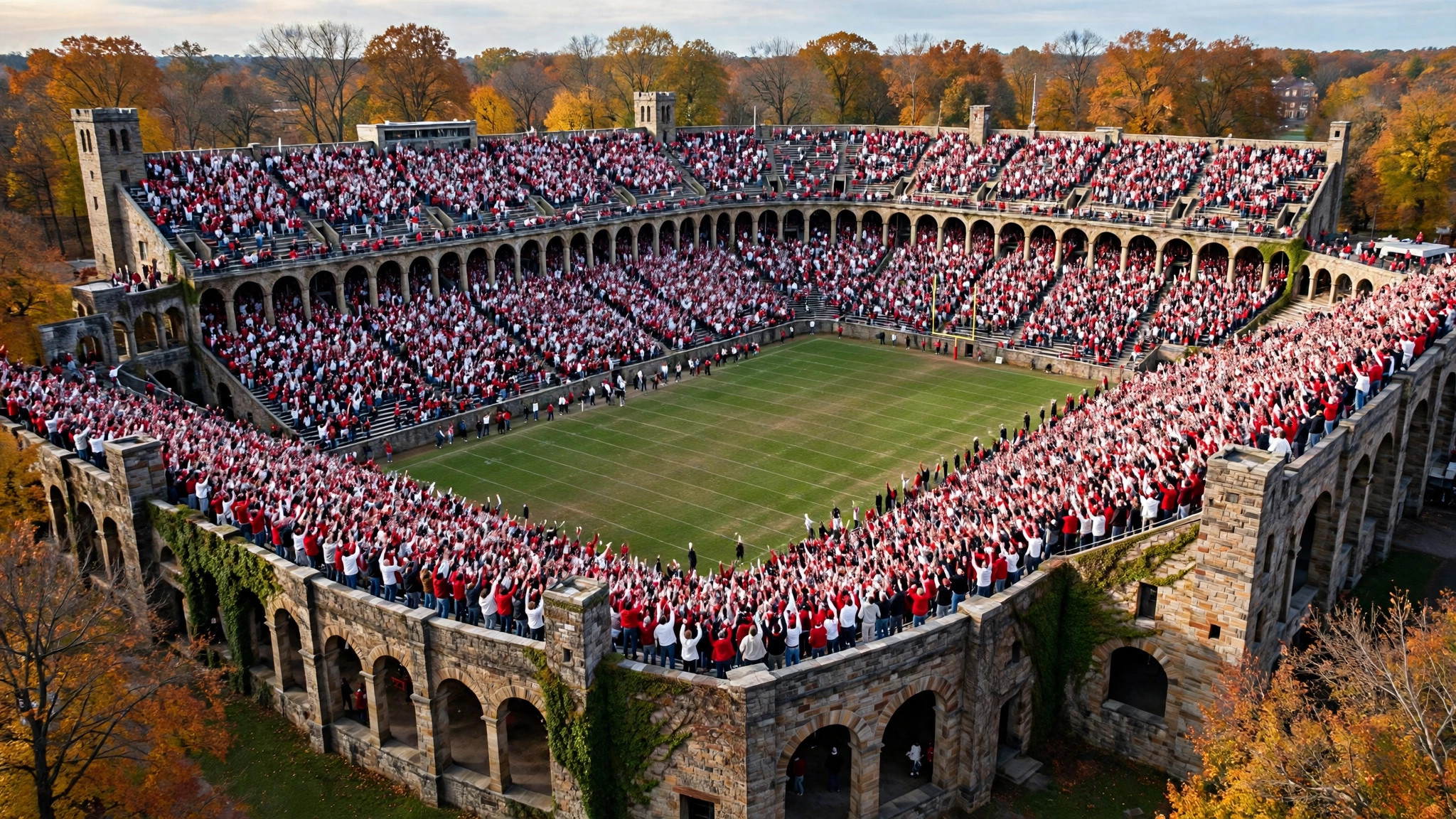
Late in a close game in Madison, the stadium starts to jump — literally. When “Jump Around” hits the speakers between the third and fourth quarters, more than 75,000 people bounce in unison until the press box sways and seismographs take notice. That is Wisconsin football: a program built in the trenches, in the Big Ten’s oldest stadium, by a state that considers an offensive line a thing of beauty. This guide covers the whole Badgers landscape — the Alvarez blueprint, the running back lineage, Camp Randall’s traditions, the current era under Luke Fickell, the schedule’s shape, tickets and how to watch.
For fans who believe football is won where the big people play, Wisconsin is your program. Start here.
Wisconsin Football: The Program at a Glance
Wisconsin football plays in the Big Ten Conference at Camp Randall Stadium, which opened in 1917 on the grounds of a Civil War training camp and is the oldest stadium in the league. The Badgers wear cardinal and white, answer to Bucky Badger, and sing “On, Wisconsin!” — the 1909 fight song so famous that its title became a phrase in the language.
For most of the twentieth century, Wisconsin was a respectable program with sporadic peaks — the 1963 Rose Bowl team that finished No. 2, the Alan Ameche era of the 1950s. The modern program is a single invention: Barry Alvarez arrived from Notre Dame in 1990, promised a Rose Bowl at his introductory press conference to general laughter, and then built one of the sport’s most reliable winners on a simple public blueprint — Wisconsin kids and walk-ons on the lines, a power running game, and a defense that treats every yard as a personal insult.
Badger Football: The Alvarez Blueprint
Badger football’s founding document is the 1993 season, when Alvarez’s fourth team went 10-1-1 and beat UCLA in the Rose Bowl — the program’s first trip to Pasadena in three decades and the moment the modern era began. The Badgers returned to win Rose Bowls after the 1998 and 1999 seasons, the latter behind Heisman Trophy winner Ron Dayne, whose punishing running style and NCAA rushing record made him the blueprint’s perfect avatar: a giant back behind a giant line, running behind fullbacks, in January, in the cold.
Alvarez’s genius was institutional rather than schematic. He stocked the roster with in-state linemen the national programs overlooked for being from Wisconsin, developed walk-ons into starters as a matter of policy, and made the program’s identity so clear that his successors inherited a machine rather than a mystery. When he moved to the athletic director’s chair, the blueprint stayed — Wisconsin has changed coaches since, but it has never really changed teams.
That continuity is the context for understanding every Badgers season since: the standard is not a style point but a head count — how many future NFL linemen are in the two-deep, how deep the running back room runs, and whether November in Madison still feels like a place visiting offenses go to be slowly, politely dismantled.
It is worth noting what the blueprint did for the university beyond football. The Rose Bowl runs of the 1990s transformed Wisconsin’s national profile and applications, filled a stadium that now anchors the city’s autumn economy, and gave the state’s flagship a sporting identity equal to its academic one. Alvarez understood, earlier than most of his peers, that a football program built to a clear and repeatable design is not merely a team but an institution — and institutions, unlike hot seasons, do not graduate. Every Badgers autumn since has been graded against the institution he left behind, which is the highest compliment a successor can inherit and the heaviest.
Badgers Football: The Running Back Lineage and the Line
No program’s identity is more concentrated in one position group. Badgers football’s rushing lineage runs from Ameche, the 1954 Heisman winner, through Dayne, and into a modern era of almost annual stars: Montee Ball, who scored touchdowns at a rate that briefly owned the NCAA record book; Melvin Gordon, whose 408-yard single-game performance in 2014 briefly set the national record; and Jonathan Taylor, who ran for nearly 2,000 yards in three straight seasons and left as one of the most productive backs in the sport’s history.
The backs will all tell you the same thing: the line made them. Wisconsin’s offensive lines are a development program unto themselves — tall, long, often home-grown, coached in a pro-style system that sends tackles, guards and centers to the NFL in numbers few programs match at any position. Scouts treat Madison as a showroom. The 2011 team, quarterbacked for one season by transfer Russell Wilson, showed the ceiling of the formula when a great passer meets it: a Big Ten title, a Rose Bowl, and one of the most efficient offenses in school history.
Reading a Wisconsin roster, then, starts where the program starts: count the linemen with NFL measurables, check the running back room’s depth, and only then ask about the quarterback. The official roster lives with the school — every other guide in this series, including our Illinois football breakdown, will tell you the same: Wisconsin’s depth chart is the argument.
Camp Randall and Jump Around
Camp Randall’s game day is a study in Wisconsin pleasures: tailgates heavy on bratwurst and local beer in the neighborhoods around the stadium, the Badger Band’s Fifth Quarter performance after the game — win or lose, the band plays on and the crowd stays — and the student section’s slow-building chaos that peaks at the end of the third quarter.
Jump Around began in 1998, when the song was played between quarters and the students responded so completely that it became permanent. The tradition now has its own physics: the stadium’s upper deck visibly moves, visiting fans bounce between delight and concern, and the team treats the moment as a fourth-quarter home-field weapon. It is the rare stadium tradition that television cannot do justice to, because the point is not watching it — it is the ground moving under your feet.
Practical notes for visitors:
- Arrive early for the neighborhoods; the walk down Regent Street and Breese Terrace is half the experience.
- Dress for a stadium that funnels November wind; Madison cold is a serious opponent.
- Stay for the Fifth Quarter. Leaving early at Camp Randall is the one sin the locals actually judge.
Wisconsin Badgers Football: The Fickell Era and the Air Raid Question
Wisconsin Badgers football entered a deliberate new chapter when the program hired Luke Fickell from Cincinnati in late 2022 — the coach who had taken the Bearcats to the College Football Playoff, the first Group of Five team to crash that party. The hire signaled ambition: keep the program’s physical soul, but modernize the offense for a Big Ten growing faster and more pass-heavy around it.
The transition has been the program’s central storyline ever since — a genuine philosophical experiment about how much of the Alvarez blueprint is sacred and how much was simply the best available technology of its time. The early seasons brought a new offensive system, portal-era roster churn and the growing pains of a fan base negotiating, in public, between its identity and its ambitions. The defense, at least, has spoken the old language fluently more often than not, which in Madison buys any coach the one currency that matters: time.
Wisconsin Badgers: Rivalries and the Axe
The Wisconsin Badgers’ defining rivalry is with Minnesota for Paul Bunyan’s Axe, a series first played in 1890 and the most-played rivalry in the Football Bowl Subdivision. The Axe itself replaced the original Slab of Bacon trophy in 1948, and the winning team’s storming of the opponent’s sideline to claim it is one of the sport’s great pieces of theater. The Iowa game, played for the Heartland Trophy, is the division’s most physical annual afternoon, and the Nebraska series, for the Freedom Trophy, has grown teeth since the Huskers joined the league.
Beyond the trophies, Wisconsin’s modern history is written against Ohio State and Michigan in the conference’s title games — the Badgers reached the Big Ten Championship Game six times in its first decade, a consistency record that tells the Alvarez blueprint’s story in a single line: not always the champion, never far from the fight.
Badgers in the NFL: Madison’s Other Scoreboard
Wisconsin keeps a second scoreboard, updated every April: the draft. The program’s professional lineage is the blueprint’s proof of concept — J.J. Watt, the walk-on-turned-transfer who became a three-time NFL Defensive Player of the Year, is its patron saint, but the depth of the list is the point: Russell Wilson’s Super Bowl ring, Jonathan Taylor’s rushing titles, and a generation of starting NFL linemen — tackles, centers and guards — who arrived in Madison as regional recruits and left as first- and second-day draft picks.
The pipeline feeds itself with unusual efficiency. NFL scouts trust Wisconsin’s offensive line film because the system is a professional one; agents steer linemen to Madison because the development is documented; and the program’s strength staff has become an industry address in its own right. When a Wisconsin season disappoints, the draft usually still testifies for the defense: the machine’s parts are excellent even in the years the whole underperforms.
For fans, the draft has become a genuine second season — three April days when the state’s recent Saturdays get re-graded by the league’s market. It is also the cleanest metric of the current era’s project: if the modernized Badgers keep sending linemen and backs to the first two rounds while the wins return to double digits, the argument between tradition and evolution in Madison will settle itself, the way most Wisconsin arguments settle — slowly, completely and in the trenches.
Wisconsin Football Schedule: Shape, Tickets and How to Watch
The Wisconsin football schedule follows the Big Ten framework: nine conference games, three nonconference dates, the Axe game anchoring the finale weekend, and Muscatine-to-Madison road trips that now stretch coast to coast in the expanded league. November home dates — Iowa, Minnesota, a heavyweight visitor in the cold — are the inventory that defines a season at the box office.
Tickets run through the school’s official channels; the Axe game and ranked visitors move fastest, and Camp Randall’s setting in a residential neighborhood rewards fans who plan parking and arrival like a military operation. Television follows the league pattern across FOX, CBS, NBC, the Big Ten Network and Peacock, with kickoffs set in-season; the official source for the confirmed schedule is Wisconsin Badgers athletics. Fans touring the league’s classic stadiums with our guides can continue to Purdue football and Maryland football — but save a November Saturday for Madison, when the ground moves, the band plays a fifth quarter, and the whole state jumps in unison to tell the visiting team exactly whose house it is.
