

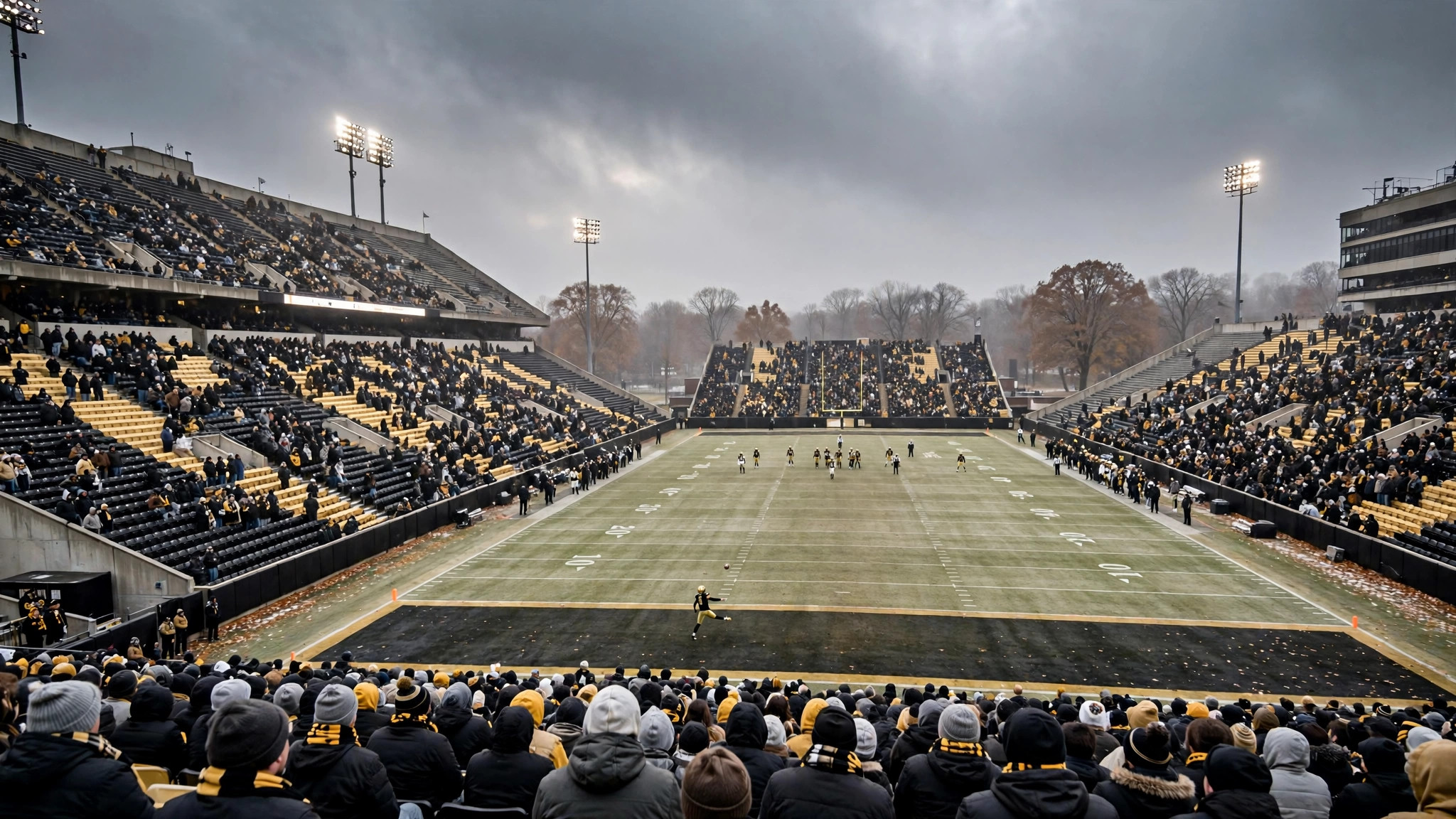
The Iowa score is the most argued-about number in college football. In an era of basketball-on-grass offenses, the Hawkeyes keep producing finals that look like baseball scores — and keep winning them. This guide explains where to follow the Iowa score live on game day, how to read the box score of a program that treats 17 points as an outburst, and why the famous low finals are not accidents but the purest expression of what Iowa football is.
Whether you are refreshing from the Kinnick Stadium stands or from three time zones away during an Iowa game today, this is the complete routine — and the decoder ring for the strangest scoreboard in the sport.
Iowa Score: Where to Follow the Hawkeyes Live
The authoritative live source is the school’s own coverage: the athletics site and app run live statistics that update play by play, with the score by quarter, drive charts and the defensive numbers that matter most in an Iowa game. National scoreboards carry the same data with a slight delay and add the Big Ten context — and with Iowa, context is everything, because a 13-10 Hawkeyes win routinely rearranges a division race or a playoff bubble somewhere else.
Television broadcasts of Iowa games have their own rhythm. The announcers will make the joke — they always make the joke — about the offense, and then the fourth quarter will arrive with Iowa’s defense defending a one-score lead like a family heirloom, and the joke will stop. The radio call remains the connoisseur’s medium in Iowa City: it has described this program’s style for generations and treats a seven-play, four-minute field-goal drive with the reverence it deserves.
For the Iowa game today crowd checking from phones: set quarter-end alerts rather than play alerts. Iowa games are low-possession affairs; the score changes rarely, and each change is an event worth savoring rather than a notification to swipe past.
Reading an Iowa Box Score: Different Numbers Matter Here
Every program’s box score tells the same categories; Iowa’s asks you to read them in a different order. Start not with total yards but with the punt column and the field-position math it creates. Iowa’s special teams — the celebrated punter pipeline, the coverage units, the return game — exist to tilt the field ten yards at a time until the opponent’s offense is playing uphill football for four quarters. The score at the end is usually just that tilt, converted.
Then the defensive core:
- Points allowed and red-zone defense: Iowa’s bend-don’t-break structure concedes yardage between the twenties and turns medieval inside them; the field-goal column for opponents is the defense’s signature.
- Turnovers created: the Hawkeyes’ ball-hawking secondaries have lived on takeaways for decades, and a plus-two Iowa turnover day is effectively a two-score head start.
- Rushing attempts and time of possession: Iowa’s offense is a clock instrument; thirty-five rushing attempts usually means the game went exactly as designed.
- The opponent’s yards per play: the single number coordinator Phil Parker’s defenses have strangled for years.
Read those four, and the final score will never surprise you. Skip them and read only the offensive totals, and you will misunderstand Iowa football the way most of the country did until the wins piled too high to dismiss. Readers building the full framework can pair this with our explainer on how long football games last — Iowa’s low-possession style makes the clock itself a Hawkeyes weapon.
Famous Finals: 7-3, and Other Iowa Legends
The Iowa score entered folklore on September 3, 2022, when the Hawkeyes beat South Dakota State 7-3 — a field goal and two safeties, no offensive touchdown, in a game the home crowd cheered like a masterpiece by the end. It became the program’s defining meme and, to its fans, a perverse point of pride: Iowa had won a game almost entirely with defense and special teams, the program’s whole philosophy distilled into one absurd, beautiful final.
The genre has a long shelf. Through the 2023 season the Hawkeyes stacked wins with finals like 15-13 and 10-7 while fielding one of the nation’s best defenses and an injury-riddled offense, a run that carried them to the Big Ten Championship Game and turned “how did Iowa win that?” into a weekly national segment. And in 2021, the Hawkeyes won a top-ten Cy-Hawk game at Iowa State 27-17 — a comparatively explosive afternoon that launched a 6-0 start and a brief stay near the top of the national rankings.
Set against them are the finals that built the brand across decades: the 2015 team’s perfect regular season, closed out week after week with fourth-quarter defensive stands, and the Ferentz era’s long list of ranked opponents who arrived in Iowa City expecting a shootout and left in a 17-14 world. The lesson the archive teaches is stable: in Iowa games, the score is low because the game is hard, and the game is hard because Iowa intends it that way.
Iowa Game: The Score Around the Big Ten
An Iowa final is never just an Iowa final. The Hawkeyes’ style makes them the league’s chaos agent: a 13-10 win in Iowa City can knock a playoff contender sideways, and the rest of the Big Ten schedules its emotional week around whatever the Hawkeyes did to somebody’s season. Fans following the full slate will notice how often the conference’s Saturday narrative pauses, collectively, to stare at an Iowa score in disbelief.
That is also why the Hawkeyes’ results age unusually well in the standings. Low scores suppress style points but not wins, and Iowa’s seasons keep resolving into bowl tiers and title-game appearances that September’s mockery never predicted. Our coverage of Illinois football shows the same league from a program trying to borrow pieces of the Iowa formula — and discovering, as everyone does, that the formula is mostly twenty years of refusing to change it.
The Emotional Arithmetic of a Fan Base
Only in Iowa City could a fan base develop superstitions about a punter. The relationship between this state and this scoreboard is genuinely different: Hawkeyes fans track drive-starting field position the way other fans track passing titles, debate special-teams coordinators at a level of detail other fan bases reserve for quarterbacks, and have turned the phrase for their style into a badge. When the final is 20-17, the whole state sleeps fine.
New fans should be warned about one thing: the Iowa score will ruin other football for you in a specific way. Once you have watched a defense hold a ranked opponent to field goals for four quarters and felt a stadium celebrate a punt that pins a team at its own four, ordinary shootouts start to look like a different, lesser sport. Resistance is possible but not, in our experience, common.
Live From Kinnick: The Score in the Building
Following the Iowa score inside Kinnick Stadium is a different sport from following it on a phone. The building is a bowl of black and gold wrapped tight around the field, the crowd is defense-literate to a degree visiting quarterbacks find unnerving, and the scoreboard’s most important feature is the down-and-distance line — because in a low-possession game, every third down is effectively a scoring play for one side or the other.
The stadium experience layers in rituals a broadcast cannot show: the roar for the punt team trotting out — genuine, informed, ironic and sincere at once — and of course the Wave at the end of the first quarter, when the scoreboard, for sixty seconds, is the least important display in Iowa City and seventy thousand people look up at a hospital instead. First-time visitors consistently say the same thing afterward: they came for the oddity of Iowa’s scores, and they left talking about the people.
If you are attending, arrive early enough to watch the stadium fill and the hospital windows fill with it. The game will be close, the score will be low, and by the fourth quarter you will understand why nobody in the building would trade either fact.
Overtime and Oddities: Iowa’s Strangest Finals
Iowa’s score history rewards a collector’s eye. There are the defensive monuments — the 7-3 safety game of 2022, the 6-4 loss at Penn State in 2004 that old-timers still cite as the genre’s founding document, the rock fights of the 2023 season that carried a team with a historically limited offense to a division title. There are the shootout exceptions that prove the rule, games where an Iowa quarterback got hot for one afternoon and the final looked borrowed from another program’s history. And there are the rivalry finals that live in family lore: Cy-Hawk one-score games in both directions, Floyd of Rosedale decided by kicks, the Black Friday finales against Nebraska settled in the final minute.
The collector’s lesson is that the strangeness is systematic. A program that plays for field position produces finals bunched at the low end, blowouts that read 24-3 instead of 45-24, and fourth quarters in which a seven-point lead functions like seventeen. Once you calibrate for the house style, the scores stop looking like typos and start reading like a language — one the whole state is fluent in and the rest of the country is slowly, grudgingly learning.
Keep a private list of the strangest finals you witness. Every Iowa fan has one, and comparing lists at a tailgate is a recognized form of scholarship in Johnson County.
Alerts, Sources and the Official Record
Build the routine once: official live stats during the game, quarter alerts on the phone, the postgame box score for the autopsy, and the program’s archive for the record. The official home of Iowa’s results, statistics and historical records is Iowa Hawkeyes athletics, and the conference-wide view — including the programs chasing Iowa’s formula — runs through guides like our Purdue football breakdown.
The Iowa score will be low. It will be argued about for a week in every barbershop in the state. It will, more often than the country’s comedians expect, belong to the Hawkeyes. Now you know how to follow it, how to read it — and how to enjoy the one scoreboard in America that treats 13 points as a feast. Bring a warm coat, a patient eye and a respect for the punt; Iowa City will supply the rest, four quarters at a time, exactly the way it has for forty years. And when the final reads something like 17-14 and the visitors are shaking their heads at how it happened, you will be able to explain it to them — in the box score’s own language, which is the only one Iowa has ever needed, and the only one it intends to learn.
