

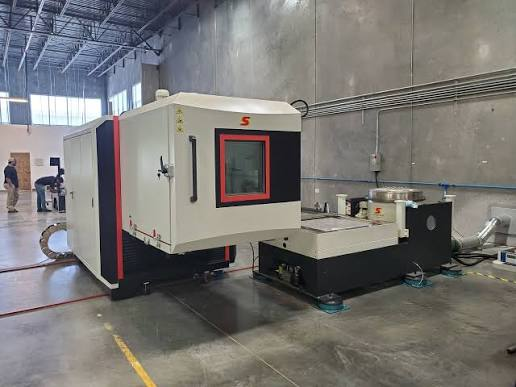
Testing how vibration affects a battery sounds simple: shake the cell and watch it age. In practice, vibration frequency, vibration amplitude, temperature, and state of charge (SOC) all interact. Testing every combination at fine resolution would take enormous time and computing effort. The multiphysics study on coupled electro-chemo-mechanical degradation in lithium-ion batteries under forced vibration solves this with a two-stage design of experiments (DoE): screen first, then refine.
Why a structured design matters
Changing one factor at a time hides interactions. A vibration that is harmless at 25°C and 20% SOC may be damaging at 60°C and 90% SOC. A structured DoE varies factors together in a planned way, so the effect of each factor and of their combinations can be separated with far fewer runs than a brute-force sweep.
Stage 1: Full factorial screening
The first stage asks a simple question: which factors matter most?
The authors used a full factorial design with four factors, each at two levels:
- Vibration frequency: 5 Hz and 50 Hz
- Vibration amplitude: 0.5 and 0.6
- State of charge: 20% and 90%
- Ambient temperature: 25°C and 60°C
Four factors at two levels give 2⁴ = 16 runs. Each run was replicated three times, giving 48 experimental conditions. Base excitation covered roughly 0.2 to 3 g, in line with transport safety standards for battery testing.
The responses tracked were capacity fade, internal resistance growth, and temperature rise. The goal of this stage was not prediction but ranking. It showed which factors drive degradation and which can be set aside.
Stage 2: Central composite design (CCD)
Two-level designs can only detect straight-line trends. Degradation is rarely linear, so the second stage uses a central composite design on the significant factors from Stage 1.
The CCD adds more levels to capture curvature:
- Ambient temperature: 25°C, 45°C, 60°C (45°C as the centre point)
- Vibration frequency: 20 Hz, 100 Hz, 200 Hz
- State of charge: 10%, 50%, 90%
- Vibration amplitude: varied between 0.2 and 0.8
The design combines factorial (cube) points, axial points, and a replicated centre point. The replicated centre point serves two purposes: it estimates pure experimental error and it tests whether the response surface is curved.
During vibration, the cell was cycled electrically at 1C charge and discharge, so mechanical and electrochemical loading acted together, as they would in a vehicle.
From runs to response surfaces
The CCD allows quadratic response surface models. Instead of a table of results, you get a mathematical map that predicts how the cell behaves anywhere inside the tested range. The responses modelled include:
- Capacity retention (or capacity fade rate)
- Internal resistance growth
- Peak and average cell temperature
- Temperature rise (ΔT)
- Voltage polarisation
Because the surfaces are predictive, they support multi-objective optimisation, for example finding operating windows that limit both capacity fade and heating.
The benign baseline
The authors also defined a low-stress reference condition based on prior literature: low frequency (5 Hz), low acceleration (0.5 g RMS), low SOC (20%), and moderate temperature (25°C). These conditions limit stress transmission, suppress side reactions, and slow degradation kinetics. This baseline gives a clean comparison point for the more aggressive cases.
Why this approach is useful
- Efficiency. Screening first avoids wasting effort on factors that do not matter.
- Interaction detection. Temperature, SOC, and vibration can amplify one another, and the design can expose that.
- Nonlinearity. The CCD captures curvature that a simple two-level test would miss.
- Predictive power. Response surfaces turn a finite set of runs into a usable design tool.
A note on interpretation
This is a simulation-based study, so the “experiments” are numerical runs of the coupled model rather than physical tests. The results should be read as mechanistic trends. Some model parameters are phenomenological, and the paper reports amplitude as a dominant factor, which the screening stage helps establish.
Takeaway
A good vibration study is not only about the physics model but also about how the model is explored. By pairing a full factorial screen with a central composite refinement, the study identifies what matters and then maps how it matters. That is what makes the later findings, such as amplitude dominating frequency, systematic rather than anecdotal.
