

Arkansas football does not do quiet rebuilds. After a 2-10 season in 2025 — a year that cost a head coach his job midseason and ended with a program legend calling plays as the interim — the Razorbacks hired Ryan Silverfield away from Memphis, watched him import an SEC-high 42 transfers, and declared the reset open. Arkansas football in 2026 is a program in a hurry, in the conference least forgiving of hurried programs.
This guide covers the whole picture: the new coach, the overhauled roster, the schedule, Donald W. Reynolds Razorback Stadium, tickets, and the proud, peculiar history of the Hogs.
arkansas football
Arkansas football represents the University of Arkansas in Fayetteville, competing in the Southeastern Conference since 1992 after generations as a power in the old Southwest Conference. The Razorbacks are the state’s team in the truest sense — the only major program in Arkansas, followed from the Ozarks to the Delta with an intensity that visiting fans consistently rank among the SEC’s most surprising.
The identity is bound up in two artifacts: the mascot, a razorback hog chosen in 1909 after coach Hugo Bezdek declared his team had fought like “a wild band of razorback hogs,” and the call — Woo Pig Sooie — that echoes out of the stadium three times, rising, before every game. Everything else about the program is negotiable across eras. Those two things are not.
arkansas razorbacks football
Arkansas Razorbacks football owns a championship pedigree its recent record hides. The pinnacle is 1964: an 11-0 season under Frank Broyles, capped by a Cotton Bowl win over Nebraska, that brought a national championship to Fayetteville and made Broyles — later the athletic director and the program’s patriarch — a legend. The Razorbacks of that era were a national program, playing in the Game of the Century against Texas in 1969, a 15-14 loss that still sits at the center of the sport’s history books.
The SEC era has been a roller coaster by design: Houston Nutt’s revival, the Bobby Petrino peak that reached a No. 3 ranking and a Sugar Bowl in the 2010 season, and the long wander since. The through-line is a fan base that never left — Arkansas draws like a contender in its worst years, which is precisely why the right coach in Fayetteville is considered one of the great sleeping jobs in the sport. Programs rebuilding with a system and a plan, like the one in our Memphis football guide — the very program Silverfield came from — know the climb Arkansas is attempting.
razorback football
Razorback football on the field has a historical accent: physical lines, a ground game with an attitude, and offenses at their best when the run sets up the strike. The great Arkansas teams — Broyles’ champions, Lou Holtz’s 1977 squad that stunned Oklahoma in the Orange Bowl, the Petrino teams with their vertical passing — all shared a nastiness at the line of scrimmage that the program treats as heritage rather than scheme.
The modern version must add a second language: the SEC’s weekly spread attacks and NFL defensive fronts demand a roster two-deep at every spot, which is why the program’s portal-era roster churn — 42 newcomers in a single offseason — is less a gimmick than a necessity. Razorback football’s identity question for 2026 is whether an identity can be installed at transfer-portal speed. Fayetteville is about to find out, one Saturday at a time.
arkansas razorback football
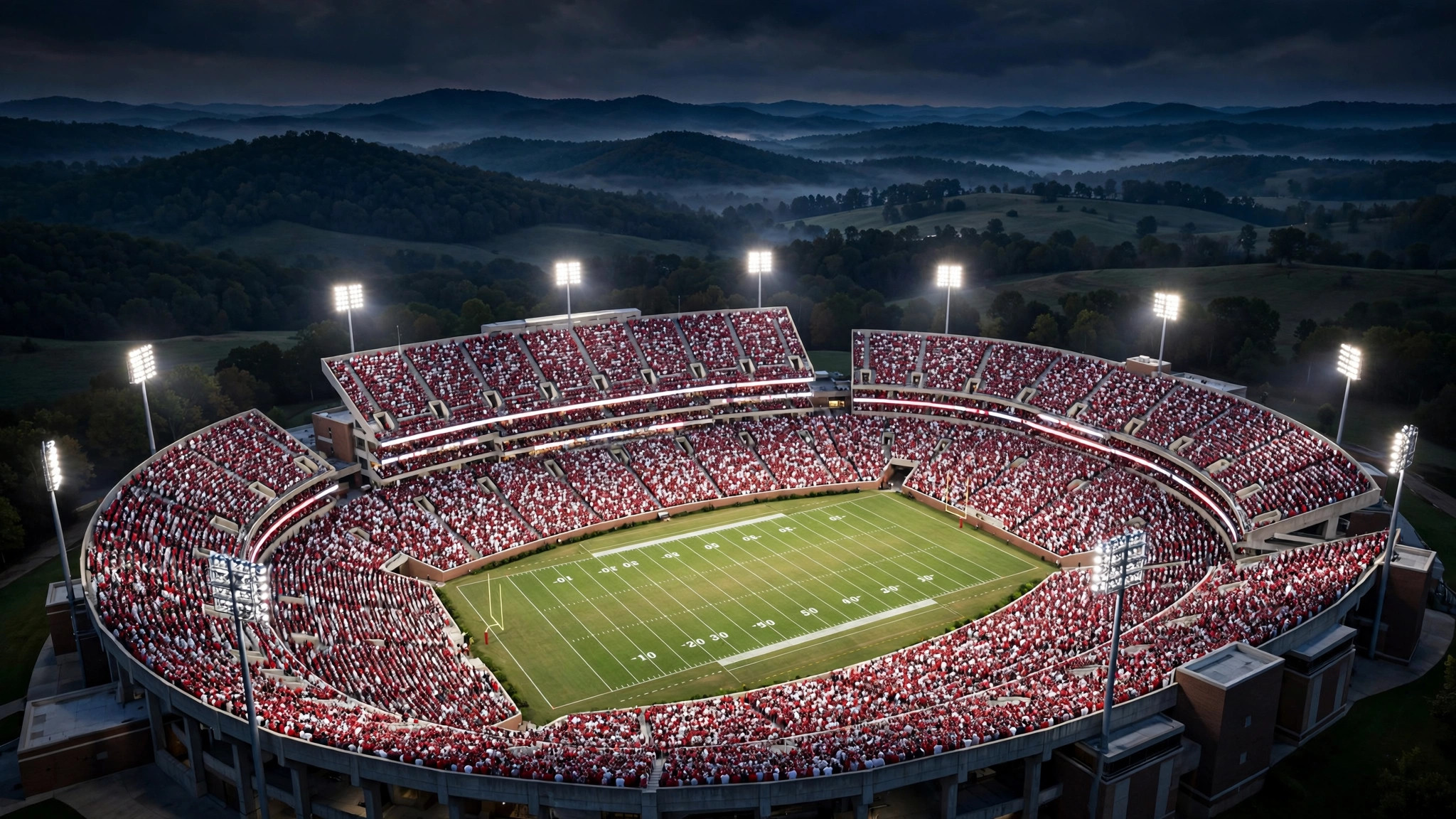
Arkansas Razorback football’s home is Donald W. Reynolds Razorback Stadium, listed at 76,000 seats for the 2026 season, carved into the hills of northwest Arkansas. The setting is one of the SEC’s most distinctive: a bowl that opens toward the Ozarks, in the fastest-growing corner of the state, where the university and the region have boomed together for three decades. The program also keeps a historic second home at War Memorial Stadium in Little Rock, a nod to the statewide nature of the fan base that few programs in America can replicate.
The game-day production matches the setting — the Hog call rolling down from the stands, the band’s “A” formation, and a pregame walk that brings the team through its people. For a visiting fan, Fayetteville is the SEC’s best-kept secret; for a visiting team, the noise in the fourth quarter of a close game is the secret’s other half.
razorbacks football
Razorbacks football measures itself against a rivalry portfolio with genuine history. Texas is the ancestral enemy — the programs’ Southwest Conference wars, including the 1969 Game of the Century, built the feud, and Texas’ arrival in the SEC has restored it to the annual calendar. LSU supplies the Battle for the Golden Boot, a trophy game with a habit of producing classics. Ole Miss, Texas A&M — a series staged for years at the Cowboys’ stadium in Arlington — and Missouri, in the Battle Line Rivalry, fill out a slate that gives Arkansas fans a grievance for every month of the fall.
The trophy case holds the 1964 crown, thirteen conference championships across its SWC and earlier history, and a line of legends — from Broyles’ teams through Darren McFadden, the two-time Heisman runner-up whose 2006-07 seasons remain the program’s modern gold standard for individual brilliance. The full program record, schedules and ticket information run through the official home at Arkansas Razorbacks athletics.
arkansas football coach
The Arkansas football coach is Ryan Silverfield, named the program’s 35th head coach on November 30, 2025. He arrived from Memphis with a 50-25 record, two ten-win seasons, bowl eligibility in all six of his seasons there, and the longest bowl streak among non-Power Four programs — a résumé built on exactly the skills Arkansas needed: roster construction, offensive production and program steadiness. His Memphis offenses finished in the national top 25 in scoring four straight years.
The situation he inherited explains the hire’s urgency. Sam Pittman, the beloved offensive line coach whose tenure peaked with a nine-win 2021 season, was fired midway through 2025; Bobby Petrino — the program’s former head coach — finished the season as interim, a surreal coda to the program’s most dramatic decade. Silverfield’s answer was total reconstruction: a new staff headlined by veteran coordinators, and a transfer class that remade the depth chart in one winter. The league will grade the experiment weekly; the early evidence — an organized camp, a settled quarterback room — suggests a program that knows what it is building.
arkansas football roster
The Arkansas football roster for 2026 is the portal era rendered in one depth chart. Quarterback KJ Jackson won the job in fall camp, a Montgomery, Alabama native who flashed in five appearances last season, completing 33 of 54 passes for 441 yards and three touchdowns. The running back room pairs Braylen Russell — a power back averaging more than five yards per carry for his career — with Sutton Smith, who rushed for 675 yards at Memphis last season and followed Silverfield west.
Around them, the roster’s story is volume: 42 transfers, the most in the SEC, including receivers and linemen from Silverfield’s Memphis pipeline and a secondary that had to be rebuilt almost from scratch after heavy departures. The honest scouting report has two columns. The offense, built from a system the staff has run for years with players who know it, should function early. The defense — new faces at nearly every spot — is the season’s question mark, and the SEC’s October will examine it without mercy. Fans tracking the roster’s evolution should watch the two-deep’s stability week to week: in a rebuild this total, the lineup that finishes September rarely resembles the one that started it, a pattern visible across the league in our LSU football schedule coverage of Arkansas’ conference mates.
arkansas football news
Arkansas football news runs on a cycle all its own, because the state’s relationship with the program leaves no quiet months. Winter belongs to the portal and signing day — Silverfield’s first class was covered like a draft. Spring is for the quarterback verdict and the Red-White game. Summer brings the schedule’s television windows and the preseason magazines’ verdicts on the rebuild.
In season, the news rhythm is the SEC’s: Monday press conferences, midweek injury reports, the Saturday verdict and the Sunday autopsy, with recruiting running underneath everything year-round. The 2026 season adds a subplot the whole conference will follow — whether a Group of Five program-builder can transplant a winning operation into the SEC intact. Every Arkansas result this fall is evidence in that argument, which is why a 2-10 team’s rebuild has become one of the league’s most covered stories. For the day-to-day record — roster moves, game times, official announcements — the school’s athletics site remains the source of record, while the broader SEC calendar in our Auburn football schedule coverage shows the neighborhood Arkansas is fighting to rejoin.
And the final truth about Arkansas football belongs to its people: in the state’s small towns, the Razorbacks are not a hobby but a heritage, passed down with the family land. The program has given that loyalty uneven returns for a decade. Everything about the 2026 reset — the coach, the roster churn, the urgency — is an attempt to deserve it again.
Game Day in Fayetteville: The Essentials
For fans making the trip to a home Saturday, the Razorback experience runs on a short list:
- Learn the call. Woo Pig Sooie rises three times before kickoff — visitors who join in earn goodwill; visitors who mock it make 76,000 enemies at once.
- Walk the campus early. The stadium sits in the hills above a campus that tailgates in the Ozark style: trucks, tents and whole roasted everything.
- See the Little Rock connection. Arkansas’ statewide soul is real — expect license plates and accents from every corner of the state in the stands beside you.
- Stay for the band. The Razorback Marching Band’s formations and the postgame alma mater are part of the ticket, not filler.
It adds up to the SEC’s most underrated road trip: a contender’s atmosphere without a contender’s ticket prices, in the prettiest corner of the conference’s western edge.
The Season Ahead in Fayetteville
Arkansas opens the Silverfield era at home on September 5, 2026, against North Alabama — the first page of a season that will be judged by trajectory rather than trophies. The realistic ambitions are a bowl game, a functioning identity, and a November that still matters; the dream is the kind of first-year leap that turns a rebuild into a movement. Either way, the Hogs will not be boring. A statewide fan base, a stadium in the hills, a coach with a system and 42 new players is a formula for the most interesting kind of season — the one where nobody, including the league’s giants, quite knows what is coming out of Fayetteville. Woo Pig Sooie, indeed.
