

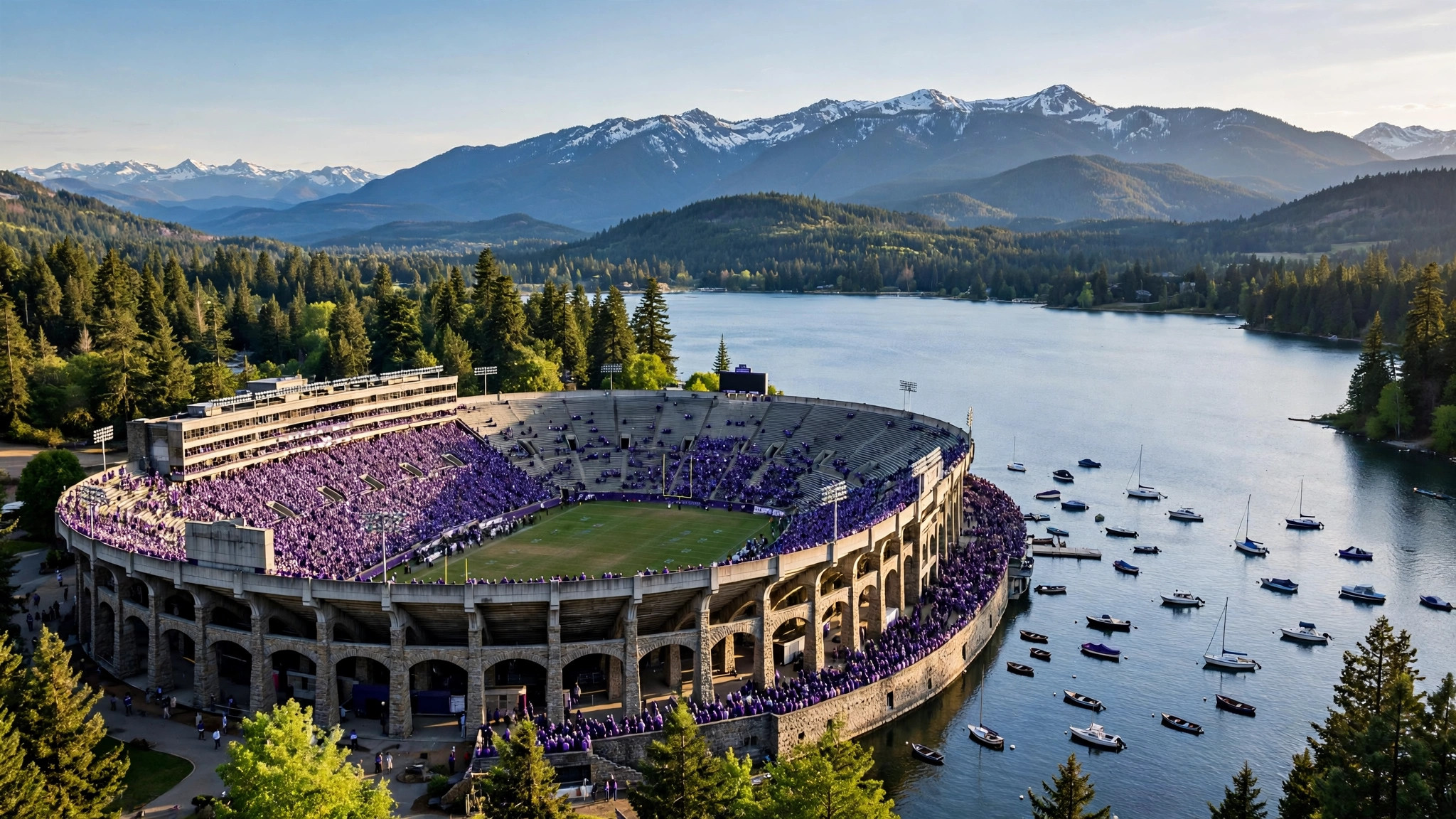
It is the only stadium in America where the tailgate has a harbor master. Husky Stadium, home of the Washington Huskies since 1920, sits on the shore of Lake Washington with the Cascade Range for a backdrop, a flotilla for a parking lot and a century of football in its bones. This guide is the complete visitor’s companion: the stadium’s history, the 2013 rebuild that made it modern, a seating tour section by section, tickets, parking and sailgating, how to get there, and the game-day tips that turn a first visit into a permanent habit.
If you attend one road game in the Big Ten’s new geography, make it this one. Here is how to do it properly.
Husky Stadium: A Century on the Lake
Husky Stadium opened on November 27, 1920, with a game against Dartmouth, built into the hillside above Union Bay at a cost the university of that era considered daring. The original horseshoe — open at the east end, facing the lake and the mountains — established the site’s genius immediately: the view was the architecture. Through the Don James era the stadium grew upper decks and a fearsome reputation; a 1992 night game against Nebraska produced crowd noise readings that are still cited among the loudest ever recorded in a college venue, the sound trapped and amplified by the steel roofs over both sides.
By the 2000s the building was beloved and obsolete at once — a running track still circled the field, a relic of its multi-use youth, pushing the front rows far from the action. The university’s answer was the defining project of the program’s modern era: a $280 million rebuild, completed in 2013, that demolished and reconstructed the lower bowl and south stands, removed the track, pulled the seats tight to the field and wrapped the whole in modern amenities — while keeping, deliberately and exactly, the lake at the open end.
The result is a stadium of about 70,000 seats that feels both new and hundred years old, which is a fair description of the program it houses.
The 2013 Rebuild: What Changed and What It Kept
The rebuild’s decisions reward study. The track went first — its removal brought the front row roughly forty feet closer to the field and changed the building’s acoustics forever; the current Husky Stadium is startlingly loud for an open-air venue, the cantilevered roofs over both grandstands holding the sound in. The south side gained premium seating, suites and the stadium’s modern press and operations core. The west end received the football program’s office and training complex, putting the team’s daily home inside its Saturday one.
What the architects refused to touch matters as much: the open east end and its view, the horseshoe’s basic geometry, and the site’s relationship to the water. New stadiums elsewhere chased novelty; this one edited a classic. Visitors who knew the old building recognize the same stadium in better clothes, and first-timers simply see the best setting in the sport with the amenities of a modern arena — the combination that makes Husky Stadium the Big Ten’s western showpiece.
Seating Guide: Where to Sit
The stadium divides into distinct experiences, and choosing well is the whole game:
- West end zone: the premium heart — chair-back seats under the program complex, the best protection from weather, and the game’s most comfortable vantage.
- North and south grandstands: the classic sideline views; the south side carries the press box and the premium inventory, the north the shade as afternoons fade. The upper decks on both sides are steep, close and loud — the connoisseur’s choice for value.
- East end zone: the student section and the band, with the lake beyond the scoreboard — the loudest, youngest, most chaotic seats, and the ones inside the “greatest setting” photograph.
- Field-level rows: after the rebuild, genuinely close to the action — close enough that the east end’s openness means weather arrives uninvited. Dress accordingly.
There is no bad seat for the view of the setting itself; the lake and the Cascades attend every section equally. Choose by temperament: sideline height for tactics, the east end for atmosphere, the west for comfort.
Sailgating: The Tailgate With a Fleet
Sailgating is Husky Stadium’s signature institution and the reason this guide exists in a category of its own. On game days, hundreds of boats — yachts, cabin cruisers, kayaks and everything between — anchor in Union Bay beside the stadium, their occupants tailgating on deck before riding shuttle boats to the stadium docks. The tradition runs back generations and has no peer in the sport; the only comparable scene in American football is Tennessee’s Vol Navy, and the two fan bases argue the title like a trophy game.
Participating as a visitor takes planning: charter boats and crewed game-day packages operate from Seattle marinas, moorage near the stadium is allocated and sells out for major games, and the shuttle system runs on a schedule worth learning before kickoff rather than after. Even landlocked fans should walk the docks pregame — the flotilla is a floating block party, purple flags on every mast, and it explains the program’s culture faster than any museum: this is a fan base that arrives at football games by water because it can.
Getting There, Parking and the Light Rail
The single best decision a Husky Stadium visitor makes is not driving. The light rail’s University of Washington station sits at the stadium’s doorstep, connecting downtown Seattle and the airport corridor directly to the gates; on game days it runs full and festive and empties the neighborhood afterward with an efficiency no parking lot can match. Buses and rideshares serve the campus edges, and the surrounding Montlake neighborhood restricts parking with an enthusiasm visitors should respect rather than test.
Drivers who insist will find the university’s lots allocated largely to donors and season passes, with public inventory limited and priced accordingly — book through official channels the moment your game is chosen. Cyclists have dedicated parking near the stadium, a very Seattle sentence that is also true. However you come, come early: the Montlake Bridge and the ship canal crossings are the city’s bottlenecks, and the sailgating spectacle is worth the hour buffer by itself.
Game-Day Tips From the Regulars
A short field guide from the people who do this seven Saturdays a year:
- Check the marine layer. Seattle autumn mornings lie; the lake wind by the fourth quarter tells the truth. Layers, always.
- Sunset kickoffs are the premium product. If the schedule offers a 4 p.m. or 7 p.m. start, choose it — the light on the water is the stadium’s signature photograph.
- Walk the full bowl once. The concourse views change by section; the east end’s open vista and the west end’s city angle are different stadiums an hour apart.
- Stay for the band. The Husky Marching Band’s postgame and the alma mater close the day the right way.
Fans studying the sport’s great buildings alongside the game itself can compare dimensions and surfaces with our explainer on how big a football field is, plan the rest of a Seattle football weekend around our College Football 26 guide, and gear up with our football cleats buying guide if the trip includes a young player’s season back home.
Beyond Football: The Stadium’s Other Lives
A building this old collects second careers. Husky Stadium hosted events for the 1990 Goodwill Games, the international multi-sport festival held in Seattle that summer, and it has served for generations as the University of Washington’s grandest room — commencement ceremonies beneath the same roofs that hold football noise, with graduates on the field where the Huskies play. Concerts and community events have cycled through across the decades, each inheriting the setting that makes the address famous.
The stadium’s most quietly important role is as the campus’s front porch. Every tour for prospective students ends at its gates; every alumni weekend orbits it; the crew teams on the lake below and the hospital across the way complete a postcard the university prints on everything. Understanding Husky Stadium as infrastructure — not just a venue but the institution’s public square — explains why the 2013 rebuild was funded and fought for the way it was. Seattle was not renovating a football stadium. It was restoring a civic monument, and the standard of care shows in every retained sightline.
The Neighborhood: Montlake on Game Day
The stadium sits in Montlake, a leafy residential neighborhood that transforms seven Saturdays a year into the city’s largest gathering. Houseboats crowd the ship canal, yard parties spill toward the bridge, and the cut between Lake Union and Lake Washington — a short walk from the gates — gives the whole district the feeling of a harbor town on festival day. Residents who are not fans have made their peace with the calendar the way New Orleans makes peace with Mardi Gras: it is the price of living somewhere people dream about, collected in traffic and repaid in identity.
For visitors, the neighborhood is the pregame. Walk it before you enter the bowl: the docks, the bridge, the campus’s Gothic spires rising behind the stadium to the west. The setting the broadcasts describe is not a backdrop applied to a stadium; it is a place, continuous and lived in, and the football is its loudest tenant rather than its only one.
Tickets and Official Information
Tickets move through the school’s official channels, with the Oregon game and the heavyweight Big Ten visitors the season’s fastest sells, and verified resale handling the remainder — buy early for November dates, when the stadium’s cold-weather reputation and the standings converge. Suite, club and group inventory runs through the same official offices.
For seating charts in interactive form, parking allocations, sailgating registration and the confirmed schedule, the program’s official home is Washington Huskies athletics. Husky Stadium has been hosting football beside that lake for more than a century, and the rebuild bought it another one. Go once, by boat if you can — and expect to spend the drive home planning the next visit.
One closing note for the first-timer: the stadium’s reputation can make it sound like a museum, a place to be admired quietly. It is not. It is a working Big Ten fortress that happens to sit inside a postcard, and on a November night with a ranked visitor in the building, the roar off the water makes the same argument the 1992 crowd made — that beauty and menace are not opposites here. They are the same address. Bring layers, arrive by rail or by water, and give the place a full day. It has been earning that investment since 1920.
