

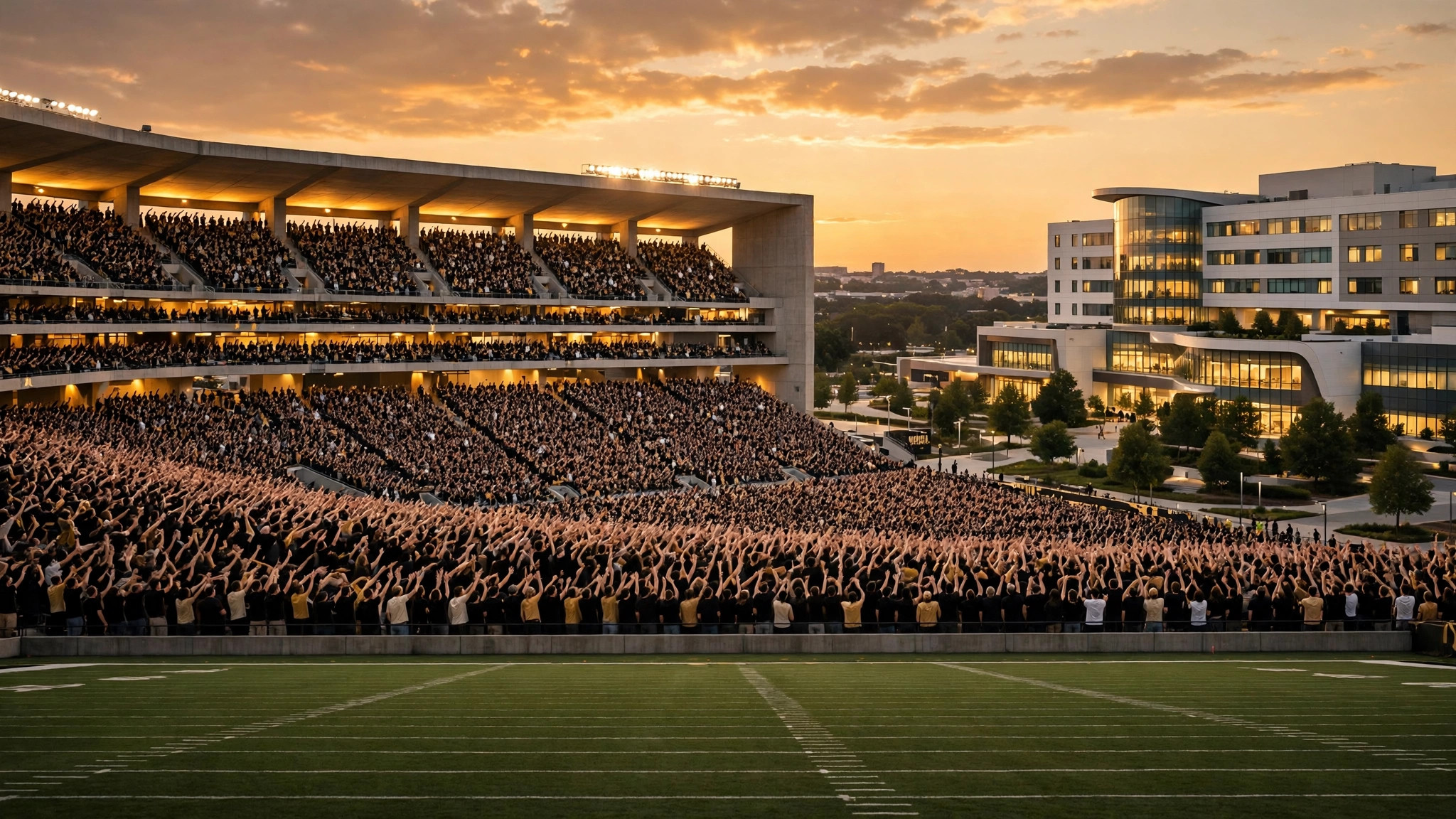
There is a stadium in Iowa City where, at the end of the first quarter, seventy thousand people turn away from the football game and wave at a hospital. That single gesture — famous now around the world — explains Iowa football better than any statistic: a program built on toughness and defense, in a community that treats the team as family, playing a brand of football that has been recognizably itself for more than four decades. This guide covers the full Hawkeyes landscape: the Ferentz era, Kinnick Stadium and the Wave, the roster-building philosophy, the rivalries, the schedule’s shape, tickets and how to watch.
Whether you are a lifelong Hawkeye, a parent of a future patient waving back, or a curious visitor, start here.
Iowa Football: The Program at a Glance
Iowa football plays in the Big Ten Conference and calls Kinnick Stadium home. The stadium, opened in 1929, is named for Nile Kinnick, the Hawkeyes’ 1939 Heisman Trophy winner who was killed serving as a naval aviator in the Second World War — a namesake who still defines the program’s values of achievement and sacrifice more than eighty years later. The building holds just under 70,000 fans and sits beside the University of Iowa Hospitals and Clinics, a geography that produced the sport’s most beloved tradition.
The Hawkeyes wear black and gold and play under the Tiger Hawk logo, introduced by coach Hayden Fry in 1979 as part of his rebuild of the program’s identity. The modern history divides cleanly: the Fry era, which restored Iowa to national relevance across two decades, and the tenure of his former assistant Kirk Ferentz, who took over in 1999 and became the longest-serving head coach in the Football Bowl Subdivision — a stability almost unheard of in the modern sport.
Iowa Hawkeyes Football: The Ferentz Blueprint
Iowa Hawkeyes football under Kirk Ferentz is the sport’s most consistent argument for an unchanging identity. The formula: recruit and develop offensive linemen as well as any program in America, build the defense around discipline and tackling, treat special teams as a co-equal phase rather than an afterthought, and win the field-position war that decides Big Ten games in November.
The philosophy famously extends to the punt. Iowa’s devotion to the kicking game — elite punters, coverage units and the field-position math they create — became a national meme during the low-scoring 2023 season, when “punting is winning” stopped being a joke and started being a defensible strategy. The program’s Australian punter pipeline, headlined in recent years by Tory Taylor, turned the position into a genuine weapon and a point of statewide pride.
Critics call the style conservative; the record calls it durable. Ferentz’s teams have produced Rose Bowl and Orange Bowl seasons, division titles, a 12-0 regular season in 2015, and a pipeline of NFL tight ends and linemen that programs with flashier offenses openly envy. The blueprint’s real product is predictability of effort: an Iowa team almost never beats itself, and in a league of rock fights, that is a championship trait even in the years it produces ten wins instead of twelve.
Iowa Hawkeye Football: Roster Building and Tight End U
The Iowa Hawkeye football roster is assembled like the state itself: locally rooted, developmentally patient, and suspicious of shortcuts. Iowa recruits its region hard, finds undervalued athletes — the program’s history of converting high school quarterbacks and wrestlers into NFL linemen and linebackers is a genre of story unto itself — and redshirts and builds them in one of the nation’s most respected strength programs.
Nowhere is the model more famous than at tight end. Iowa’s claim to the “Tight End U” title rests on a production line that includes Dallas Clark, George Kittle, T.J. Hockenson and Noah Fant — players who arrived as recruits of varying acclaim and left as first-round talents and All-Pros. The position is the offense’s centerpiece by design: Iowa’s pro-style system asks its tight ends to block like linemen and run like receivers, which is precisely the job description the NFL keeps drafting.
The official roster, with its class years and hometowns, is maintained by the school, and it rewards an annual read: the third-year player who arrived as a two-star is this program’s favorite plot twist, and it happens often enough to be a system rather than a surprise. Compare the approach with a fellow developmental program in our Illinois football guide.
Kinnick Stadium and the Wave
Every guide to Iowa football must stop at the end of the first quarter. In 2017, the new Stead Family Children’s Hospital opened beside Kinnick Stadium, its top floors looking directly down into the bowl. A fan’s suggestion spread through the community that summer: when the first quarter ends, everyone should turn and wave to the kids watching from the windows. In the 2017 season opener, the crowd did. They have done it at every home game since.
The Wave is now the most imitated gesture in American sports — visiting fans join in, players and coaches from both teams turn and wave, and the children wave back with signs and lights. It has been honored nationally, copied by other stadiums and wept over by more broadcasters than will admit it. It is, simply, what this program and this place decided to be about, and it will outlive every player who ever participates in it.
The rest of game day holds its own: the Tiger Hawk at midfield, the swarm entrance, a crowd that understands defensive football deeply enough to cheer a punt unit’s coverage with genuine expertise. Visitors should arrive early enough to walk the hospital-side concourse and see the windows the whole stadium waves toward — context that makes the moment land as it should.
Hawkeye Football: Rivalries and the Trophy Case
Hawkeye football keeps its history in trophies. The Cy-Hawk Trophy goes to the winner of the annual Iowa State game, the state’s Super Bowl, which splits households, offices and marriages across Iowa every September. The Floyd of Rosedale — a bronze pig — rides on the Minnesota game, a rivalry trophy dating to a 1935 wager between governors. The Heartland Trophy, a brass bull, marks the Wisconsin series, the Big Ten’s most reliably physical afternoon. And the Heroes Trophy game against Nebraska closes the regular season the day after Thanksgiving.
The trophy case tells the program’s story honestly: Iowa measures itself against its neighbors first and the nation second, and its greatest seasons — 1985’s Rose Bowl run under Fry, 2015’s perfect regular season under Ferentz — are remembered as much for the trophies stacked along the way as for the final rankings.
Iowa Football Schedule: The Season’s Shape
The Hawkeyes play the Big Ten’s standard framework — nine conference games, three nonconference dates, the Cy-Hawk game fixed in September and the Nebraska finale fixed to Black Friday — but the schedule’s personality is set by its defense-first arithmetic. Iowa’s games are short on possessions by design, which makes every date a low-margin affair and the schedule’s swing games obvious: the road trips to the league’s physical fronts, and any week the offense must win a game the defense cannot.
Sports Iowa Football: Saturdays in a One-Sport State of Mind
Sports Iowa football culture deserves its own note, because Iowa is one of the few states where college football is unambiguously the main event. With no major-league professional teams inside its borders, the state’s sporting attention concentrates on its two FBS programs with an intensity most states split five ways. The result is a statewide football literacy that visitors notice immediately: farmers discuss Iowa’s two-deep at the co-op, the Cy-Hawk game moves real money and real moods, and Kinnick Stadium sells out for a product that proudly wins games 13-10.
The essentials of the Iowa football Saturday:
- Black and gold everywhere: the state’s dress code from Thursday onward in game weeks.
- A defense-literate crowd: fans who cheer third-down stops and punt coverage with a connoisseur’s ear.
- The Wave: the first-quarter pause that has made the stadium famous far beyond the sport.
- Trophy literacy: every rivalry trophy’s location and history, known by schoolchildren.
- November football as identity: cold, close and decided late — the way the state likes its autumns.
It is a culture built to sustain exactly the program Iowa runs: patient, physical and proud of it.
The Iowa Standard: What the Program Exports
Iowa’s influence on the sport travels in people. Hayden Fry’s coaching tree reshaped college football — his assistants included future head coaches at Oklahoma, Kansas State, Wisconsin and across the profession — and Ferentz, himself a Fry assistant, extended the line another generation, with former Iowa assistants and players now coaching throughout the Big Ten and the NFL. The league’s sidelines are, in a real sense, partly an Iowa City alumni association.
The player pipeline carries the same signature. Iowa sends offensive linemen and tight ends to the NFL with a regularity that makes scouts treat Kinnick Stadium as a showroom, and its defensive backs and linebackers follow close behind. The league’s personnel departments trust Iowa film because the program’s techniques translate: a Hawkeye lineman has played in a pro-style system against pro-style fronts, and a Hawkeye tight end has actually blocked. In a draft economy built on projection, Iowa sells certainty — the same product it sells its fans every Saturday.
That export economy loops back into the program’s present: recruits in the region grow up watching Hawkeyes play on Sundays, which keeps the developmental pitch credible, which restocks the roster that produces the next class of professionals. It is the quiet engine under the Ferentz era’s longevity, and it runs whether the scoreboard says 13-10 or 31-28.
Iowa Hawkeyes: Tickets and How to Watch
Kinnick Stadium tickets move through the school’s official channels, with the Iowa State and Nebraska home dates commanding the season’s highest demand; the state effectively shuts down for the Cy-Hawk game in whichever city hosts it. Television follows the Big Ten pattern — FOX, CBS, NBC, the Big Ten Network and Peacock — with kickoff times assigned six to twelve days out. For official news, tickets and the schedule as it is confirmed, the program’s home is Iowa Hawkeyes athletics.
Fans who appreciate this brand of football will find its cousins across our coverage — the developmental model in our Purdue football guide and the league context in our Maryland football breakdown. But the original is in Iowa City: black and gold, defense and field position, and a stadium that stops a football game to wave at a hospital. There is nothing else like it in the sport — and this guide is your way in, from the first tailgate to the last defensive stand of the season.
