

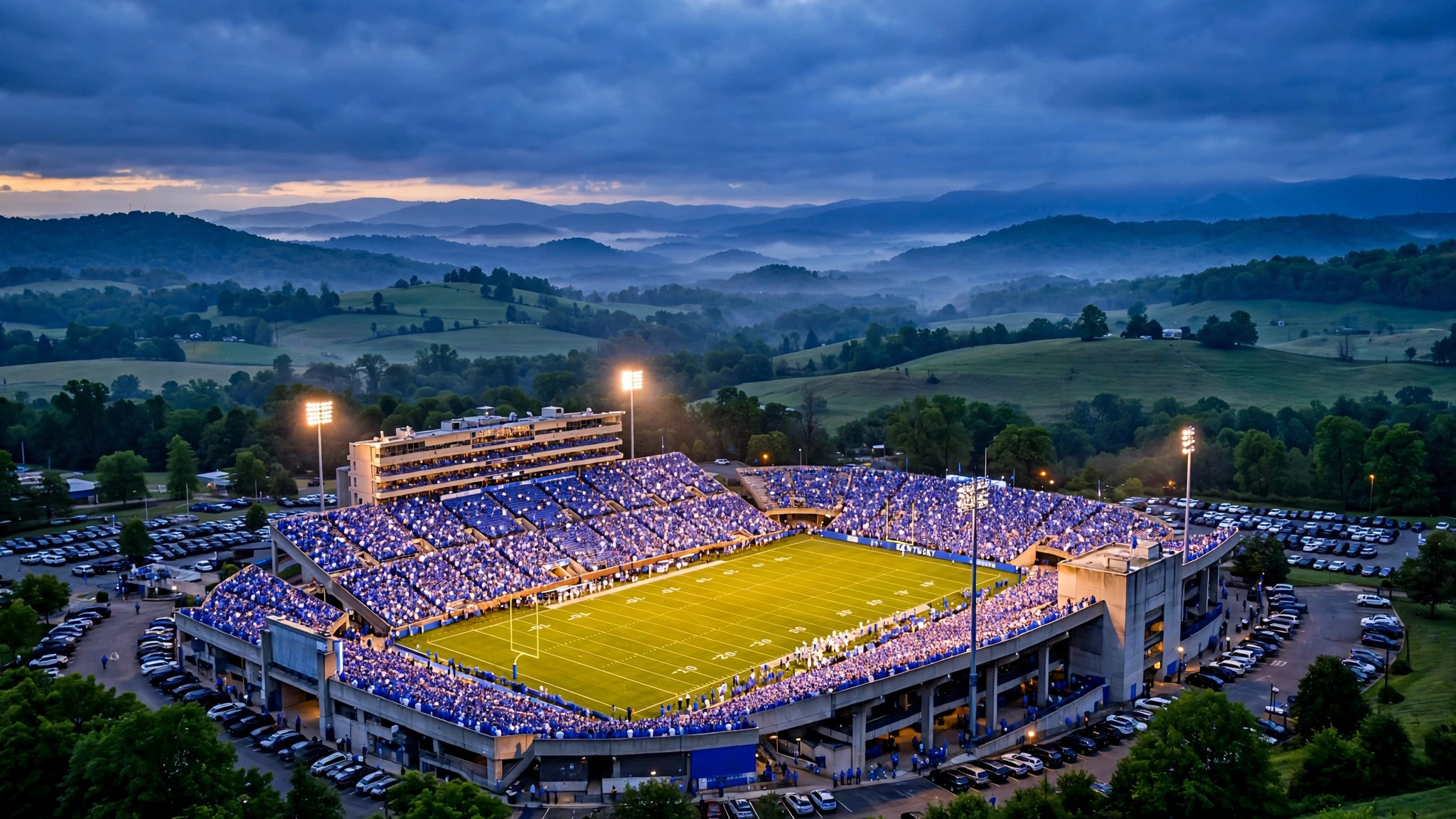
Kentucky football is college sports’ most interesting experiment: can a school whose identity is basketball build a football program that matters in the SEC? Under Mark Stoops, the Wildcats answered with a decade of steady competence — bowl streaks, two ten-win seasons, and a fan base that learned to expect November relevance. Now the program has handed the keys to Will Stein, a Louisville native and former Oregon offensive coordinator, and Kentucky football in 2026 has become one of the SEC’s surprise stories.
This guide covers the full picture: the new era, the schedule, Kroger Field, tickets, and the history that Big Blue Nation carries into every Saturday.
kentucky football
Kentucky football competes in the Southeastern Conference from Lexington, playing at Kroger Field — capacity 61,000 — in the heart of horse country. The program’s modern arc is the Stoops era: hired in 2013, Mark Stoops rebuilt a perennial underdog into a program that reached eight consecutive bowl games at its peak, won ten games in 2018 and 2021, and beat Penn State and Iowa in Citrus Bowls. When Stoops’ thirteen-year tenure ended after the 2025 season, he left as the longest-tenured coach in the SEC and the winningest in school history.
The Stein hire, announced December 1, 2025, made Kentucky’s coach the youngest in the SEC at 36 — a deliberate bet on offensive modernity. Stein directed one of the nation’s most explosive offenses as Oregon’s coordinator under Dan Lanning, and his pitch to Kentucky was simple: the program that Stoops made respectable, he would make dangerous.
uk football
UK football’s 2026 season opened as advertised: a 45-13 win over Youngstown State in Stein’s debut on September 5, followed immediately by the schedule’s first giant — Alabama at Kroger Field — in a September that told everyone in the league the Wildcats intended to be more than a spoiler. Stein’s offense, built on tempo and quarterback-friendly structure, suits a roster assembled quickly through the portal and a recruiting pitch that suddenly has proof of concept.
The structural challenge is permanent: Kentucky shares a conference with programs that outspend and out-recruit it, and its schedule, by ESPN’s FPI measures, ranks among the nation’s hardest in 2026 — seven of the Wildcats’ twelve opponents opened the season in the AP Top 25. UK football is not going to become a favorite’s story. It is becoming something arguably more interesting: an underdog with a system, a young coach and a stadium that has started to believe. Compare the gauntlet with the LSU football schedule — Kentucky’s league offers no weekends off, and that is precisely the brand now.
ky football
KY football culture is Big Blue Nation culture, and it operates on a scale outsiders underestimate. Kentucky fans travel for football the way they travel for basketball — in numbers that fill visiting sections across the SEC — and Kroger Field’s atmosphere has professionalized alongside the program: sellouts for the big dates, a student section with genuine volume, and in 2026, spontaneous singalongs that have already become the season’s signature images in Lexington.
Game day in the Bluegrass has its own texture. Tailgating spreads across the lots around the stadium in horse-country style, the Cat Walk delivers the team through the crowd, and the whole production sits twenty minutes from the bourbon-and-bluegrass tourism trail that brings visitors to Lexington year-round. For a first-time fan, a Kentucky home Saturday is one of the SEC’s most accessible big-game experiences — major-conference football without the impossible ticket market. The official source for tickets and game-day information is Kentucky Wildcats athletics.
kentucky wildcats football
Kentucky Wildcats football owns more history than its reputation suggests. The program claims the 1950 national championship under a young head coach named Paul “Bear” Bryant, whose Wildcats beat Oklahoma in the Sugar Bowl to cap an 11-1 season — Bryant’s Kentucky tenure remains the program’s golden age, complete with an SEC title in 1950. The Wildcats added a shared SEC championship in 1976 and produced, across the decades, a line of NFL talent that includes quarterbacks and pass rushers who outshone the teams around them.
The modern foundations are Stoops’ two Citrus Bowl wins and the NFL development pipeline — Kentucky became a quiet factory for offensive linemen and edge defenders, a development identity Stein’s staff inherits and intends to keep. Programs in similar rebuild-with-a-system positions, like the one profiled in our Maryland football guide, show how long the climb takes; Kentucky’s advantage is that its climb already happened once, in living memory, and the fan base knows the route.
The Schedule and the SEC Gauntlet
Kentucky’s calendar follows the SEC’s new shape: a nine-game conference slate without divisions, nonconference dates in September and around the rivalry finale, and a closing Governor’s Cup meeting with Louisville — the in-state game that ends the regular season and, in 2026, features a ranked Cardinals team. The early portion doubles as a statement tour: Youngstown State, Alabama at home, then Texas A&M on the road in the season’s first three weeks, a stretch that graded the Stein experiment publicly and early.
Fans should read the schedule in tiers. The home dates at Kroger Field are where bowl eligibility is built; the road trips to the league’s giants are where the program’s ceiling gets measured; and the Louisville game is its own season within the season, the one result Big Blue Nation refuses to lose. Television assignments across ESPN, ABC and the SEC Network follow the league’s staged announcements through the fall.
Roster, Recruiting and the Stein System
The Stein era’s roster logic mirrors its offensive logic: speed and fit over stars. The staff has recruited Kentucky and the Ohio Valley with renewed priority — Stein is a Louisville native who played quarterback at Louisville, a biography that makes him an unlikely but potent recruiter in a border-state footprint — while using the portal to patch the lines, the positions where Kentucky’s development tradition is strongest.
What to watch on the field: an offense that plays with tempo and throws to set up the run, a defense under a veteran coordinator hired to keep the Stoops-era toughness, and special teams treated as a scoring unit. The model’s promise is that system plus development beats recruiting rankings over a season. Kentucky fans have heard versions of that promise before; the difference in 2026 is that the early evidence — a 7-1 start that tied the best in school history through eight games, per the record books reaching back to 1909 — arrived ahead of schedule.
Tickets, Kroger Field and How to Watch
Kroger Field’s 61,000 seats make Kentucky one of the SEC’s more attainable live experiences, though the 2026 surge has tightened the market: Alabama and Louisville dates are premium, and the season-ticket base has grown with the program’s profile. Game-day logistics run through the official athletics site, from parking to the Cat Walk timing.
On television, Kentucky games distribute across ABC, ESPN, ESPN2 and the SEC Network, with kickoff times set in the league’s twelve-day windows — the same staged pattern fans follow on the Auburn football schedule. Radio coverage across the UK Sports Network remains the state’s common language on Saturdays.
What Big Blue Nation Wants Next: A Checklist
Strip the season down and Kentucky’s ambitions for the Stein era fit on a short list:
- Beat Louisville every year. The Governor’s Cup is the state’s championship, and it is non-negotiable in Lexington.
- Protect Kroger Field. The Stoops era was built on making Lexington a miserable road trip; the Stein era must keep the fortress while adding the fireworks.
- Win a January-stage bowl. The Citrus Bowl wins set the modern bar; the next step is a New Year’s Six or playoff stage.
- Keep the NFL pipeline flowing. Kentucky’s development reputation is a recruiting asset that compounds annually.
- Make November matter. Contention in the season’s final month — not merely eligibility — is the difference between a good story and a program.
The list is deliberately unglamorous. Kentucky’s rise, in both of its modern versions, has been built on doing the achievable things relentlessly until the glamorous things came within reach. Stein’s twist is tempo: he is attempting in three years what his predecessor built in eight, and the early returns of the 2026 season — including a debut win, immediate national attention and a start that matched marks not seen in Lexington in over a century — say the acceleration is real. The SEC will test it weekly, in Tuscaloosa-grade road environments and ranked home dates alike. But a program that was a punchline in basketball season a generation ago now enters November with ambitions, and that transformation is the real story of Kentucky football.
The Rivalry That Ends the Season
One date deserves its own paragraph in any Kentucky season guide: Louisville, Thanksgiving weekend, the Governor’s Cup. For most of the modern era it was a September appetizer; as the regular-season finale it has become the Commonwealth’s championship game, and in 2026 it arrives with the Cardinals ranked and the Wildcats resurgent — the most anticipated edition in years. Stein, a Louisville native who once quarterbacked the Cardinals, coaching Kentucky against his alma mater in a ranked-versus-ranked finale is the kind of storyline the sport manufactures rarely and the state will talk about for a generation. Win it, and the season is a triumph whatever the bowl says. Lose it, and the winter is long in Lexington regardless of everything that came before. That is rivalry math, and Kentucky fans would not trade it for a softer ending.
And one more consideration for the road: Kentucky’s traveling support has become a storyline of its own in the Stein era’s first months, with away sections at conference stadiums filling in blue in numbers that opposing fans have started to remark on. A fan base that travels like a basketball crowd is discovering what its football Saturdays can be — and the players have said, in so many words, that they can hear it. Programs are built on quieter things than noise, but noise is not nothing; in the SEC, it is closer to a recruiting pitch with a marching band.
The Season Ahead
Kentucky football has spent a century as the SEC’s supporting actor. The Stein era is a declaration that the program wants a larger part — an offense with a national reputation, a coach young enough to grow with the job, and a fan base that has started singing in the fourth quarter like it means it. Whether 2026 ends in a breakthrough bowl or a reality-check November, the direction is set: Kentucky is done being the schedule’s soft spot. The Wildcats intend to be the problem on everyone else’s calendar — and for the first time in the program’s modern history, the rest of the SEC is treating a trip to Lexington accordingly.
