

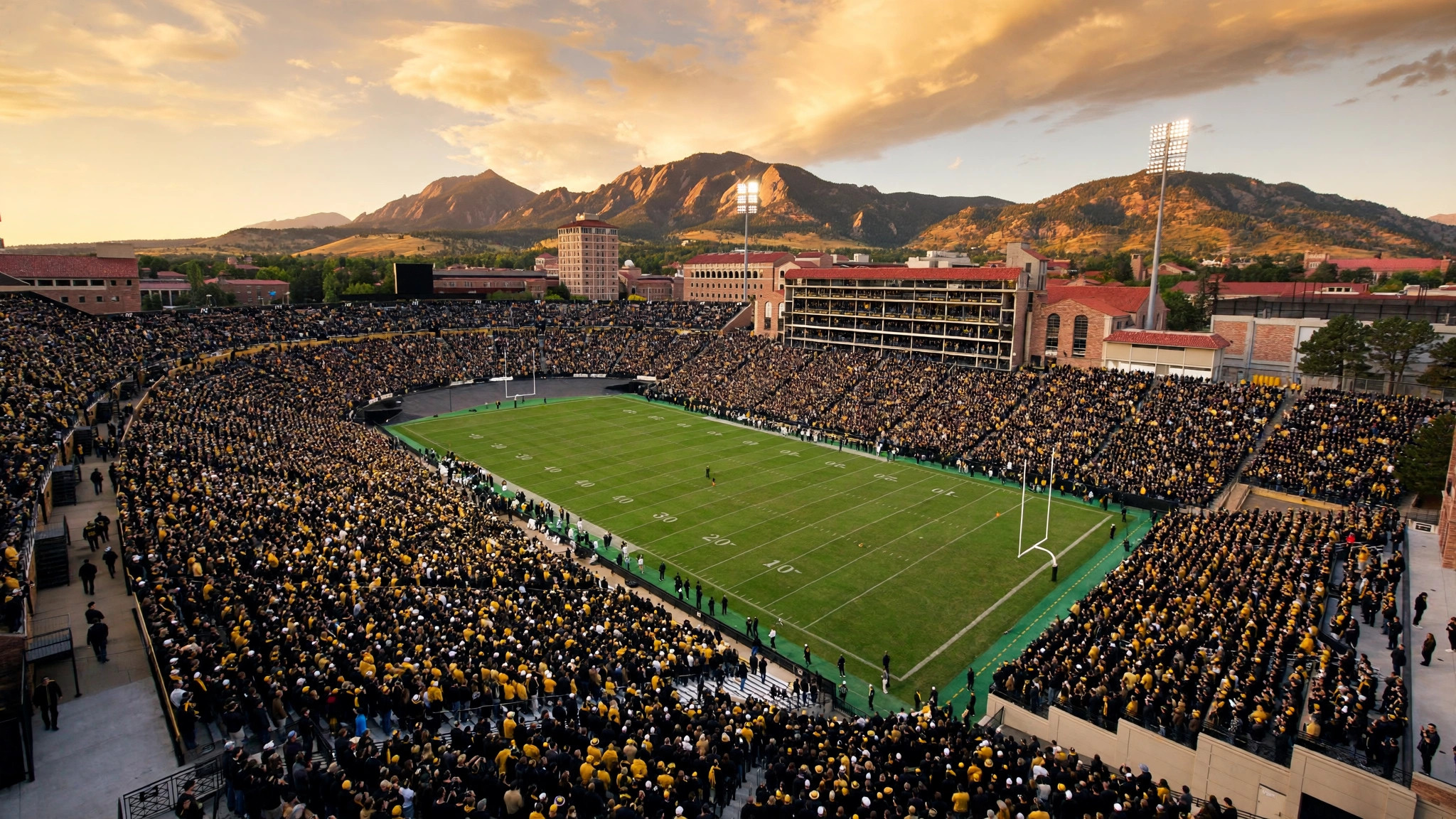
No program in America changed its national profile faster than Colorado football did when Deion Sanders arrived in Boulder in December 2022. A team that had gone 1-11 became the most televised, most debated and most imitated story in the sport — and then, in 2024, backed the noise with a 9-4 season and a Heisman Trophy. Colorado football is now something it had not been in a generation: a genuine national attraction with a Big 12 schedule, a sold-out stadium and a standard it has to defend every Saturday.
This guide is the full picture: the schedule and roster, the Coach Prime era, Folsom Field, tickets, and the history underneath the hype — from the 1990 national championship to the altitude that visiting teams still complain about on the flight home.
colorado buffaloes football
Colorado Buffaloes football is the flagship program of the University of Colorado Boulder, competing in the Big 12 Conference since returning to the league in 2024. The Buffaloes’ identity has always been a little different: a mountain school with a live buffalo mascot, a stadium tucked against the Flatirons, and a history of punching above its weight against the sport’s blue bloods.
The program’s peak is undisputed. The 1990 team, coached by Bill McCartney, won a share of the national championship, beating Notre Dame in the Orange Bowl to finish an era that included a perfect storm of option football, altitude and attitude. Running back Rashaan Salaam won the Heisman Trophy in 1994, and the Buffs spent the decade as a fixture in the national conversation. The Sanders era is best understood as an attempt — loud, deliberate and largely successful — to restore that status rather than invent it.
cu football
CU football in the Sanders era runs on a model the sport had not seen before: a Hall of Fame head coach who recruits through celebrity and the transfer portal simultaneously, turning over rosters at a pace that would have been impossible a decade ago. The 2023 season proved the attention was real — record television audiences and a sold-out spring game — while 2024 proved the football was real, with nine wins and Travis Hunter’s Heisman season playing both ways at a level not seen in the modern era.
The honest summary of CU football now is that the floor has moved. Colorado is expected to be competitive in the Big 12 every year, to develop NFL talent visibly — Hunter and Shedeur Sanders both headlined the program’s draft presence — and to treat every home game as an event. The next phase of the project, replacing generational stars with sustainable depth, is the test the whole sport is watching.
colorado buffaloes
The Colorado Buffaloes name carries a menagerie of tradition. Ralphie, the live buffalo who leads the team onto the field, is one of college football’s great entrances — a full-speed buffalo charge around a stadium more than 5,000 feet above sea level, handled by a team of student runners. The black and gold colors, the interlocking CU, and the Flatirons backdrop make a Colorado home game instantly recognizable on television, which is part of why networks keep choosing it.
Rivalries anchor the Buffaloes’ emotional calendar. The Nebraska series, renewed in recent seasons after a decade’s pause, remains the most heated — a border war from the old Big Eight and Big 12 days. Colorado State supplies the in-state Rocky Mountain Showdown, and Utah, now a conference mate again, provides the Rumble in the Rockies. Fans of other western programs will recognize the same regional-web feeling in our Arizona football guide — programs defined as much by geography as by standings.
cu buffs football
What does CU Buffs football actually look like on the field? The Sanders teams have been built on speed and skill talent: explosive receivers, a passing game that stresses defenses horizontally and vertically, and defensive backs coached by a man who played the position at the highest level in history. The line play — the quiet question of the era — has improved year over year as the recruiting has deepened, because every Big 12 Saturday is ultimately decided in the trenches.
The system asks a lot of its quarterback: quick decisions, deep shots, and the composure to operate in games that draw circus-level attention. It asks even more of its defense, which plays more snaps than most because of the offense’s tempo. Fans evaluating a Colorado season should watch the rushing defense and the offensive line’s sack numbers first — those two lines have predicted the Buffs’ results more reliably than any highlight reel.
buffs football
Buffs football Saturdays in Boulder follow a script unlike anywhere else. Folsom Field, opened in 1924 and holding more than 50,000 fans, sits in the middle of campus with the Flatirons rising behind the south stands — routinely called one of the most beautiful settings in the sport. The elevation is real, the sun is relentless, and visiting teams feel both by the fourth quarter.
The game-day cast includes Ralphie’s run, a student section that has grown teeth in the Sanders era, and a celebrity row that television cameras cannot resist. But longtime fans will tell you the core experience has not changed: it is a mountain town that shuts down for its team, in a stadium where the Buffs have beaten giants in every era of the program’s history. For practical planning — tickets, parking, the works — the official home of the program is Colorado Buffaloes athletics.
university of colorado football
University of Colorado football sits inside one of the great public-university settings in America, and the program’s economics reflect it. Conference realignment carried the Buffaloes from the Big 12 to the Pac-12 in 2011 and back to the Big 12 in 2024, a round trip that says everything about the modern sport — and the return has been the making of the current era, restoring old rivalries and regional logic to the schedule.
Academically and athletically, the program recruits nationally in a way it rarely could before: the Sanders effect opened doors in Florida, Texas and Georgia that the Buffaloes now walk through every cycle. Facilities have followed the ambition, with the indoor practice facility and Champions Center giving the program infrastructure that matches its television profile.
cu buffs
Ask what defines the CU Buffs as a fan culture and the answer is resilience with style. This fan base endured the long post-McCartney wander — coaching changes, conference moves, a 1-11 season — and then embraced the loudest rebuild in the sport without blinking. The black and gold travel now: Buffs fans have turned road stadiums into television stories of their own, and Boulder’s visiting-fan experience has become a destination trip for opposing supporters too.
The culture exports well because it is visual: the colors, the mountains, the buffalo, the celebrity sheen. But the locals will correct you on the hierarchy of things — the football is the point, the scene is the bonus. Programs that build destination fan cultures, like the one in our Montana State football guide, share that same foundation: place first, spectacle second.
Game Day in Boulder: The Essentials
For fans making the trip, a Colorado home Saturday runs best on a simple checklist:
- Arrive Friday if you can. Boulder rewards a full weekend — Pearl Street, the Flatirons trails and a fan base that starts its tailgate planning early.
- Respect the altitude. The stadium sits more than a mile high; hydrate before you arrive, and give visiting-team friends the same advice you would want in the fourth quarter.
- Do not miss Ralphie. The buffalo’s run happens before kickoff, and it is not a repeat performance — be in your seat early.
- Plan the exit. Campus empties onto a small street grid; the patient fans eat in Boulder and let the traffic clear.
The checklist is simple because the setting does the heavy lifting. Few stadiums in America ask so little of their fans and give back so much scenery in return.
Roster, Recruiting and the Road Ahead
The roster question for Colorado is permanent by design. Sanders has built through the portal more aggressively than any peer, which means every December and January is effectively a free-agency season in Boulder. The staff’s evaluation hit rate — finding Hunter at Jackson State, building an offensive line from five different schools — is the program’s real competitive advantage, and its sustainability is the debate that follows the Buffs everywhere.
What is not debated: the standard. Nine wins and a Heisman set a bar that the fan base now treats as the expectation rather than the ceiling. The Big 12 offers no hiding places — the league’s depth punishes thin rosters in November — so the Buffs’ path runs through the trenches, the training room and the second weekend of November as much as through any September spotlight game.
There is also the matter of what Colorado means to the sport’s future. The program under Sanders is the loudest test case for the portal era, the NIL era and the celebrity-coach era all running at once. Other athletic directors study Boulder the way businesses study a disruptive competitor — some with admiration, some with alarm, most with a notebook. If the model produces a conference championship, it will be copied everywhere within two recruiting cycles. If it stalls, it will be taught as a cautionary tale. Either way, Colorado football is the experiment the entire sport is watching, from a stadium in the mountains that suddenly sits at the center of the college football map.
And a note for the skeptics who treat the Colorado phenomenon as a television show that happens to field a football team: television shows do not beat ranked conference opponents on the road in November. The Buffs have flaws the whole country can recite, but they also have a roster full of players other programs wanted, a coach whose eye for talent is a documented skill, and a home-field advantage built into the geography. The longer the experiment runs, the more it looks like a program.
How to Watch and Follow
Colorado’s television profile remains outsized: the Buffs are a ratings draw, and the Big 12’s partners — ESPN, ABC, FOX and FS1, with ESPN+ streaming windows — place them in featured slots accordingly. Kickoff times follow the conference’s staged announcements, and Boulder’s mountain time zone means Buffs fans on the coasts should double-check every start time twice; a “night game” in Boulder is a late night in the East.
However you follow — in Folsom Field’s thin air, on a national broadcast, or through the program’s enormous social footprint — Colorado football has become unavoidable, which is precisely what its coach promised. The Buffs demanded the sport’s attention. Now they have to keep earning it, one Big 12 Saturday at a time, in the prettiest stadium in America. Fans mapping the wider western slate around Colorado’s season can pair this guide with our Navy football history for the service-academy side of the sport’s traditions.
