

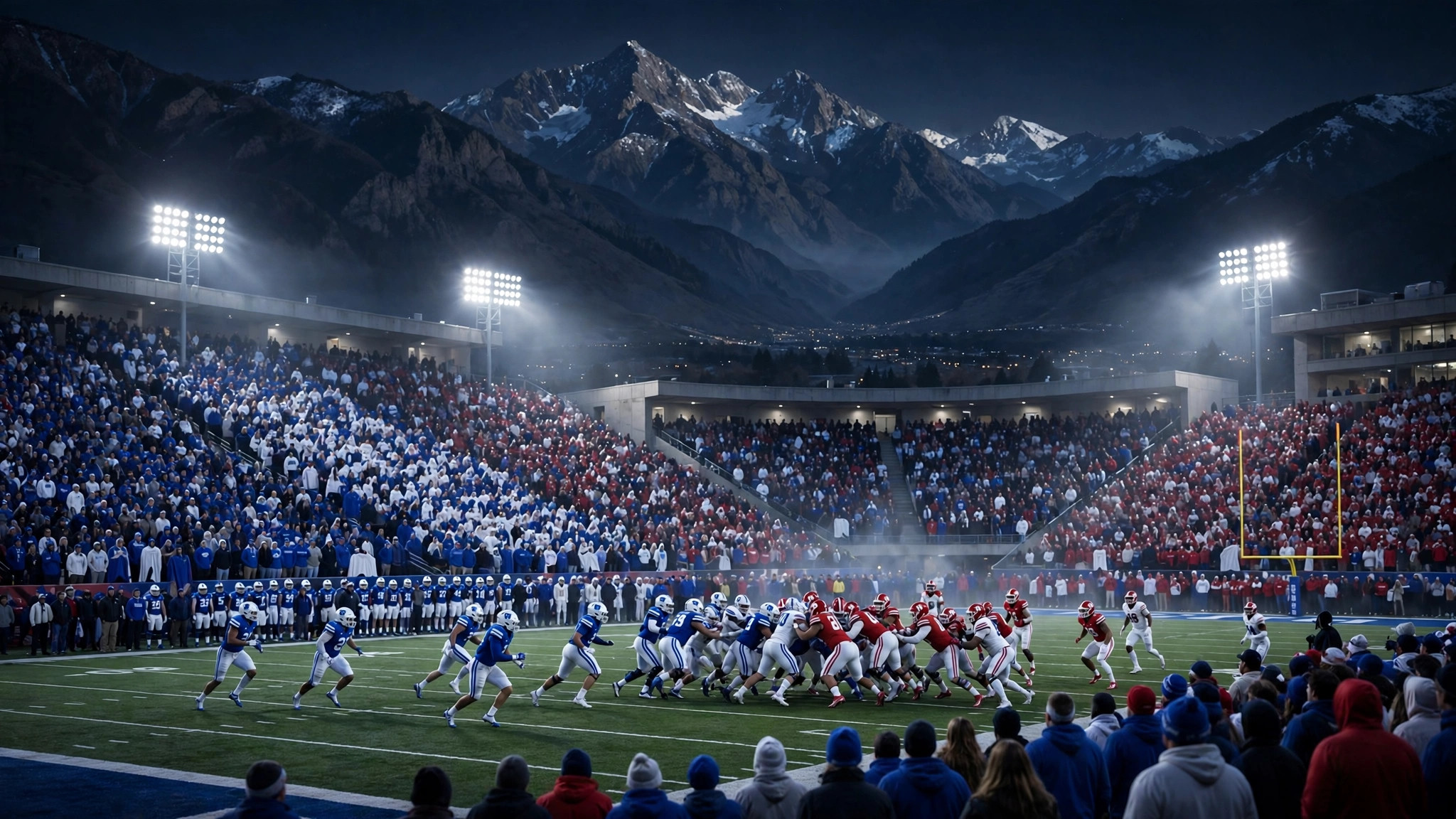
There are rivalries, and then there is BYU vs Utah — the Holy War, a game so woven into its state’s identity that the two schools cannot even agree on when it started. Utah counts a first meeting in 1896; BYU counts 1922. They have been arguing ever since, through more than a hundred games, conference realignments, and a century of Saturday afternoons that split families, wards, workplaces and the state itself into red and blue.
This guide covers the whole feud: the disputed origins, the head-to-head record, the games that defined it, the trophy, and everything a fan needs for the next meeting — already set for November 7, 2026, with BYU riding a three-game winning streak after the 24-21 classic in Provo in October 2025.
byu vs utah
The first thing to understand about BYU vs Utah is that it was never just a football game. The University of Utah is the state’s flagship public school; Brigham Young University is owned by The Church of Jesus Christ of Latter-day Saints. The rivalry carries a cultural charge — public against private, secular against faith-owned — that most college feuds cannot replicate, and the nickname “Holy War” has attached to it for generations.
On the field, the game’s modern shape came from two coaching eras. LaVell Edwards turned BYU into a passing-game pioneer and national champion in 1984, while Utah built its counter-identity on defense and toughness, a contrast that still describes the matchup: BYU’s offensive artistry against Utah’s trench physicality. Since 2023 the game has carried conference stakes again, with both schools in the Big 12 — the first time the rivalry has lived inside one league since their Mountain West days ended in 2010.
The atmosphere is its own argument. The two campuses sit about 45 miles apart, close enough that both fan bases attend both stadiums in force, and the noise when the visiting section answers the home crowd is unlike anything else in the West. Rivalry guides for other programs — our Navy football history among them — describe service-academy pageantry; the Holy War offers something rawer, a state’s whole sporting identity compressed into one Saturday.
utah vs byu
Flip the fixture — Utah vs BYU, in Salt Lake City — and the game changes flavor without losing heat. At Rice-Eccles Stadium, Utah’s MUSS student section drives one of the loudest environments in the Big 12, and the Utes have historically defended their home field in this series with particular pride.
Utah still leads the all-time series — by Utah’s accounting, 62-37-4 across 103 meetings; by BYU’s count, 59-34-4 in 97 — and for long stretches the Utes owned the modern era. Utah won nine straight from 2010 through 2019, a decade of dominance that included heartbreakers BYU fans still describe by year alone. The tide turned in 2021, when BYU’s 26-17 win in Provo snapped the streak, and the Cougars have now won three in a row: 2021, the 22-21 escape in Salt Lake City in 2024 — decided by a field goal in the final seconds — and the 24-21 win in 2025.
That recent run matters for the next Utah vs BYU meeting, because streaks in this series tend to come in waves: nine straight for Utah in the 2010s, nine straight for BYU from 1979 to 1987, and Utah’s 21-game unbeaten run in the rivalry’s early decades. Whoever wins in 2026 is not just winning a game; they are arguing that the wave is theirs.
byu utah game
The most recent BYU Utah game, on October 18, 2025, belongs on the rivalry’s top shelf. No. 15 BYU hosted No. 23 Utah at LaVell Edwards Stadium with both teams ranked — a top-25 Holy War — and delivered a 24-21 thriller that swung on a true freshman. BYU quarterback Bear Bachmeier threw a 17-yard touchdown to Chase Roberts, ran for 64 yards, and scored the game-winner on a 22-yard run with 4:22 remaining in a fourth quarter that saw the lead change hands repeatedly.
The supporting numbers describe a classic: Utah outgained BYU 470-368 behind Devon Dampier’s 244 passing yards and two touchdowns and Daniel Bray’s 121 rushing yards, but the Cougars committed zero turnovers to Utah’s two, got 122 rushing yards from LJ Martin, and closed the game with late defensive stops, including a Tanner Wall interception. BYU improved to 7-0; Utah fell to 5-2; and the Cougars’ third straight rivalry win — their longest run in the series since 1989-92 — reset the feud’s balance of power.
Ask either fan base to rank the great BYU Utah games and the same nights surface:
- 1980: BYU’s 56-6 win, still the largest margin in series history.
- 2006: BYU’s last-play touchdown — the “Harline’s still open” game — a 33-31 classic in Salt Lake City.
- 2024: BYU 22, Utah 21, won on a field goal in the final seconds after a controversial late flag kept the drive alive.
- 2025: the Bachmeier game, 24-21, a freshman announcing himself in the rivalry’s biggest spotlight.
football byu vs utah
Strip away the folklore and football BYU vs Utah is a study in contrasting program-building. BYU develops quarterbacks like a factory — the lineage from the Edwards era through Ty Detmer’s 1990 Heisman Trophy to the modern Big 12 starters — and builds its identity around offensive execution and remarkable home consistency. Utah, under its long modern run of defensive-minded coaching, builds from the defensive line outward, wins the field-position battle, and treats special teams as a weapon rather than a formality.
The trophy that formalizes the feud within the state is the Beehive Boot, contested among Utah’s FBS programs, and the Holy War winner usually takes it with them. But the game’s real prize is simpler: twelve months of bragging rights in a state where the loser hears about it at work, at church and at Thanksgiving. Few rivalries anywhere ask fans to live this close to the enemy, and none in the Big 12 carries the same everyday stakes — one reason neutral fans have adopted the game as a must-watch, the way they plan around the windows in our where to watch Ohio State vs Indiana guide.
The Games That Built the Legend
Beyond the scorelines, the Holy War’s mythology was written in specific autumns. The Edwards era produced the rivalry’s great offensive showcases, including BYU’s 56-6 win in 1980 — still the largest margin in the series — during the run that made the Cougars the West’s glamour program. Utah’s answer came in waves of defensive classics and, in the BCS era, its own national statements, including the undefeated seasons that carried the Utes to major bowl wins and reset what the state’s fans believed was possible.
Two modern games deserve their own paragraphs in any rivalry history. The 2006 meeting in Salt Lake City ended 33-31 on the final play, BYU’s Jonny Harline catching the winner while falling to his knees — “Harline’s still open” remains the most quoted sentence in the feud’s vocabulary. And the 2004 game, a 52-21 Utah win that completed an undefeated regular season, announced Utah’s arrival as a national program and still stands as the high-water mark of Utes dominance in the series’ modern chapter.
The streaks tell the feud’s other truth: dominance here is always rented, never owned. Utah’s nine straight wins from 2010 to 2019 felt permanent right up until BYU ended them; BYU’s current three-game run feels permanent to its fans for exactly the same reason, and the 2026 meeting exists to test it. That rhythm — long runs, sudden reversals, and a century of accumulated grievance — is what separates the Holy War from ordinary conference fixtures and puts it on the short list of rivalries every college football fan should experience in person at least once, ideally in both stadiums.
Holy War Game Day: A Fan’s Practical Guide
Attending the Holy War is a bucket-list item with logistics attached. Tickets in both stadiums move through season-ticket bases first, and what reaches public sale disappears quickly; visiting-fan allotments are small and sit in the sections where the noise rains down hardest. Book lodging early in whichever valley hosts — Provo and Salt Lake City both fill on rivalry weekend — and expect traffic on the I-15 corridor between them to move at kickoff-weekend speed, which is to say slowly.
Inside the stadium, the etiquette is its own tradition: the taunting is relentless and almost entirely good-natured, the student sections trade chants that have been refined over decades, and the postgame scene — one fan base celebrating in the other’s building — is managed with a sportsmanship both schools genuinely pride themselves on. First-timers should arrive early enough for the pregame rituals: the bands, the warmups within heckling distance, and the moment the visiting team takes the field to a wall of noise that reminds everyone exactly what this game is.
If you attend one rivalry game in the West, make it this one — and if you can only watch from home, clear the evening anyway. The Holy War has a century-long habit of producing the game of the weekend, and its next edition arrives with both programs ranked in the national conversation more often than not. November 7, 2026 is already circled on two calendars that agree about nothing else.
The Next Meeting: November 7, 2026
The next chapter is already dated: BYU and Utah meet again on November 7, 2026, in the heart of the Big 12 race, with the rivalry’s streak question hanging over the whole season. Utah will spend a year preparing to end a three-game skid; BYU will spend it defending a run of wins that has re-energized its claim to the state.
Expect the standard Holy War broadcast treatment — a national television window on the Big 12’s partner networks, with kickoff time set in the usual staged announcements — and the standard ticket reality: this game sells out in both stadiums, and the secondary market prices it like a conference championship. Fans planning to attend should watch the official athletics channels, starting with BYU Cougars athletics, the moment single-game sales open.
However it lands, BYU vs Utah will remain what it has been for more than a century: the game that divides a state for a day and defines it for a year. The schools cannot agree on when the feud began, who leads it by how much, or whose stadium is louder. They agree on the only thing that matters — that on the first Saturday it is played, nothing else in Utah comes close. If you are new to the rivalry, start with the next meeting on November 7, 2026, and work backward through the classics. The argument, like the series itself, is nowhere near finished — and fans planning their fall around it can map the whole season with our Hawaii football guide’s approach to building a year around one program’s biggest dates.
