

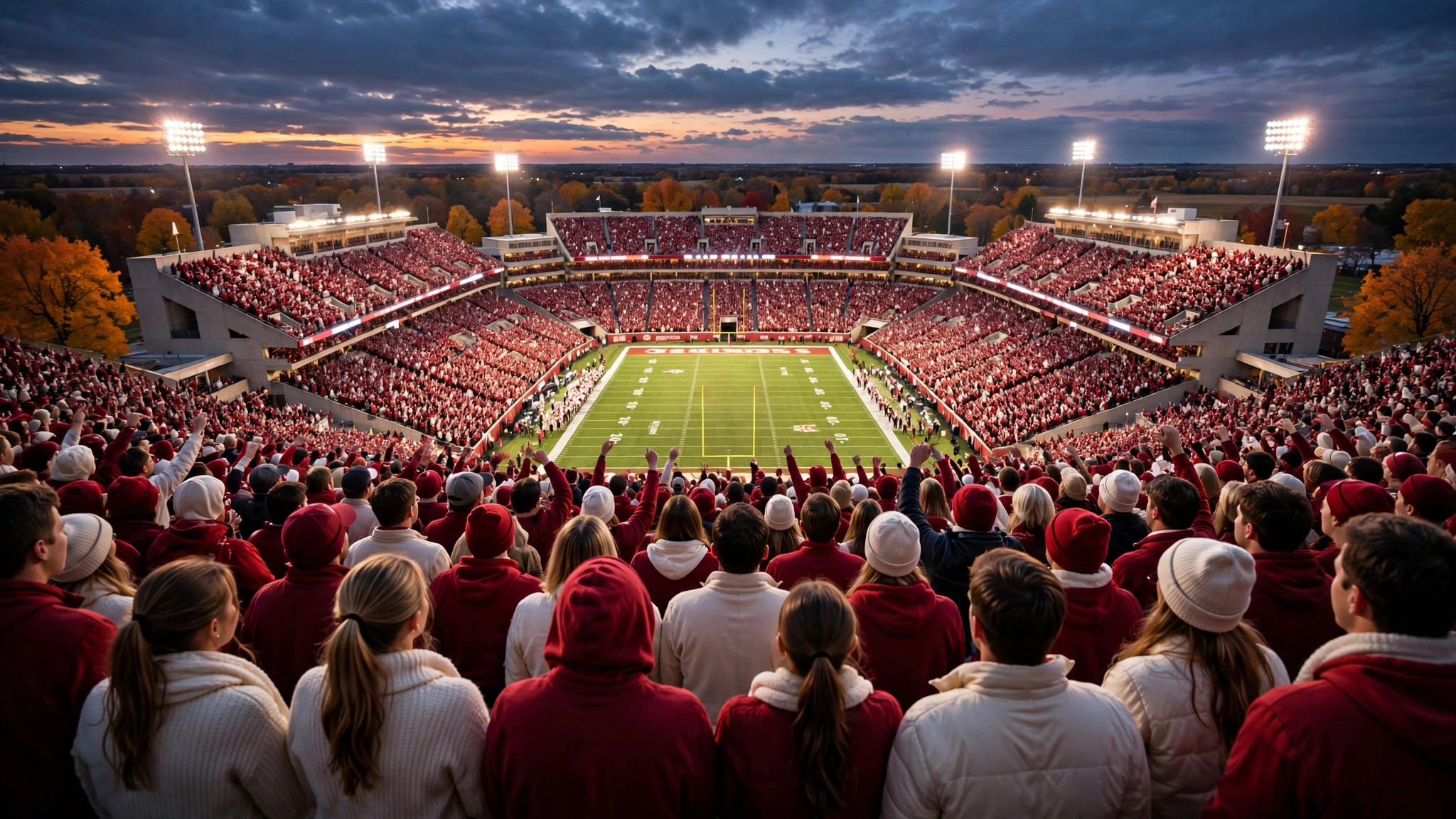
No program in college football has rewritten its story the way Indiana football has in the last two seasons. For most of its history, Indiana was the answer to a trivia question no fan wanted: the program with more losses than any other in the top division of the sport. Then Curt Cignetti arrived in Bloomington, and within two years the Hoosiers were Big Ten champions, owners of a perfect 16-0 season, and holders of the school’s first national championship.
This guide pulls the whole picture together. It explains how Indiana football got here, how the team plays, what game day at Memorial Stadium looks like, which rivalries matter, and how to follow the schedule, buy tickets and watch the Hoosiers wherever you are.
Indiana Football: The Program at a Glance
Indiana plays in the Big Ten Conference, the oldest and one of the most powerful leagues in college sports, and the Hoosiers’ home is Memorial Stadium in Bloomington, a venue the program has occupied since 1960. Indiana University is the flagship public university of the state, and its football team shares the campus spotlight with one of the most famous basketball programs in America — a balance that shaped the football program’s identity for decades.
That identity used to be simple: basketball school, football afterthought. The last two seasons demolished it. Indiana football now operates like a national power, with a veteran roster built through the transfer portal, a head coach who has won everywhere he has been, and a stadium that sells out to watch a defending champion. Everything in this guide flows from that transformation.
IU Football: From the Losingest Program to National Champions
To understand the scale of the turnaround, you have to sit with the history. IU football spent most of the twentieth and twenty-first centuries near the bottom of the Big Ten. Bowl trips were rare events worth celebrating on their own, winning seasons were news, and the Hoosiers carried the heaviest loss total in the history of the Football Bowl Subdivision into the 2024 season.
There were bright spots — the 1967 team that reached the Rose Bowl, bowl teams under Bill Mallory in the late 1980s and early 1990s, and a nine-win season in 2020 under Tom Allen — but sustained success never took root. Indiana would flash, then fade, while neighbors such as Ohio State, Michigan and Penn State stacked championships.
The change began when Indiana hired Curt Cignetti away from James Madison after the 2023 season. Cignetti had built winners at Indiana University of Pennsylvania, Elon and James Madison, and he brought much of his Dukes roster with him through the portal. The 2024 Hoosiers went 11-2 and reached the College Football Playoff. The 2025 Hoosiers did something no one in Bloomington had ever seen: they never lost.
Indiana Hoosiers Football: The Cignetti Turnaround
Curt Cignetti’s formula is not mysterious, which is part of why it travels so well. Indiana Hoosiers football under Cignetti is built on experienced players — the championship team’s starters averaged close to four years of college experience — relentless attention to detail, and a refusal to beat itself. The Hoosiers rarely lead the nation in penalties, turnovers or confusion, and that discipline compounds over a sixteen-game season.
The portal strategy matters, too. Rather than collecting the highest-rated names available, Indiana’s staff targets proven producers who fit specific roles, many of them players Cignetti and his assistants already know. The result is a roster that looks older and plays calmer than almost every opponent it faces, a decisive edge in November and December.
Recruiting has followed the wins. A program that once fought for three-star prospects in its own state now signs classes that reflect its new standing, and the staff’s pitch is easy: come play for a coach who has never had a losing season as a head coach, in a conference that puts its champion in the playoff.
The turnaround has also changed the campus around the team. Applications and merchandise sales spiked with the championship, Memorial Stadium weekends now drive Bloomington’s autumn economy, and football — for generations the warm-up act for basketball season — has become a co-headliner. University administrators who once apologized for the football budget now point to the program as the school’s loudest advertisement, a status that would have been unthinkable five years ago and that shows no sign of fading while Cignetti’s machine keeps producing double-digit wins.
Indiana University Football: Memorial Stadium and Game Day
Indiana University football is played at Memorial Stadium, on the north side of the Bloomington campus. Opened in 1960 and nicknamed “The Rock,” the stadium holds a little over 52,000 fans and has been expanded and modernized in stages, including the enclosed north end zone that houses training facilities and premium space.
For years, the honest description of a fall Saturday in Bloomington was that the tailgating outdrew the game. That era is over. The championship run turned Memorial Stadium into one of the toughest tickets in the Big Ten, with students camping for seats and the stadium’s limestone-and-cream-and-crimson look showing up on national broadcasts every week.
Game-day advice is straightforward:
- Arrive early and tailgate in the lots and fields around the stadium; Bloomington in autumn is half the experience.
- Expect a loud, late-arriving student section that now stays for four quarters.
- Build time for the walk through campus — Kirkwood Avenue and the Sample Gates are the classic route into the neighborhood.
- Book lodging early; Bloomington is a small city and hotel rooms vanish on game weekends.
Football Indiana Hoosiers Style: How the Team Plays
Ask around the league about football Indiana Hoosiers style, and the answers are consistent: balanced, efficient and ruthless about mistakes. The championship offense could run or pass as the defense dictated, and it protected the football as well as any team in the country. The defense, coordinated to attack protections and disguise coverages, held up against the best schedules in the sport.
The defining individual performance of the era came from quarterback Fernando Mendoza, the Cal transfer who won the Heisman Trophy — the first in school history — by throwing for 3,535 yards and 41 touchdowns against just six interceptions in 2025. Mendoza’s season ended with one of the most replayed plays in championship history, a fourth-down touchdown run in the title game that he finished by diving across the goal line.
Mendoza has moved on to the NFL, and the staff turned to the portal again, bringing in veteran TCU transfer Josh Hoover to lead the next chapter. The system, though, is the star: whoever lines up at quarterback inherits an experienced line, a deep receiver room and a coaching staff that schemes to his strengths.
Hoosiers Football: The 2025 Championship Run
The season that Hoosiers football fans will tell their grandchildren about unfolded like a script. Indiana stormed through the regular season unbeaten, survived a physical game at Oregon, won a last-minute thriller at Penn State, and then beat top-ranked Ohio State in the Big Ten Championship Game to take the conference crown.
The College Football Playoff brought the biggest names in the sport to Indiana’s path, and the Hoosiers handled all of them. They overwhelmed Alabama in the Rose Bowl, beat Oregon again in the semifinal — the numbers behind that matchup are broken down in our Indiana vs Oregon player stats breakdown — and then faced Miami in the national championship game in Miami Gardens on January 19, 2026.
Indiana won 27-21. Mendoza’s fourth-down touchdown run gave the Hoosiers a ten-point cushion in the fourth quarter, and defensive back Jamari Sharpe intercepted Miami’s Carson Beck in the final minute to seal the program’s first national title and a perfect 16-0 record. A program that began the season as the losingest in the sport’s history ended it as the last team standing.
Indiana Hoosiers: Rivalries and Big Ten Life
The Indiana Hoosiers’ signature rivalry is with Purdue, played annually for the Old Oaken Bucket, a trophy chain of “I” and “P” links that dates to 1925. For most of the series’ life, the Bucket game was the one Saturday both fan bases circled regardless of records. Our guide to Purdue football covers the rivalry from the other sideline, and the matchup now carries conference stakes it rarely used to.
Beyond Purdue, the expanded Big Ten has given Indiana a rotating cast of heavyweight weekends. Games against Ohio State, Michigan, Penn State and Oregon now define the Hoosiers’ path to Indianapolis for the conference title game, and the championship run proved Indiana belongs in those conversations rather than beneath them.
The program also maintains a trophy game with Michigan State for the Old Brass Spittoon, a quirk of Big Ten history that predates realignment and still gets circled on the calendar in Bloomington.
Traditions That Travel With the Team
Indiana’s game-day rituals grew up fast once the winning started, but the roots are older. The team’s arrival, known as The Walk, brings the Hoosiers through a corridor of fans into Memorial Stadium two hours before kickoff. Inside the locker room, players touch Hep’s Rock, a limestone boulder installed under coach Terry Hoeppner in the mid-2000s as a symbol of the program’s foundation — a tradition that carried new weight when the championship team kept it at the center of its routine.
The Marching Hundred, Indiana’s band, anchors the sound of the day, and the school’s fight song, “Indiana, Our Indiana,” dates to 1912. The cream and crimson colors, adopted in the 1890s, were chosen over the more common red and white precisely to stand apart — a small decision that reads as prophecy now, because standing apart from its own history is exactly what this program just did.
Hoosiers: Tickets, TV and How to Follow the Season
Demand changed everything about following the Hoosiers. Season tickets and single-game seats at Memorial Stadium move through the school’s official athletics channels, and the biggest home dates now sell out well in advance. Fans hunting seats should start with official sales and verified resale, and treat unsolicited offers with suspicion.
On television, Big Ten football is spread across FOX, CBS and NBC, the Big Ten Network and Peacock streaming, with kickoff times typically announced six to twelve days ahead. Fans planning around a specific matchup can use our guide on where to watch Indiana vs Ohio State as a template for how the Hoosiers’ biggest games are distributed. For day-to-day news, roster updates and ticket links, start with the program’s official home at Indiana Hoosiers athletics.
Indiana football is no longer a pleasant surprise story. It is a defending champion with a proven coach, a full stadium and a target on its back — and this guide is your starting point for every part of the season ahead.
