

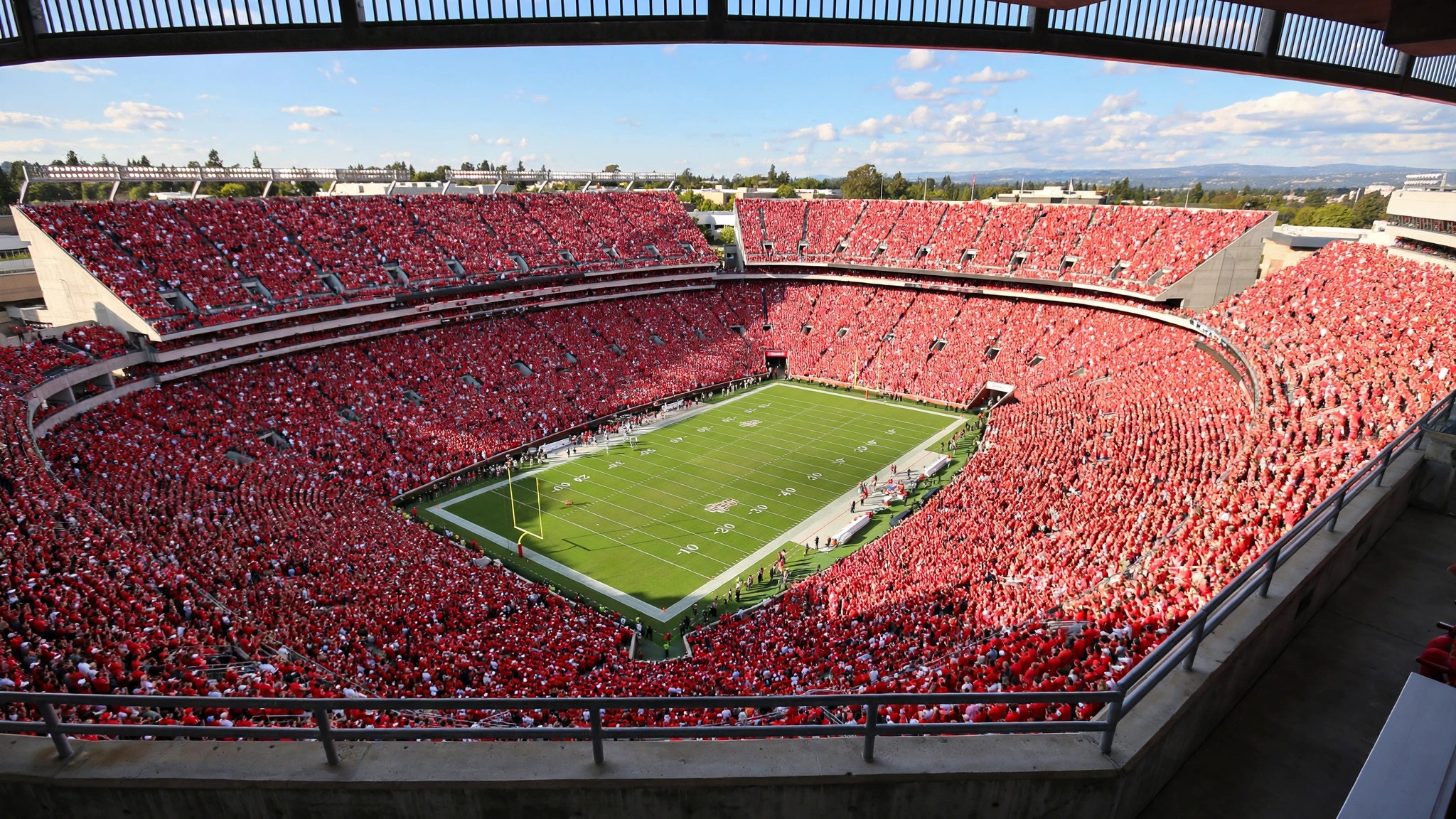
There is no place in college football quite like Lincoln on a Saturday. Nebraska football is a state religion in the purest sense — the only major program in a state of two million people, playing in a stadium that becomes Nebraska’s third-largest city on game days, in front of a crowd that has sold out every single home game since 1962. This guide covers the whole landscape: the Cornhuskers’ championship history, the Matt Rhule rebuild, the roster and the stars, Memorial Stadium, the traditions, the schedule’s shape, tickets and how to watch.
Whether you are a lifelong Husker, a new fan drawn in by the program’s resurgence, or a visitor planning the bucket-list trip to Lincoln, everything you need starts here.
Nebraska Football: The Program at a Glance
Nebraska football plays in the Big Ten Conference, which the Cornhuskers joined in 2011 after a century in the Big Eight and Big 12. The program’s home is Memorial Stadium in Lincoln, opened in 1923 and named for Nebraskans who served in the nation’s wars. On game days the stadium holds more than 80,000 people — and has not had an empty seat to sell since November 3, 1962, a streak of consecutive sellouts that passed 400 games and stands as the longest in college football history.
The colors are scarlet and cream, the mascot is Herbie Husker, and the identity is singular: in a state with no professional teams in the major leagues, the Cornhuskers are Nebraska’s franchise. That concentration of loyalty explains both the stadium’s streak and the scrutiny the program lives under — every Nebraska football season is a statewide conversation, and every coaching decision is front-page news from Omaha to Scottsbluff.
Football Nebraska Cornhuskers: A Championship History
The history of football Nebraska Cornhuskers fans inherit is one of the sport’s richest. The program claims five national championships. Bob Devaney’s teams won back-to-back titles in 1970 and 1971, building the modern program almost from scratch after arriving from Wyoming in 1962 — the same autumn the sellout streak began, which is no coincidence.
Devaney’s successor, Tom Osborne, turned excellence into permanence. Across twenty-five seasons Osborne’s teams never won fewer than nine games, and his final years produced the dynasty’s defining run: national championships in 1994, 1995 and 1997, with the 1995 team — a ruthless, record-setting machine — still argued as the greatest single team in the sport’s history. The option offense, the Blackshirts defense and a walk-on program that turned Nebraska farm kids into All-Americans became the program’s signatures.
Three Huskers have won the Heisman Trophy: Johnny Rodgers in 1972, Mike Rozier in 1983 and Eric Crouch in 2001. The decades since have been the wilderness the current rebuild is trying to end — conference moves, coaching changes and near misses — which is why the present moment carries so much emotion in the state. Fans comparing the Big Ten’s old and new powers can browse our guide to Illinois football for another program writing its own comeback chapter.
Husker Football: The Matt Rhule Rebuild
Husker football entered its current era when Nebraska hired Matt Rhule in late 2022. Rhule arrived with a specific reputation: the coach who takes over broken programs and rebuilds them in order — Temple, then Baylor, each transformed by year three. His Nebraska blueprint has followed the same script: rebuild the lines, restore the walk-on and developmental pipeline, recruit nationally while locking down the state, and construct a defense worthy of the Blackshirts name.
The trajectory has bent the right way. The 2024 team ended the program’s long bowl drought and beat Boston College in the Pinstripe Bowl, Nebraska’s first bowl appearance and win in nearly a decade. The 2025 team took the next step, riding a powerful running game and an improving defense into the Big Ten’s upper half — including a 28-21 win at UCLA in November where a freshman quarterback stole the state’s heart, a night we will meet again in the roster section below.
Rhule’s staff stability and recruiting traction have quieted the churn that defined the previous decade. For a fan base that counts patience in generations, the question has shifted from “when will Nebraska be back?” to “how far can this build go?” — a much better question to argue about all winter.
Nebraska Cornhuskers Football: Roster and Players to Know
A Nebraska Cornhuskers football roster is built in layers: national recruits at the premium positions, developmental linemen who arrive as projects and leave as starters, and the walk-ons who remain the program’s soul. The 2025 season showed the model’s ceiling when it mattered most — at quarterback, where the room’s depth turned a season-threatening injury into a star turn.
The story every fan knows: starter Dylan Raiola, the former five-star recruit whose decision to come to Lincoln headlined the rebuild, was lost for the season to a broken fibula suffered against USC. In stepped true freshman TJ Lateef, a Compton, California native, who made his first career start at the Rose Bowl — twenty-five miles from home — and completed 13 of 15 passes for 205 yards and three touchdowns to beat UCLA. Beside him, running back Emmett Johnson produced a game for the record books: the first Husker ever with 100 rushing yards and 100 receiving yards in the same game, 232 all-purpose yards and three touchdowns.
That is the current roster in miniature: star talent at the top, developmental depth behind it, and a freshman class already producing. The full official roster, with heights, weights and class years, is maintained by the school and is the only source fans should trust for depth-chart details, which shift weekly through the season.
The Blackshirts and the Walk-On Tradition
Two ideas explain Nebraska’s identity better than any slogan. The first is the Blackshirts: the black practice jerseys awarded to the defensive starters, a tradition begun in the Devaney era that grew into the program’s defining standard. A Nebraska defense does not merely play; it defends a jersey, and in rebuilding years the fans’ first question is always whether the Blackshirts look like Blackshirts again. The current staff treats the tradition with the seriousness it demands — jerseys are earned in camp, and the standard is the standard.
The second is the walk-on program, historically the deepest in the nation. Nebraska built its dynasty partly on roster spots given to unrecruited in-state players who developed in the program’s strength system and emerged as starters on championship teams. Dozens of former walk-ons have reached the NFL from Lincoln. The modern transfer era has squeezed walk-on rosters nationally, but Nebraska still treats the pipeline as sacred — a stance that doubles as a recruiting argument in every small town in the state: the door is genuinely open.
Together they describe the Rhule rebuild’s cultural target. Recruit the stars the modern game requires, develop the linemen the old game demanded, and hold both to a defensive standard set sixty years ago. When those pieces align in Lincoln, history suggests the wins argue for themselves.
Memorial Stadium: Game Day in Lincoln
Game day begins with the Tunnel Walk, the team’s entrance through the tunnel beneath the north stands — a tradition dating to 1994 that turns a walk to the field into a rock concert’s opening number. The stadium’s famous inscription, carved above the southwest corner, reads in part: “Through these gates pass the greatest fans in college football.” Visitors routinely report that the reputation is earned — Nebraska crowds are famous for applauding visiting teams as they leave the field, win or lose.
The practical guide:
- Arrive early. Downtown Lincoln’s Haymarket district fills hours before kickoff, and the walk to the stadium is part of the show.
- Expect the sellout. There is no casual ticket inventory for conference games; plan purchases weeks ahead.
- Stay for the whole game. The fourth quarter in Memorial Stadium, with the sea of red standing, is the experience people describe years later.
- Mind the weather. November in Lincoln is a cold-weather test for fans as much as players.
Stadium traditions once included the release of red balloons after Nebraska’s first touchdown; the practice has been scaled back in recent seasons for environmental reasons, a small modern footnote to a century of rituals.
Huskers Football: Rivalries and the Big Ten Slate
Huskers football rivalries run in two eras. The old Big Eight and Big 12 wars — above all Oklahoma, the annual day-after-Thanksgiving classic that defined two programs for decades — still live at the center of fan memory, and the fan base treats every revival of that series as a holiday. Colorado, Kansas State and Missouri complete the old map.
The Big Ten era has built a new one. The annual Black Friday meeting with Iowa, played for the Heroes Trophy the day after Thanksgiving, has become the modern anchor — a cold, physical game between two programs that recruit the same footprint and play the same brand of football. Our guide to Purdue football covers another of Nebraska’s annual conference tests, and the expanded league now rotates the Huskers through the sport’s biggest stadiums — Columbus, Ann Arbor, State College — on a regular cycle.
Bowl season remains the measuring stick the state watches most closely. Ending the drought in 2024 reset expectations; the standard in Lincoln is no longer reaching December, but climbing the Big Ten’s bowl ladder toward the playoff places the program’s history says it should occupy.
Huskers: Schedule Shape, Tickets and How to Watch
The Huskers play the standard Big Ten framework: nine conference games, three nonconference dates, one or two bye weeks, and a Black Friday finale against Iowa. September in Lincoln usually means nonconference home games under the lights; October and November bring the conference grind and the weather that made this program’s reputation.
Tickets run through the school’s official channels, with the sellout streak meaning secondary markets handle most single-game demand — use verified resale and buy early for conference weekends. On television, Nebraska’s games land across FOX, CBS, NBC, the Big Ten Network and Peacock, with kickoff times set six to twelve days out. For official roster news, ticket links and schedule updates, the program’s home is Nebraska Huskers athletics.
Programs with peer traditions make the best comparisons, and our look at the service-academy model in the Navy football guide shows how differently another tradition-rich program builds its roster. Nebraska’s version — a whole state, one team, four hundred sellouts and counting — remains one of a kind. This guide is your map to it, all season long, from the first September night game to the cold Friday afternoon in late November when the whole state stops to watch its team one more time.
