

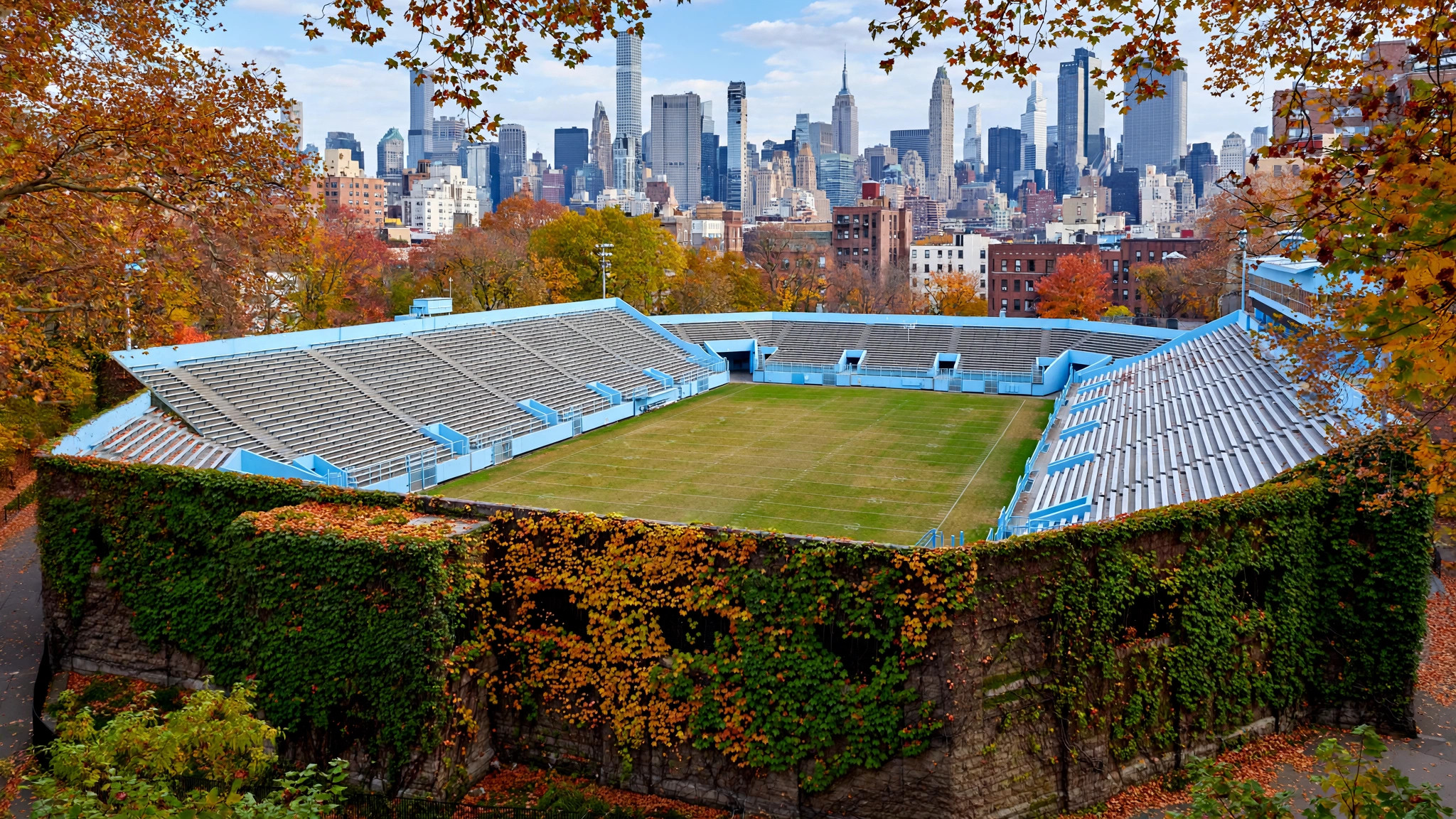
College football in Manhattan sounds like a contradiction, but at the northern tip of the island, Columbia football has been played since 1870 — making the Lions one of the oldest programs in the sport. Columbia plays in the Ivy League, at a 17,000-seat stadium tucked into the Inwood neighborhood, and its recent rise to the top of the league has given the old program a brand-new storyline. This season guide covers how the schedule works, how the roster is built, who coaches the Lions, and how to watch or attend a game.
For most of its history, Columbia was known for tradition more than trophies. That changed when the Lions shared the 2024 Ivy League championship, their first league title since 1961. Suddenly the program that once owned the longest losing streak in college football is a contender, and every autumn Saturday at Wien Stadium matters.
Columbia Football Schedule: How the Ivy League Season Is Built
An Ivy League schedule looks different from the FBS calendar. Columbia plays a compact 10-game regular season, starting later than most of the country — the Ivies traditionally open in mid-to-late September. Seven of the ten games are conference games, one against each of the other seven Ivy schools, and the remaining three are nonconference matchups, often against Patriot League opponents or regional FCS programs.
There is no conference championship game in the Ivy League. The title is decided purely by the round-robin standings, which means every league game from the opener onward carries championship weight — a September loss can be the one that costs a team the crown in November. For decades the Ivies also declined to send their champion to the FCS playoffs, a tradition that only recently began to change, adding a possible postseason chapter to the Lions’ calendar.
Columbia’s biggest dates are easy to spot: the Empire State Bowl against Cornell, the Lions’ oldest rival, and the Liberty Cup game against Fordham, the crosstown meeting that opens many seasons. Homecoming at Wien Stadium and the late-season trips to Harvard, Yale and Princeton round out the emotional core of the schedule. Fans comparing formats can see how a service academy’s calendar is assembled in our Navy football guide, or how an FCS playoff contender structures its year in our Montana State football guide.
Columbia Lions Roster: Positions and Players to Know
Ivy League rosters are built under rules no other league follows. There are no athletic scholarships in the Ivy League; players choose Columbia for the degree as much as the depth chart, and recruiting is national — the Lions’ roster typically pulls from thirty or more states, because the admissions pool, not a recruiting budget, defines the map.
That model produces a distinctive roster shape:
- Quarterback: Ivy offenses lean on accurate, decision-making passers, and Columbia’s recent success has started with steady quarterback play and an offense that protects the ball.
- Offensive line: With no scholarship arms race, line development is a multi-year project; the Lions’ best teams have been anchored by veteran lines full of juniors and seniors.
- Defense: Ivy defenses win with discipline and tackling rather than sheer size, and Columbia’s recent units have built their identity around limiting explosive plays.
- Specialists: In a league full of one-score games, kickers and punters decide seasons — field position is a genuine weapon at Wien Stadium, where wind off the Hudson and Harlem rivers can move the ball.
The official roster, with class years, positions and hometowns, is maintained by the school, and it is the source to trust for current numbers and eligibility. Because Ivy players historically could not take a fifth year at their own school, roster turnover follows the academic calendar more strictly than anywhere else in Division I.
Head Coach Jon Poppe
Jon Poppe took over Columbia in 2024 and immediately delivered the season the program had waited six decades for: a share of the Ivy League championship, the Lions’ first since 1961. A former Columbia assistant under the legendary Al Bagnoli era’s successor staffs and later the head coach at Saint Peter’s and an assistant at Holy Cross and Harvard, Poppe knew the Ivy model from the inside — how to recruit to an admissions office, how to develop players who arrive without scholarship leverage, and how to win close games in a league where almost every Saturday is close.
His Columbia teams have been built on balance and composure. The Lions defend the run first, play clean special teams, and trust a methodical offense to stay on schedule. The championship season changed the program’s self-image: Columbia now recruits and plans as a program that expects to be in the title race in November, not one hoping to spoil somebody else’s.
The challenge in the Ivy League is sustainability. With small recruiting classes, no scholarships and strict academic filters, one great senior class can lift a program for two years and then vanish. Poppe’s staff has treated depth — especially along both lines — as the answer, and the Lions’ recent recruiting has reflected it.
Wien Stadium: Football at the Top of Manhattan
Columbia plays at Robert K. Kraft Field at Lawrence A. Wien Stadium, in the Baker Athletics Complex at the very northern tip of Manhattan. The stadium seats about 17,000 and sits where the Harlem River meets the Hudson, with views across to the Bronx and the Palisades — a setting unlike any other in college football, where the 1 train delivers fans to the gate and the skyline fills the ride home.
Wien Stadium has been Columbia’s home since 1984. It is an intimate bowl by Division I standards, which suits the Ivy League: the crowd is close, the band is loud, and a big conference game in October feels like a genuine event in the neighborhood. The track that once ringed the field is gone, replaced by modern FieldTurf, keeping the sightlines tight.
For visitors, the routine is simple: take the subway or Metro-North, arrive early enough to walk the complex, and dress for wind — the river location makes late-season games some of the coldest in the league. It is a small price for one of the most distinctive addresses in the sport.
The crowd itself is part of the charm. Columbia draws alumni who treat the Baker Complex as a reunion, students who ride the train up from Morningside Heights, and neighborhood families from Inwood and Washington Heights. The Columbia University Marching Band’s irreverent style has been part of the soundtrack for generations, and the whole production feels personal in a way a 90,000-seat stadium cannot imitate. On a clear October afternoon, with the leaves turning on the hills across the Harlem River, there are few better places in the FCS to watch a game.
Columbia Football History and Tradition
Columbia’s history is genuinely ancient. The Lions played in the fourth intercollegiate football game ever held, against Rutgers in 1870, and the program claims national titles from 1875 and 1933. The 1933 team supplied the program’s most famous moment: a 7–0 upset of Stanford in the 1934 Rose Bowl, still the only Rose Bowl appearance and victory in school history, sealed by Al Barabas’s touchdown run on a hidden-ball play.
The decades after were harder. Columbia won the 1961 Ivy League title and then endured generations of losing, including a 44-game losing streak from 1983 to 1988 that stood as an NCAA record. The program became a national punchline — which is exactly why the 2024 co-championship, and the competitive teams that followed under Poppe, landed so emotionally with alumni. Programs like Liberty football show how fast a school can build a winner from scratch; Columbia’s story is the opposite lesson, about a 150-year-old program finally climbing back.
The traditions are Ivy through and through: Columbia blue and white, the fight song “Roar, Lion, Roar,” mascot Roar-ee, and rivalry games that predate the forward pass. For fans who love the sport’s roots, there may be no better autumn classroom.
Columbia Greats: From Sid Luckman to the Modern Lions
No history of the passing game is complete without Columbia. Sid Luckman, who starred for the Lions in the late 1930s, went to the Chicago Bears and became the defining quarterback of the T-formation era, a Pro Football Hall of Famer whose Columbia roots are still a point of pride on campus. A generation earlier, the 1934 Rose Bowl team put Columbia on the national map, and the program’s record books reach back through the sport’s founding decades — Columbia played in the fourth intercollegiate game ever held.
The alumni line runs beyond football. Lou Gehrig wore Columbia colors before he wore Yankees pinstripes, playing on Columbia’s fields in the early 1920s. More recently, the Lions have sent a steady trickle of players to NFL camps and All-Ivy honors lists, and Poppe’s championship team put multiple Lions on the league’s postseason awards lists — a sign of how far the talent level has climbed.
For fans, the takeaway is that Columbia’s ceiling is historical fact, not nostalgia. This is a program that has won a Rose Bowl, produced a Hall of Fame quarterback and, after sixty years of waiting, lifted a league trophy again. Every autumn now starts with a legitimate question: can the Lions do it again?
Tickets, How to Watch and Game-Day Tips
Columbia tickets are sold through the school’s athletics channels and are among the most affordable in Division I football, with single-game options for every home date at Wien Stadium. Rivalry games — Cornell and Fordham especially — draw the biggest crowds, so buying those in advance is wise even in the Ivy League.
Television coverage of Ivy football runs mainly through ESPN’s platforms, with most games streaming on ESPN+ and selected matchups on ESPN’s linear networks; kickoffs are typically early afternoon Eastern. Radio and live stats are carried by the school. For official roster news, schedules and ticket links, the program’s home is Columbia Lions athletics.
To get the most from a Columbia season:
- Ride the 1 train to 215th Street; driving and parking at the top of Manhattan is the hard way.
- Circle the Cornell and Fordham games — the Empire State Bowl and Liberty Cup are the season’s emotional peaks.
- Dress for river wind in late October and November.
- Watch the turnover margin. Columbia’s contention under Poppe has been built on winning the close, clean games.
Columbia football is the sport in its oldest form — played by one of its founding programs, in a stadium at the top of Manhattan, for a league title that suddenly feels within reach every fall. Few Saturdays offer more history per seat, and fewer still reward a curious new fan this quickly: one trip up the 1 train is usually all it takes to be converted.
