

Few programs in college football combine history, location and scenery the way UCLA football does. The Bruins play in the most famous stadium in the sport, wear one of the most recognizable color combinations in the game, and now compete in the Big Ten, where every autumn Saturday brings a heavyweight opponent to Pasadena. Whether you are planning a trip to the Rose Bowl, following the roster from across the country, or simply trying to understand where this program is headed, this season guide pulls everything together.
UCLA football has entered a new era. The move from the Pac-12 to the Big Ten changed the Bruins’ opponents, travel and television windows, and a coaching change has reset expectations inside the program. This guide explains how the schedule is built, how to read the roster, who is leading the team, and how to watch or attend games, all in one place.
UCLA Football Schedule: How the Bruins’ Season Is Built
A modern UCLA football schedule follows the standard Big Ten framework. The Bruins play a 12-game regular season: a small set of nonconference games in the opening weeks, followed by nine Big Ten conference games, with one or two bye weeks worked into the calendar. The regular season traditionally ends with the crosstown rivalry game against USC, played for the Victory Bell, one of the most storied rivalry trophies in the sport.
Because the Big Ten now stretches from Los Angeles to New Jersey, the Bruins’ conference slate mixes home games at the Rose Bowl with long road trips to places such as Columbus, Ann Arbor and State College. Home-and-away balance matters in Pasadena: a season with five conference home games feels very different from one with four, especially when traditional powers rotate onto the schedule. Fans comparing formats across leagues can see how differently the calendar is assembled in our guide to Memphis football, while UCLA’s own conference trips now regularly include stops at programs such as Purdue and Illinois.
Kickoff times are rarely set far in advance. The Big Ten’s television partners usually announce start times and channels six to twelve days before each game, so the smart routine is to check the official schedule page each week rather than relying on a printable calendar from August. Bowl eligibility still begins at six wins, and the Big Ten Championship Game sends its winner toward the College Football Playoff picture in December.
UCLA Football Roster: Positions and Players to Know
Reading a college roster starts with understanding how it is built. Under current NCAA rules, FBS programs can carry up to 105 players, and a game-day depth chart usually lists two or three names at each position. UCLA’s roster blends California high school recruits, transfers from the portal, and a growing number of players developed inside the program over several seasons.
The positions that shape the Bruins’ identity most years are easy to spot:
- Quarterback: The Bruins have a long lineage of passers, and the starter’s job in a Big Ten offense demands both arm strength for November weather and the mobility to survive aggressive pass rushes.
- Offensive line: UCLA traditionally recruits size on the line, and the unit’s health usually decides whether the run game travels on the road.
- Defensive front: In the Big Ten, stopping the run is the first job every week, so the Bruins’ defensive tackles and edge rushers carry an outsized share of the game plan.
- Secondary: Pasadena’s wide-open Rose Bowl field rewards speed, and UCLA secondaries are usually built around versatile defensive backs who can cover in space.
The full, official roster — with heights, weights, class years and hometowns — is published and updated by the school, and it is the only source fans should trust for jersey numbers and eligibility. Depth charts shift weekly with injuries and performance, so treat any preseason projection as a starting point rather than a promise.
Head Coach Bob Chesney and the New Era
The Bruins’ sideline changed hands in a hurry. DeShaun Foster, the former UCLA running back who took over the program in 2024, was dismissed early in the 2025 season, and assistant Tim Skipper steadied the team as interim head coach for the rest of that campaign. UCLA then turned to one of the most successful program-builders in the country: Bob Chesney.
Chesney arrived from James Madison, where his teams ranked among the strongest in the Group of Five, and before that he built Holy Cross into a consistent FCS playoff program. His reputation is built on structure: disciplined, physical teams that run the ball, defend the run, and rarely beat themselves with penalties or turnovers. It is a profile that translates well to the Big Ten, a league that still rewards line play and field position more than almost any other.
For fans, the practical point is that a Chesney team has a clear identity. The Bruins are being built to win the line of scrimmage first and layer explosive plays on top, rather than living and dying by shootouts. Recruiting under the new staff has emphasized the trenches and multi-year development, which means the roster sections above are worth re-reading each spring as the depth chart is rebuilt.
The Rose Bowl: UCLA’s Home Stadium
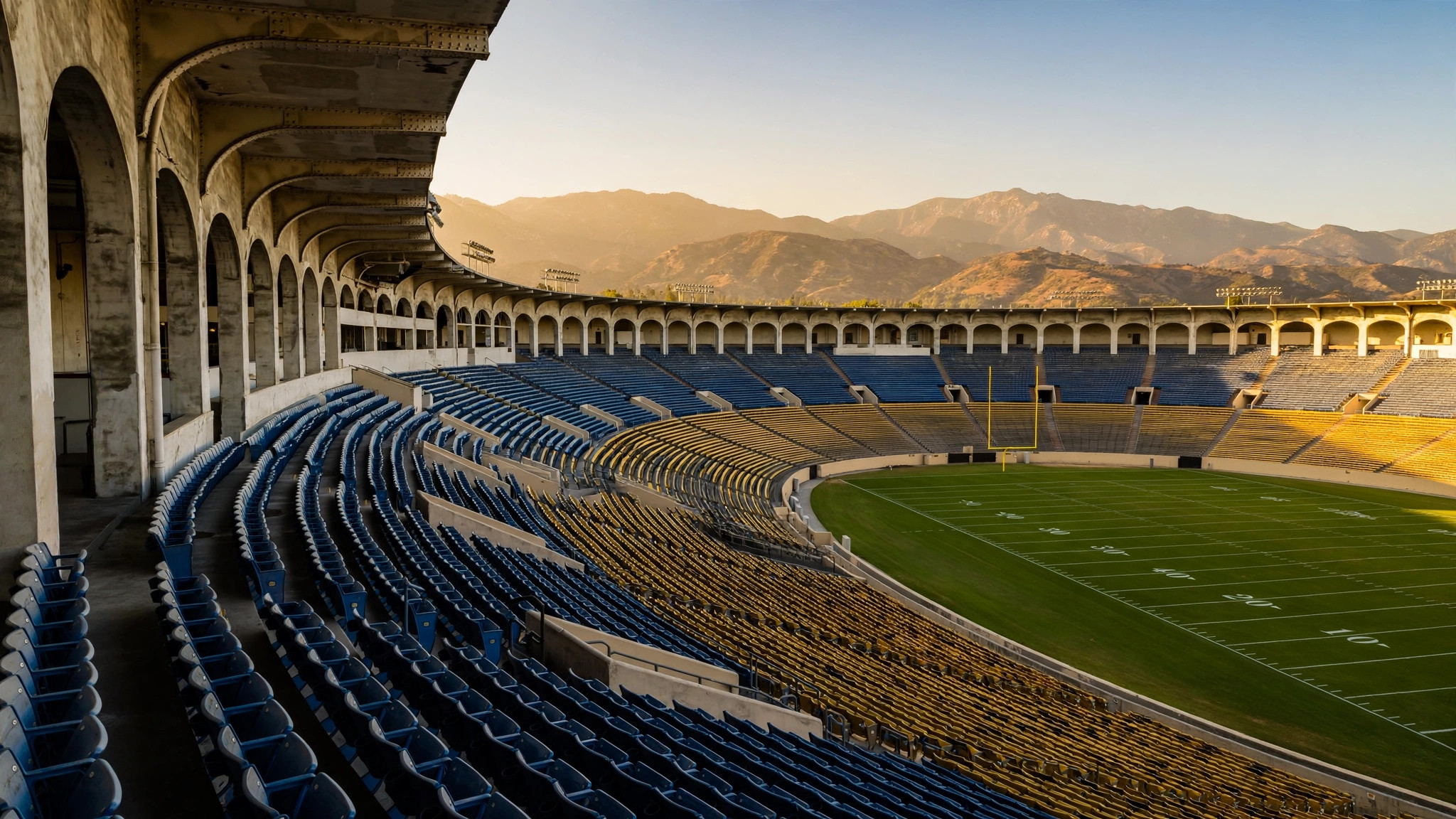
UCLA plays its home games at the Rose Bowl in Pasadena, one of the most famous sporting venues on earth. Opened in 1922 and nestled in the Arroyo Seco beneath the San Gabriel Mountains, the stadium has hosted the Rose Bowl Game, a World Cup final, Olympic events and Super Bowls, and it remains one of the largest stadiums in the United States, seating close to 90,000 fans.
Game day in Pasadena starts in the surrounding parkland, where tailgating on the grass around the stadium is a tradition as old as the building itself. The setting is the experience: afternoon sun on the mountains, the famous sign over the south entrance, and sunset kickoffs that turn the sky pink behind the press box. First-time visitors should plan on arriving early, because traffic funnels through a small number of roads in and out of the Arroyo.
UCLA has called the Rose Bowl home since 1982, after decades at the Los Angeles Memorial Coliseum. The stadium’s wide, single bowl means there are very few bad seats for watching a game develop, although the low angle of the stands puts some seats farther from the field than in modern vertical stadiums. It is a trade-off most visitors happily accept for the setting.
UCLA Football History and Tradition
The Bruins’ history is headlined by the 1954 team, which went unbeaten and claimed a share of the national championship under coach Red Sanders. UCLA has produced a steady line of stars across the decades, including Heisman Trophy winner Gary Beban, Hall of Fame quarterback Troy Aikman, and standouts such as Kenny Easley, Jonathan Ogden and Maurice Jones-Drew.
The program’s defining rivalry is with USC, a series that began in 1929 and is played for the Victory Bell, a painted railroad bell that goes to the winner each year. Because the schools sit about twelve miles apart, the game turns Los Angeles into a divided city for a week, and both fan bases treat it as the single most important Saturday of the season regardless of records.
UCLA’s colors — true blue and gold — and the famous gold helmets are among the most recognizable in the sport, and the Bruins’ script logo is a staple of college football Saturdays. The program spent most of its history in the Pac-12 and its predecessor leagues before joining the Big Ten in 2024, a move that traded old West Coast rivalries for a national conference schedule while keeping the USC game intact.
The NFL pipeline is part of the tradition, too. Few schools have sent players to the professional ranks as consistently as UCLA, and Bruins appear on draft boards and Pro Bowl rosters in most decades. For recruits and fans alike, that lineage matters: the Rose Bowl is not just a beautiful place to play, it has been a proven stage on the way to the next level.
Game-Day Traditions: The 8-Clap and the Bruin Walk
UCLA’s signature sound is the 8-clap, the rhythmic cheer — two claps, arms raised on the chant of U-C-L-A — that rolls around the Rose Bowl before kickoff and after every score. It is one of the most copied cheers in college sports, and hearing close to 90,000 people do it in unison is a Pasadena rite of passage for visiting fans.
Tailgating at the Rose Bowl happens on the grass of the surrounding Brookside golf course and parkland, where generations of families set up in the same spots year after year. The team makes its entrance through the Bruin Walk, greeting fans on the way into the stadium, and the UCLA Bruin Marching Band anchors the pregame show before the team takes the field through the tunnel at the north end.
The student section, known as The Den, drives the noise from the east side of the bowl. Combined with sunset kickoffs and the mountains turning purple behind the stadium, the atmosphere explains why the Rose Bowl is a bucket-list trip even for fans with no connection to UCLA. Plan the whole day around it: arrive by early afternoon for a 4 p.m. kickoff, tailgate on the grass, and let the traffic clear afterward rather than fighting it.
Tickets, How to Watch and Game-Day Tips
Season and single-game tickets are sold through the school’s official athletics channels, and the Rose Bowl’s size means tickets are usually available for most games, with rivalry and marquee conference matchups selling first. Fans should buy through official sellers or verified resale platforms and check the official schedule page for kickoff times, which are set by television.
On television, Big Ten football is spread across FOX, CBS and NBC, plus the Big Ten Network and streaming on Peacock, so a Bruins game can land in almost any Saturday window. Radio broadcasts and the school’s official app cover fans who are traveling. For the most reliable day-to-day information — roster updates, kickoff announcements and ticket links — the starting point is the program’s home at UCLA Bruins athletics.
A few final tips for following the season:
- Check kickoff times the week of the game, not the week before.
- Build Rose Bowl trips around early arrival; Pasadena traffic is the one opponent every fan faces.
- Watch the trenches. Under the current staff, UCLA’s results track its line play more than any single star.
- Keep the USC game circled. Whatever the records say, it defines the season in Los Angeles.
UCLA football is a program in transition with a famous home, a demanding new conference and a coach known for building sturdy teams. This guide will point you to everything that matters — the schedule, the roster, the stadium and the story — every time the Bruins take the field.
