

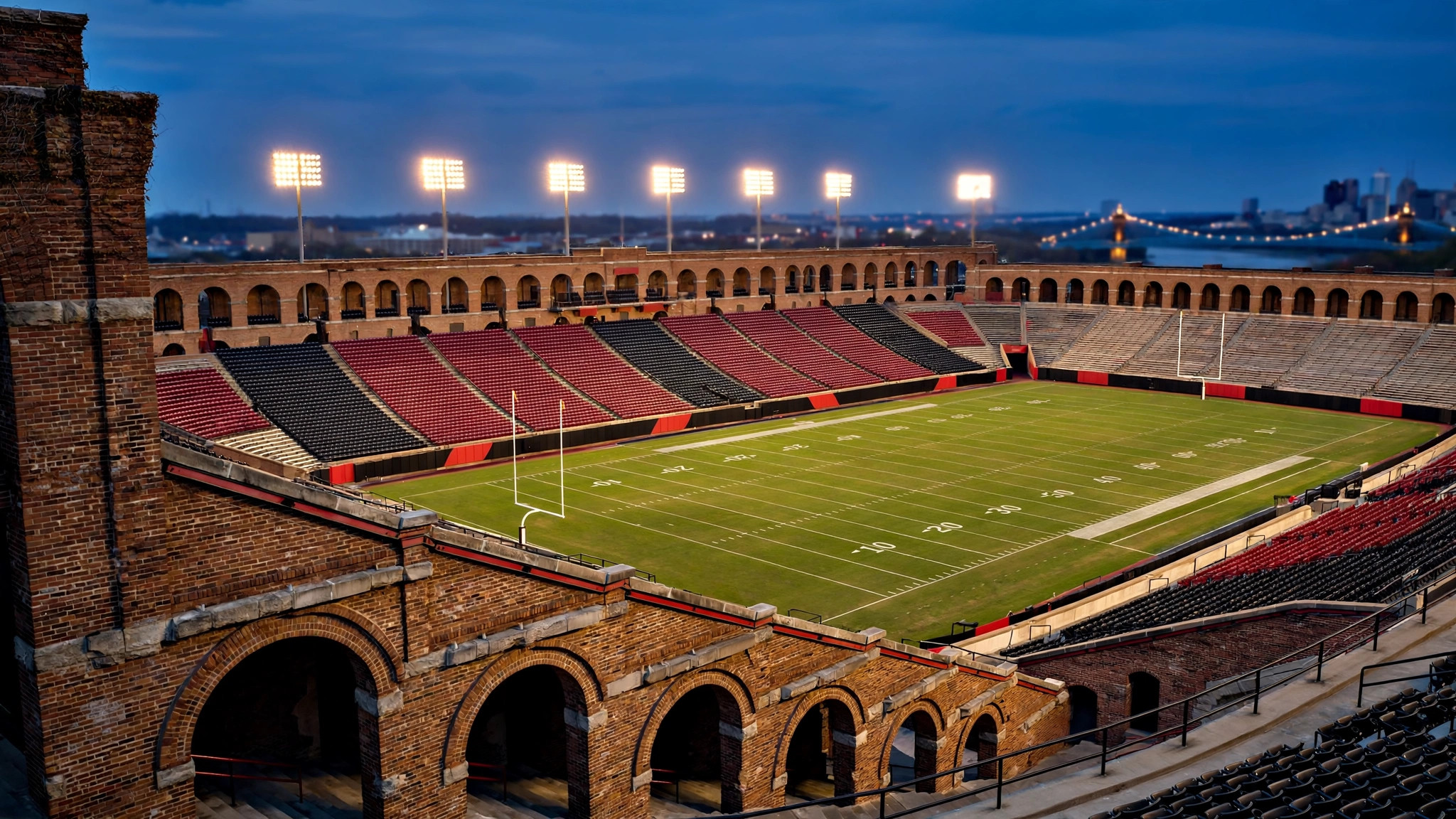
There is no college football setting quite like a night game at Nippert Stadium, where the crowd sits almost on top of the field and the noise rolls down from the surrounding campus. UC Bearcats football has grown from a proud regional program into a Big 12 contender with a College Football Playoff trip on its résumé, and this season guide covers everything a fan needs: how the schedule works, how the roster is built, who leads the team, and how to watch or attend games.
The Bearcats’ rise is one of the great modern stories in the sport. Cincinnati spent years as the best program outside the power structure, crashed the Playoff in 2021, and then made the jump to the Big 12 in 2023. The names and the league have changed, but the identity — tough defense, a real home-field edge, and a city that shows up — has stayed the same.
Cincinnati Bearcats Football Schedule: How the Season Is Built
A UC Bearcats football season follows the Big 12 template: a 12-game regular season with three nonconference games, nine conference games and bye weeks built in. The Bearcats’ nonconference slate usually mixes a marquee opponent, a regional matchup and a home game against a Group of Five or FCS visitor before league play takes over in late September.
The rivalry that anchors the calendar is the Victory Bell game against Miami (Ohio), one of the oldest rivalries in college football, first played in 1888. Conference play now sends Cincinnati across the Big 12 map — to places such as Provo, Lubbock and Orlando — while Nippert hosts a rotating cast of league powers. Fans who follow other former AAC programs can compare formats with our guide to Memphis football, a longtime Cincinnati rival from the American, or the season structure in our North Texas football guide.
Kickoff times in the Big 12 are set by television partners, usually announced six to twelve days out, across FOX, ESPN’s networks, TNT and streaming services. Six wins bring bowl eligibility, and the Big 12 Championship Game in Arlington sends its winner into the College Football Playoff race. Check the official schedule page weekly rather than trusting a preseason calendar, because flex scheduling moves kickoffs deep into November.
UC Bearcats Roster: Positions and Players to Know
Cincinnati’s roster model has been consistent through coaching changes: recruit Ohio and the Midwest hard, develop offensive and defensive linemen over several years, and use the transfer portal to fill the skill positions. The result is a team that usually looks older and more physical than its recruiting rankings suggest.
The position groups that define Bearcats football most seasons:
- Defensive line: Cincinnati’s best teams have been built up front on defense, with interior linemen who wreck running games and edge rushers who finish plays.
- Running backs: The Bearcats lean on the run to control tempo at home, and the backfield usually splits carries between a power back and a speed option.
- Quarterback: Recent Cincinnati offenses have asked the quarterback to be a distributor first — protect the ball, use play-action, and let the run game set the table.
- Secondary: The Bearcats have sent a steady stream of defensive backs to the NFL, and man coverage on the outside is a program trademark.
The school publishes the official roster with heights, weights and class years, and that is the only source to trust for jersey numbers and eligibility. Depth charts in the Big 12 change weekly with injuries and matchups, so use preseason projections as a map, not a contract.
Head Coach Scott Satterfield
Scott Satterfield has led the Bearcats since 2023, arriving from Louisville after building his reputation at Appalachian State, where his teams won consistently with a run-first offense and disciplined defense. His Cincinnati tenure has been about translating that formula to a harder league: the Bearcats took their lumps during the transition from the American to the Big 12, then rebuilt the roster around the line of scrimmage.
Satterfield’s teams are easy to recognize. They want to run the ball, control the clock, and make opponents drive the length of the field. It is a style that fits Nippert Stadium perfectly, where a patient offense and a loud crowd can squeeze visiting teams in the second half. His staff has also leaned into Cincinnati’s natural recruiting base — the city and state produce high-level high school talent every year, and keeping it home is a stated priority.
The measuring stick for the program is no longer just bowl eligibility. Cincinnati fans have seen a Playoff team, and the expectation under Satterfield is to compete in the top half of the Big 12 and be playing meaningful football in November. Roster retention in the portal era and continued line development are the two areas that will decide whether the Bearcats get there.
Nippert Stadium: One of America’s Oldest Home Fields
Nippert Stadium is the Bearcats’ fortress and one of the oldest stadiums in college football — football has been played on the site since 1901, and the stadium itself dates to the 1920s. A major renovation in 2015 modernized the press box, suites and concourses while keeping the bowl’s intimate feel, and capacity sits at just over 38,000, which makes it one of the smallest — and loudest — home fields in the power conferences.
The stadium sits in the middle of the University of Cincinnati’s campus, sunken into the ground so the roar stays in. There is not a bad seat in the building, and the student section and marching band keep the atmosphere closer to a basketball arena than a typical football Saturday. Visiting teams regularly describe it as one of the toughest trips in the league relative to its size.
Game-day advice is simple: arrive early, because campus parking fills fast, and walk the surrounding neighborhoods where tailgates spill out of front yards. Night games at Nippert are the program’s signature experience and the ones neutral fans should circle.
Cincinnati Bearcats Football History and Tradition
Cincinnati’s history stretches back to 1885, but the modern era is defined by a climb: Brian Kelly’s unbeaten regular season in 2009, the sustained success under several staffs in the American, and then the breakthrough 2021 team. That squad, coached by Luke Fickell, went undefeated through the regular season and became the first Group of Five team to reach the College Football Playoff, playing Alabama in the Cotton Bowl semifinal.
The program has produced NFL talent across generations, from early stars to recent names such as Sauce Gardner, and its black and red colors and the C-Paw logo are fixtures of autumn in Ohio. The Victory Bell rivalry with Miami (Ohio) gives the Bearcats one of the sport’s oldest annual games, and the trophy — a bell that tolls for the winner — remains the emotional center of the nonconference schedule.
The Big 12 move in 2023 was the payoff for all of it. Cincinnati now measures itself against national brands every week, and guides like our Hawaii football season preview show how wide the modern scheduling map has become for programs outside the old power structure.
The 2021 run also permanently changed what a Cincinnati season ticket means. Before the Playoff season, Nippert seats were a local secret — affordable, available, and loud. The Fickell team’s march through an unbeaten regular season put the Bearcats on national television every week, and demand reset at a new level that has never fully receded. Season-ticket renewals, student demand and single-game sales for marquee visitors all operate in that post-2021 reality.
It is why the program guards its home atmosphere so fiercely. Cincinnati knows exactly what a full, deafening Nippert did for the 2021 team, and everything from kickoff scheduling requests to stadium presentation is designed to recreate it. When the Bearcats are good, there is no harder road environment in the league relative to the size of the building.
Bearcats Traditions: Down the Drive and the Bearcat Name
Cincinnati’s nickname has one of the great origin stories in the sport. In 1914, during a game against Kentucky, a cheerleader led a chant for the team’s star fullback, Leonard “Teddy” Baehr — “They may be Wildcats, but we have a Baehr-cat on our side” — and a student cartoonist turned the line into an image. The Bearcat stuck, and more than a century later it is the identity of the whole university.
The cheer that echoes at Nippert is “Down the Drive,” the chant that builds as the Bearcats push toward the south end zone. The student section packs the lower bowl behind the visitors’ bench, the marching band’s pregame show spills onto campus, and the Bearcat mascot — consistently ranked among the nation’s best — works the crowd from the first tailgate to the final whistle.
Beyond Miami, Cincinnati’s trophy history includes the Keg of Nails series with Louisville, a rivalry born when both schools sat in the same leagues and renewed whenever the schedule allows. Those games carry a regional edge that Big 12 play has not replaced, and older fans still rank them among Nippert’s loudest afternoons.
Game day in Clifton starts hours before kickoff, with tailgates filling the campus greens and fraternity row, and it ends with the team singing with the student section. For a 38,000-seat stadium, the whole production feels bigger than the building.
Tickets, How to Watch and Game-Day Tips
Tickets are sold through the school’s official athletics channels, and Nippert’s small capacity means conference games — especially night games — can sell out, so buying early matters more in Cincinnati than at most Big 12 stops. Verified resale platforms are the fallback, and prices there move with the opponent and the weather forecast.
On television, Big 12 games are spread across FOX, FS1, ESPN, ESPN2, TNT and ESPN+, and kickoff windows range from noon Eastern to late night. Radio coverage and the school’s app handle fans on the move. For official roster news, kickoff announcements and ticket links, start with the program’s home at Cincinnati Bearcats athletics.
To get the most from a Bearcats season:
- Buy Nippert tickets early — it is a small stadium and big games go fast.
- Check kickoff times the week of the game; Big 12 flex scheduling is aggressive.
- Watch the defensive line first. Cincinnati’s ceiling is set up front.
- Keep the Victory Bell game circled; it matters in Ohio no matter the records.
UC Bearcats football has already proven it can crash the sport’s biggest party. With a settled Big 12 home, a veteran head coach and one of the best small-stadium atmospheres in America, the Bearcats’ next chapter is about turning that one magical run into a standard.
