

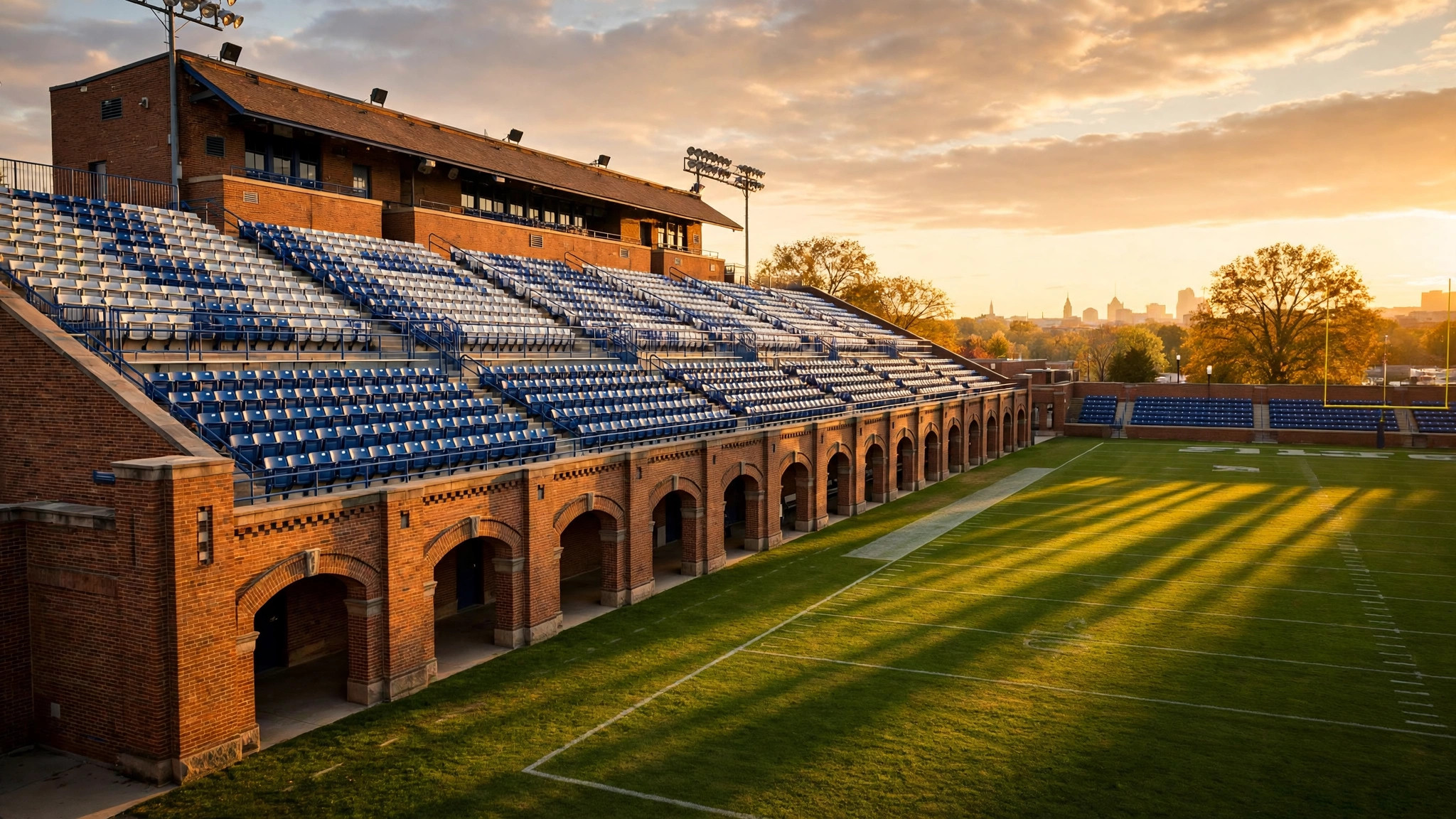
Butler University is famous around the world for basketball, but on the north side of its Indianapolis campus, Butler football has been played since the 1880s — in a bowl that sits in the trees, in a league unlike any other in Division I. The Bulldogs compete in the Pioneer Football League, the nation’s home for non-scholarship FCS football, and this season guide explains how the schedule works, how the roster is built, who leads the program, and how to watch or attend a game at one of the most pleasant settings in the sport.
Butler’s model is deliberately old-fashioned. There are no football scholarships at Butler. Players come for the degree, the campus and the chance to keep playing, and the Bulldogs have built a proud program on that foundation — including conference championships and a fan base that treats autumn Saturdays at the Sellick Bowl as a neighborhood tradition.
Butler Football Schedule: How the Pioneer League Season Is Built
Butler plays an 11-game regular season: three nonconference games, usually a mix of regional FCS opponents and the occasional Division II or NAIA visitor, followed by an eight-game Pioneer Football League schedule. The PFL is the most geographically spread league in the FCS — its members stretch from San Diego to New York — so a Butler season includes both short Indiana road trips and flights across the country.
The league champion earns an automatic berth to the FCS playoffs, which gives every conference game real stakes from September onward. There is no conference championship game; the round-robin table decides the title and the playoff bid, and tiebreakers settle the rest.
The date every Butler fan circles is the Hoosier Helmet game against Valparaiso, the Bulldogs’ in-state rival. The trophy is an old football helmet mounted for the winner, and the series is one of the oldest in Indiana football. Homecoming at the Sellick Bowl and the trips to Dayton and Drake — two of the PFL’s traditional powers — round out the season’s core. Fans who want a contrast can see how an Indiana neighbor at the FBS level structures its year in our Purdue football guide, or how another FCS program builds toward the playoffs in our Montana State football guide.
Butler Bulldogs Roster: Positions and Players to Know
A non-scholarship roster is built differently from the rest of Division I. Without athletic scholarships to offer, Butler recruits students first — players who can handle the university’s academic load — and then develops them for four years. The result is a roster heavy on Indiana and Midwest talent, multi-sport high school athletes, and juniors and seniors who have waited their turn.
The groups that shape the Bulldogs’ seasons:
- Quarterback: PFL offenses ask the quarterback to be both distributor and runner, and Butler’s best teams have had dual-threat passers who protect the ball.
- Offensive line: Development is everything in a non-scholarship program; the line is usually the most veteran unit on the team by design.
- Linebackers: Butler’s defenses have traditionally been anchored by productive, undersized linebackers who play bigger than their measurables.
- Special teams: In a league of one-score games, the kicking game and return units carry outsized weight, and Butler treats them as a genuine third phase.
The school publishes the official roster with heights, weights, class years and hometowns, and that is the only source to trust for current numbers and eligibility. Because PFL players cannot be kept on scholarship, continuity is earned — the seniors in the two-deep are players who chose to stay, which gives Butler’s roster a stability the transfer portal rarely touches.
Head Coach Kevin Lynch
Kevin Lynch became Butler’s head coach in December 2024, taking over after Mike Uremovich departed for Temple. Lynch was no stranger to the program or the league: he had served on Butler’s staff as offensive coordinator, and his coaching roots run through the region. His first season was about installing his system and identity while keeping the program’s developmental core intact.
Lynch’s football is built for the PFL: a balanced offense that can run the ball on the road, a defense that tackles in space, and an emphasis on winning the hidden-yardage battles — penalties, field position, and turnovers — that decide close league games. In a conference where nearly every roster is built the same way, coaching and continuity are the edges, and Butler bet on a coach who already understood its locker room.
The program he inherited has real history to draw on. Butler has won Pioneer League championships in 1994, 2009, 2012 and 2013, and the Bulldogs’ expectation each year is to be in the title race in November. Lynch’s task is to turn the program’s stability into another championship run and an FCS playoff trip.
The Sellick Bowl: Butler’s Home in the Trees
Butler plays at the Bud and Jackie Sellick Bowl — known for a century simply as the Butler Bowl — a 7,500-seat stadium that opened in 1928 and remains one of the most charming small venues in college football. Brick, trees and a campus setting give game day a feel closer to a great high school rivalry or an Ivy League afternoon than to the modern stadium arms race.
The bowl was the centerpiece of Butler’s great athletic era under Tony Hinkle, the legendary coach whose name adorns the fieldhouse next door, and it has been renovated over the years with FieldTurf and modern amenities while keeping its scale and character. There is not a seat from which the game feels distant.
For visitors, the routine is part of the appeal: tailgate on the campus lawns, walk to the bowl, and watch a game where you can hear the pads pop. Indianapolis in October — cool air, changing leaves, a marching band echoing off the brick — is exactly what small-college football is supposed to feel like. The bowl sits in the shadow of Hinkle Fieldhouse, the cathedral of Butler basketball, so a fall Saturday doubles as a walk through one of the most storied athletic campuses in America.
Butler Football History and Tradition
Butler fielded its first football team in the 1880s, and the program’s history runs through the golden age of Indiana sports. Tony Hinkle — the man who coached Butler basketball and gave the orange basketball to the sport — also coached the football Bulldogs, and his teams dominated the Indiana Collegiate Conference for decades. Butler’s trophy case holds conference titles across the ICC, the Heartland Collegiate Conference and the Midwest Intercollegiate Football Conference before the move to the Pioneer League in 1993.
The Bulldogs’ colors are blue and white, the mascot is the beloved live bulldog Butler Blue — currently Butler Blue IV — and the fight song is “The Butler War Song.” The Valparaiso rivalry, played for the Hoosier Helmet, gives the season its centerpiece, and programs across the region, like the one in our Navy football guide, would recognize Butler’s formula: identity, continuity and a game that belongs to the whole campus.
Butler’s football story is proof that the sport does not need scholarships or a hundred thousand seats to matter. It needs a place, a rival and a reason to come back every fall — and the Bulldogs have had all three for more than 140 years.
Butler and the FCS Playoffs
The Pioneer League’s automatic bid gives Butler a clear target every season, and the Bulldogs have reached the postseason promised land before. Butler’s 2013 championship team earned the program’s first FCS playoff berth, traveling to face Tennessee State in the opening round — a landmark moment for a non-scholarship program and a proof of concept for the whole league.
That trip still shapes how the program talks about itself. The standard in the locker room is not simply a winning season; it is a November spent in the playoff conversation. The path is unforgiving — the PFL plays no championship game, so one bad Saturday in October can erase a season — but Butler’s recent teams have been built precisely for that grind: veteran lines, a deep two-deep, and a defense that travels.
The playoff picture also raises the value of the nonconference schedule. Strong showings against scholarship FCS opponents do not change the automatic bid, but they harden a roster for league play and give the selection committee a reason to remember the Bulldogs’ name in an at-large year. Every Butler season, in other words, is two campaigns at once: win the league, and prove the league belongs.
Game Day in Indianapolis: What to Know Before You Go
Butler’s campus sits in one of Indianapolis’s most attractive residential neighborhoods, and game day has a block-party feel. Parking is close, tickets are inexpensive, and families spread picnics across the lawns around Hinkle Fieldhouse before walking into the bowl. The marching band and the cheer squad keep the small crowd loud, and Butler Blue IV — the live English bulldog who serves as the university’s mascot — makes his rounds for photographs.
Practical advice: dress in layers for November games, when Indiana wind cuts across the open bowl; arrive early enough to see the team walk; and stay for the alma mater after the game, a tradition that ties the football crowd to the wider university. Visitors from out of state often pair a Butler Saturday with a Colts Sunday downtown, making Indianapolis one of the easiest two-game football weekends in the Midwest.
Tickets, How to Watch and Game-Day Tips
Butler tickets are sold through the school’s athletics channels and are among the most affordable in Division I, with the Sellick Bowl’s small capacity making the Valparaiso and Homecoming games the dates to buy first. Pioneer League games stream primarily through ESPN’s platforms and school broadcasts, with most Butler games available on ESPN+ or the league’s streaming coverage.
Kickoffs are typically early afternoon Eastern, and schedules are confirmed on the official athletics site each season. For roster news, schedules and ticket links, the program’s home is Butler Bulldogs athletics.
To get the most from a Butler season:
- Buy Hoosier Helmet and Homecoming tickets early; the bowl only holds 7,500.
- Arrive in time to tailgate on the campus lawns — it is half the experience.
- Watch the linebackers and the turnover battle; they decide PFL games.
- Say hello to Butler Blue IV, the live bulldog mascot, a game-day institution.
Butler football is the sport at its most personal: a historic bowl, a helmet on the line against an in-state rival, and players who chose the school first and the program second. That is a combination worth a Saturday — and, for many Indianapolis families who have made it a tradition across generations, worth every Saturday of the fall.
