

UH football has always been a little ahead of its time. Houston was throwing the ball all over the field when the rest of the sport thought that was reckless, produced a Heisman Trophy winner from the run-and-shoot, and later gave the game its most prolific passer ever. This guide covers the modern Cougars: schedule, roster, stadium, history and how to follow the program in its Big 12 era.
Today’s Houston is led by head coach Willie Fritz, hired from Tulane for his reputation as one of the sport’s great program builders. The Cougars joined the Big 12 in 2023, stepping up from the American Conference into a league that tests them weekly, and Fritz’s patient, physical approach is designed to make Houston a fixture in that race.
Houston Cougars
The Houston Cougars football program began in 1946 and has spent eight decades as one of the sport’s great laboratories. The Cougars won conference titles in the Missouri Valley in the 1950s, joined the Southwest Conference in the 1970s and promptly won it in 1976, their first season in the league, on the way to a Cotton Bowl win.
The program’s trophy case holds eleven conference championships in all: Southwest Conference crowns in 1976, 1978, 1979 and 1984, Conference USA titles in 1996 and 2006, and the 2015 American Conference championship that sent Houston to the Peach Bowl, where the Cougars beat Florida State to finish a 13-1 season that fans still talk about as a modern high-water mark.
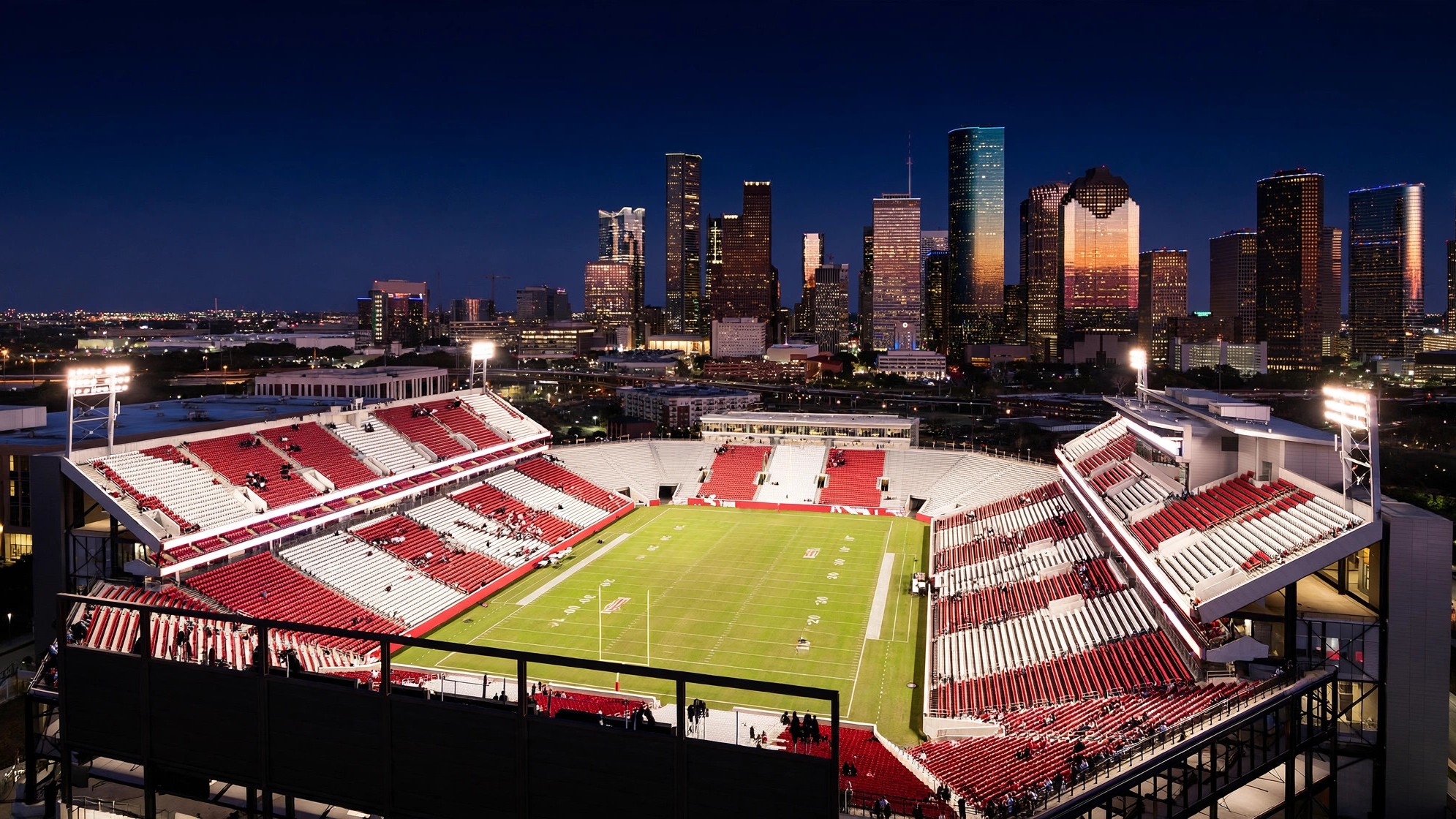
Houston’s colors are scarlet and white, its mascot is Shasta the cougar, and its home since 2014 is TDECU Stadium, a 40,000-seat venue on campus built on the site of the old Robertson Stadium. The Spirit of Houston marching band and a student section that has grown with the Big 12 move give game days a charge the program’s commuter-school past never promised.
Official schedules, rosters and tickets live at Houston’s athletics website.
UH Football Schedule and Key Dates
The UH football schedule is a Big 12 schedule now: nine conference games, three nonconference dates, and a championship-game path that runs through Arlington. The league releases opponents and dates ahead of the season, with kickoff times set by television in stages.
How a Cougars season is structured:
- September: nonconference tests and the first Big 12 games, played in Houston’s late-summer heat
- October and November: the conference grind, mixing home dates with trips across the league’s sprawling map
- The Bayou Bucket game against Rice, the crosstown rivalry that remains Houston’s most personal fixture
- December: the Big 12 title game for the league’s best, then bowl season
The Rice rivalry deserves its place. The two Houston schools sit a few miles apart, and the Bayou Bucket trophy gives the city a football argument of its own. In a schedule full of new Big 12 relationships, that game is the Cougars’ oldest grudge, and it still moves tickets.
Fans in the region can compare the Cougars’ path with our North Texas football guide, which covers another Texas program that built its name on quarterback play and offensive ambition.
Houston Cougars Roster and Style of Play
Fritz’s Houston is built differently from the program’s air-raid reputation. The Cougars still recruit Texas speed at receiver and in the secondary, but the foundation is line play, a real running game and defense that travels. It is a deliberate trade: less chaos, more control, designed for a league where November road games punish finesse teams.
Positions that define a Houston season:
- The offensive line, the first thing Fritz rebuilds everywhere he goes
- Quarterback, where game management and mobility matter as much as arm talent
- The defensive front, asked to hold up against Big 12 rushing attacks
- Texas-bred skill talent, the program’s natural recruiting inheritance
Roster building at Houston draws on the richest local talent pool in America. The greater Houston area produces hundreds of college players a year, and keeping even a slice of them home gives the Cougars a base most programs envy. The transfer portal then fills the gaps the schedule exposes.
Houston’s Quarterback Legacy: Ware and Keenum
No guide to the Cougars is complete without the two names that made Houston “Quarterback U” for a generation. Andre Ware won the Heisman Trophy in 1989, throwing for 4,699 yards and 46 touchdowns in Jack Pardee and John Jenkins’ run-and-shoot, and became the first Black quarterback to win the award. His successor, David Klingler, kept the system humming with a 5,000-yard season of his own.
Two decades later, Case Keenum rewrote the national record book. Across a career interrupted by injury and extended by a medical redshirt, Keenum threw for 19,217 yards — still the NCAA career record — and 155 touchdown passes, leading Houston to a 13-1 season in 2011. Between Ware and Keenum, Houston quarterbacks did not just star; they changed what the sport believed passing offenses could be.
The legacy shapes recruiting to this day: Texas quarterbacks grow up knowing what Houston did for passers, and the Cougars’ history at the position opens doors that programs of similar size cannot. Our Memphis football guide tells a parallel story about another program built around great quarterback play.
Houston Cougars History in Brief
Houston’s history rewards a closer look, because the Cougars have been present at several of the sport’s turning points. Bill Yeoman, who coached Houston from 1962 to 1986, invented the veer offense and integrated the program’s recruiting in the 1960s, signing Warren McVea as one of the first Black scholarship stars at a major Texas program. Yeoman’s teams won four conference titles and turned Houston into a national name before the Southwest Conference finally admitted the school — and promptly watched it win the league in its first try.
The run-and-shoot era under Jack Pardee and John Jenkins made Houston the most entertaining team in America between 1987 and 1991, setting passing records weekly and producing Ware’s Heisman and Klingler’s 5,000-yard season. Later chapters added their own landmarks: the 2006 Conference USA title under Art Briles, the Keenum years under Kevin Sumlin, and the 2015 Peach Bowl season under Tom Herman, when a 13-1 team finished in the top ten and reset the program’s ambitions.
Each era left the same lesson. Houston, given a real stage and the right coach, produces football the whole country watches. The Big 12 is the biggest stage the school has ever had, and the Cougars’ history suggests they will not waste it.
Following the Cougars: TV, Tickets and Traditions
Watching Houston is straightforward in the Big 12 era. Conference games are spread across the league’s broadcast partners in the ESPN and FOX families, and the Cougars’ Texas footprint means frequent regional windows and regular primetime slots when the team is winning. Kickoff times are set in stages, so the official schedule is worth checking weekly during the season.
Traditions worth knowing:
- The Cougar Paw hand sign, fingers curled to honor the program’s mascot history — legend ties its modern form to Shasta’s injured paw
- The “Whose House? Coogs’ House!” chant that rolls through TDECU Stadium
- The Frontier Fiesta festival and a campus that has invested heavily in the game-day experience
- A student section that has become the stadium’s loudest engine in the Big 12 era
Ticket demand follows the opponent. Ranked Big 12 visitors and the Rice game are the toughest seats; September nonconference dates are the accessible entry point for new fans. As with any school, buy through official channels or verified resale, and plan for Houston weather — the city’s autumn can serve up anything from summer heat to a Gulf storm.
Houston Cougars Season Outlook
The Cougars’ outlook in the Big 12 is the story of a program climbing a ladder it always believed it belonged on. The first seasons in the league were about survival and adjustment; the Fritz era is about converting Houston’s natural advantages — location, recruiting ground, history — into conference contention.
What will decide the climb:
- Line play, the currency of the Big 12’s best teams and Fritz’s stated priority
- Keeping Houston-area stars home against the SEC and national competition
- Home form at TDECU, where a maturing crowd can turn a good team into a contender
- Quarterback development, the program’s ancestral strength
The ingredients are unusually strong for a program still new to the league. Houston has done more with less for eighty years. Give the Cougars equal footing, a builder coach and the nation’s best recruiting backyard, and the ceiling is the one Ware and Keenum pointed at: a Houston team the whole country has to watch.
Houston Cougars Recruiting: Owning the Backyard
Houston’s recruiting pitch begins with a map. The metropolitan area produces elite talent at every position, and the Cougars’ staff sells the simplest story in the sport: stay home, play in a power conference, and let your family watch you do it. When Houston keeps its share of the city’s best, the roster’s floor rises fast, because the local baseline is that high.
The competition for that talent is the entire sport. SEC powers, Big 12 rivals and national brands all recruit Houston as a second home, so the Cougars’ wins are earned against the best closers in the business. Fritz’s reputation as a developer is the counterweight: parents and coaches across the city know his programs graduate players and send them to the league prepared. In the portal era, that reputation also boomerangs Houston natives back home after stops elsewhere, quietly restocking the roster with experienced talent that wanted to be Cougars all along.
Houston Cougars Game Day at TDECU Stadium
TDECU Stadium, opened in 2014 on John O’Quinn Field, gave the Cougars a true on-campus home after years in the Astrodome and Robertson Stadium. The stadium’s design frames the downtown Houston skyline beyond the north end, one of the prettiest backdrops in the Big 12, and its 40,000 seats keep the crowd close to the field.
Game-day notes for visitors:
- The stadium sits on the University of Houston campus, southeast of downtown, with light rail service that simplifies the trip
- September games are hot and humid; evening kickoffs are a blessing
- Tailgating has grown with the Big 12 era, and student turnout is the atmosphere’s engine
- The Bayou Bucket and ranked Big 12 visitors are the premium dates
For a look at another Big 12 home environment, our Arizona football guide profiles a fellow conference member with a very different desert setting.
Houston’s story is still being written. A program that pioneered the passing game now plays in a power conference with a builder coach and the nation’s deepest recruiting backyard. The Cougars have been ahead of the sport before. Nobody in the Big 12 should be surprised if UH football matters in November — the program has made a habit of arriving early to the future.
