

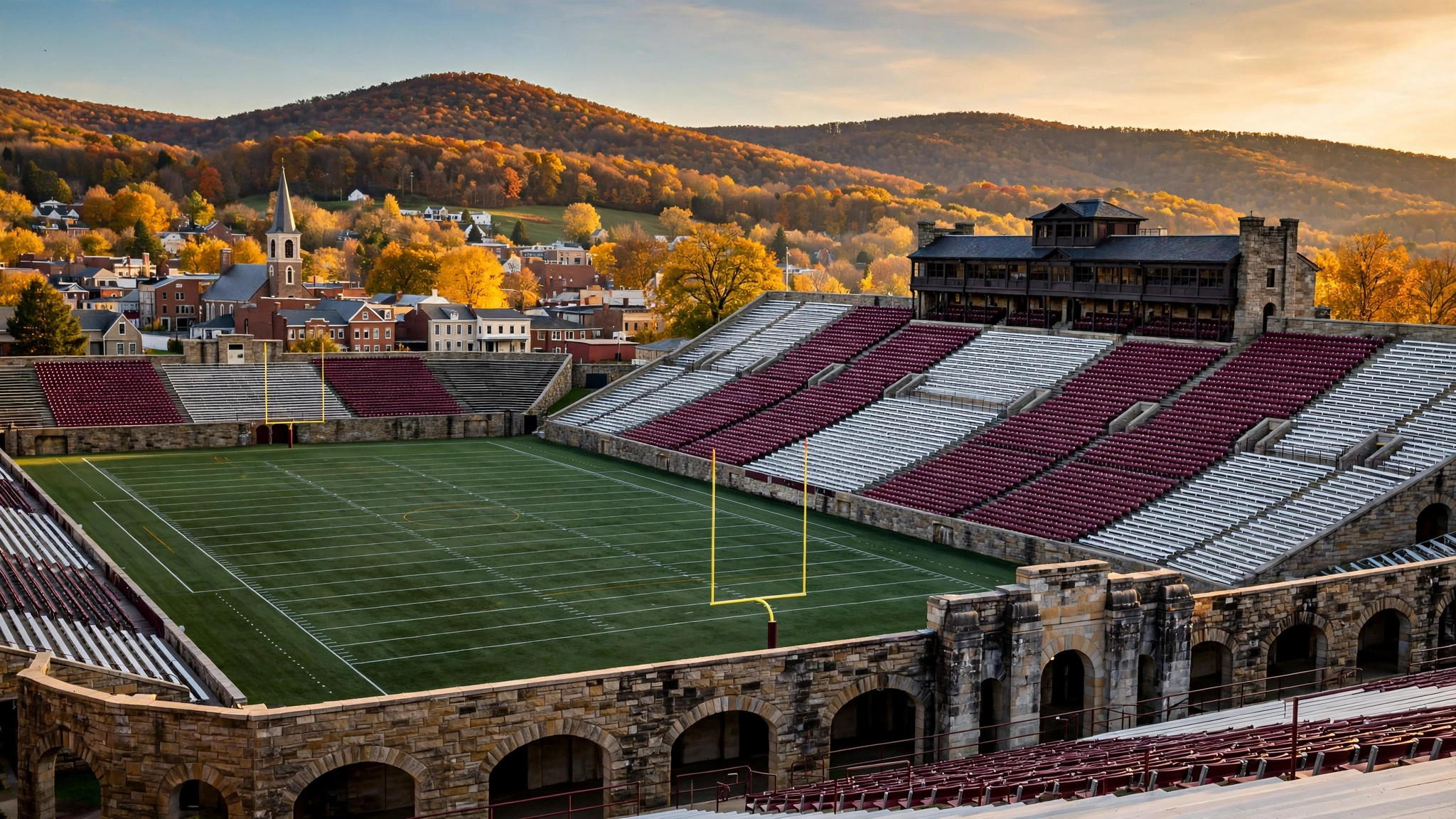
There is a game in the Lehigh Valley that has been played since 1884, between two schools less than twenty miles apart, and it defines Lafayette football more than any standings table ever could. The Leopards of Lafayette College play in the Patriot League, at a classic small stadium in Easton, Pennsylvania, and their season builds every year toward one Saturday in November: The Rivalry against Lehigh, the most-played matchup in college football history. This guide covers Lafayette’s schedule, roster, coach, stadium and traditions — everything a fan needs for a Leopards season.
Lafayette is one of the founding programs of the sport, with claimed national championships from the 19th and early 20th centuries and a Patriot League pedigree that includes eight league titles. It is small-college football with genuine history behind it.
Lafayette Football Schedule: How the Patriot League Season Is Built
Lafayette plays an 11-game regular season: a nonconference slate of regional FCS opponents — often Ivy League schools and CAA programs — followed by the Patriot League schedule. The Patriot League champion earns an automatic berth to the FCS playoffs, so the conference table is the whole season; there is no league championship game to rescue a slow start.
League play is a round-robin against the league’s core of Bucknell, Colgate, Fordham, Georgetown, Holy Cross and Lehigh, with recent expansion adding programs such as Richmond to the rotation. The nonconference highlight most years is a bus ride to an FBS opponent or an old Ivy rival — programs like Navy football show the same regional-scheduling logic at the FBS level.
Everything, though, funnels to the finale. Lafayette and Lehigh have met more times than any two teams in the sport — the series began in 1884, and the schools once played twice a year. The 150th meeting in 2014 was staged at Yankee Stadium. Most years the game closes the regular season, alternating between Easton and Bethlehem, and it regularly decides the Patriot League championship or a playoff berth. Kickoff times across the league are usually early afternoon Eastern, confirmed week by week on the official schedule.
Lafayette Leopards Roster: Positions and Players to Know
Lafayette recruits to the Patriot League model: high-academic students, developed over four years, with the roster drawn heavily from Pennsylvania, New Jersey and the Mid-Atlantic. Since the league began offering football scholarships in 2013, the Leopards have blended those scholarship classes with the same developmental depth the program always relied on.
The position groups that drive Lafayette’s seasons:
- Offensive line: The Leopards’ best teams — including the 2023 championship squad — were built on veteran offensive lines, and line play is the program’s stated foundation.
- Running back: Lafayette’s offense has traditionally leaned on a workhorse back who can carry a November game in bad weather at Fisher Stadium.
- Defensive front: Pressure decides Patriot League games; the Leopards’ fronts are asked to disrupt without blitzing the whole defense apart.
- Quarterback: Efficient, experienced quarterback play has been the difference in Lafayette’s title seasons, when the margin in the league is usually one score.
The official roster, with heights, weights, class years and hometowns, is maintained by the school and is the only source to trust for current numbers and eligibility. In a league where rosters turn over on the academic calendar and the transfer portal now cuts both ways, the two-deep each August tells the real story of the season ahead.
Head Coach John Troxell
John Troxell is not just Lafayette’s head coach — he is a Lafayette man. A former Leopards defensive back who graduated in 1994, he returned to Easton in December 2021 after sixteen seasons as head coach at Franklin & Marshall, and by 2023 he had delivered the program’s first Patriot League championship since 2013, earning Patriot League Coach of the Year honors along the way.
Troxell’s teams reflect his background. He played and coached defense, and his Lafayette squads are built from the line of scrimmage out: run the ball, stop the run, win the turnover battle, and be the more disciplined team in the fourth quarter. His 2023 champions paired that formula with an explosive rushing attack, and his recent teams have stayed in the title race into the final weekends — a consistency the program had chased for a decade before his arrival.
The portal era tests every Patriot League coach, and Troxell has been open about the model: recruit the right fit, develop players who want to be in Easton, and accept that some stars will be recruited away — then develop the next one. For a program of Lafayette’s size, that honesty is a strategy, not a slogan.
Fisher Stadium: The Leopards’ Home
Lafayette plays at Fisher Stadium in Easton, a 13,132-seat venue that opened in 1926 and sits above the Delaware River on College Hill. A major renovation in the 2000s added modern seating, a new press box and FieldTurf while preserving the stadium’s classic footprint — a horseshoe of stands wrapped around the field with the scoreboard and hillside beyond.
Fisher is one of the great small-stadium experiences in the FCS. The crowd is close to the field, the Lafayette–Lehigh game sells it out, and autumn in Easton — brick buildings, river views, and the whole college on one hill — gives game day a postcard quality. The Rivalry’s Easton editions are among the toughest tickets in small-college football, and students famously celebrate wins in ways that have occasionally cost the school a goalpost.
Visitors should build time around the setting: walk College Hill before the game, take in the view over the Delaware, and expect a knowledgeable crowd. Patriot League fans travel well, and the Fisher Stadium atmosphere for Bucknell, Colgate and Holy Cross visits is stronger than the capacity suggests. On Rivalry day, arrive hours early — Easton fills from the hill to the river, and the walk into the stadium through a sea of maroon is part of the ceremony.
Lafayette Football History and The Rivalry
Lafayette fielded its first team in 1882 and was a national power in the sport’s early decades, claiming national championships in 1896, 1921 and 1926. The 1921 and 1926 teams were giants of their era. When the modern Patriot League formed in 1986, Lafayette became a charter member, and the Leopards have won league titles in 1988, 1992, 1994, 2004, 2005, 2006, 2013 and 2023 — with the mid-2000s teams reaching the FCS playoffs in three straight seasons.
But the program’s identity is The Rivalry. Lafayette and Lehigh first met in 1884, and no two schools in America have played more often. The game has its own MVP award voted by the media since 1960, its own lore of torn-down goalposts and stolen cannons, and a 150th edition that filled Yankee Stadium. Ross Scheuerman’s school-record 304 rushing yards in that 2014 game is the kind of performance Rivalry history is made of. Programs like Liberty football have built rivalries quickly; Lafayette and Lehigh have been building theirs for over 140 years.
The colors are maroon and white, the fight song is “On, Lafayette!”, and the mascot is the Leopard. In Easton, though, everything is measured against one opponent seventeen miles away in Bethlehem — and against the trophy-less, priceless right to say who won the latest chapter. A look at Montana State football shows the same pattern at the other end of the FCS: one game that defines a season.
Lafayette in the FCS Playoffs
The Patriot League’s automatic bid has carried Lafayette to the postseason in its best seasons, and the Leopards’ playoff history tracks the program’s modern peaks. The mid-2000s teams reached the FCS playoffs in three consecutive seasons, 2004 through 2006, announcing Lafayette as one of the league’s standard-bearers. The 2013 champions returned to the field, traveling to New Hampshire in the opening round, and Troxell’s 2023 title team carried the banner again a decade later.
Those trips matter beyond the bracket. Playoff football means December practices, national television exposure and a recruiting story no brochure can match — and for a school of Lafayette’s size, the contrast between a playoff November and an empty one is enormous. The league’s recent expansion has made the race deeper, which raises the value of every conference win in October.
The goal in Easton is no longer just to reach the playoffs but to win in them; the program’s postseason victories remain rare enough that the next one would be a generational event for the fan base. Until then, the formula is fixed: survive the league table, beat Lehigh, and take your chances in the bracket.
Rivalry Week in Easton and Bethlehem
The week before The Rivalry transforms both campuses. Lafayette students guard campus landmarks, the band rehearses late, and alumni who have not watched a snap all season start making plans. The game has been played at Yankee Stadium and in NFL-sized crowds, but locals insist it belongs in the Valley’s small stadiums, where both student sections can be heard trading chants.
The traditions run deep: a media-voted MVP award dating to 1960, a history of fans tearing down goalposts after landmark wins, and stories — part legend, part police report — of stolen mascots, painted statues and a cannon whose whereabouts became an annual mystery. Ross Scheuerman’s 304-yard game in the 150th meeting and Lafayette’s 2023 championship run, sealed in the rivalry crucible, are the modern chapters.
For first-time visitors, the advice is simple: treat it like a cup final. Tickets, parking and restaurant tables in both Easton and Bethlehem disappear days ahead, and the atmosphere — two towns, one river valley, 140 years of grievance — is unlike anything else at the FCS level.
Tickets, How to Watch and Game-Day Tips
Lafayette tickets are sold through the school’s athletics channels; most games are affordable and easy to buy, but The Rivalry in Easton sells out and should be purchased as early as possible. Patriot League football streams primarily on ESPN+, with selected games on CBS Sports Network, and kickoffs are typically in the early afternoon.
For official schedules, roster news and ticket links, the program’s home is Lafayette Leopards athletics.
To get the most from a Leopards season:
- Buy Rivalry tickets the day they go on sale; Fisher Stadium holds just over 13,000.
- Arrive early and walk College Hill — the setting is part of the ticket.
- Watch the rushing battle. Troxell’s teams win when they own the ground game.
- Learn the date in November first. Every Lafayette season is a countdown to Lehigh.
Lafayette football offers something the modern sport keeps losing: a program where the biggest game is against the school down the road, as it has been since 1884. Add a championship coach, a classic stadium and a league race that runs through Easton, and the Leopards are well worth a Saturday.
