

Altitude is a roster spot in Salt Lake City. Utah football plays at 4,600 feet, in a stadium that hosted an Olympics, for a program that has spent two decades as the sport’s model of development — the team that takes the recruits the giants overlooked and beats the giants with them. This guide covers the full Utes landscape: the Whittingham era and its astonishing coda, the Morgan Scalley succession, the roster philosophy, Rice-Eccles Stadium and the MUSS, the Holy War, the schedule’s shape, tickets and how to watch.
For fans of program-building as an art form, Utah is the master class. Start here.
Utah Football: The Program at a Glance
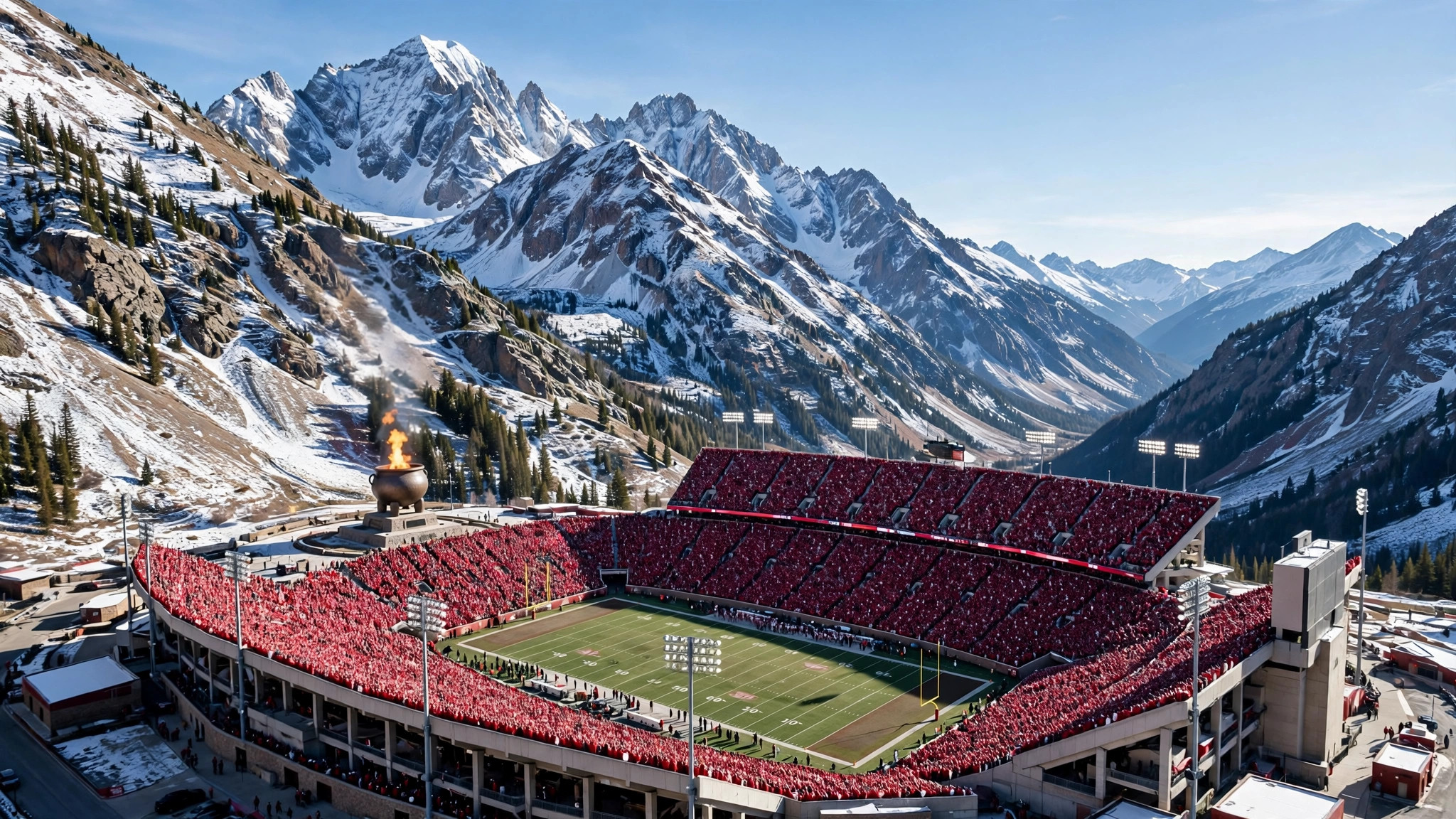
Utah football plays in the Big 12 Conference — the program’s third league home in fifteen years, after the Pac-12 run that followed its Mountain West origins — at Rice-Eccles Stadium in Salt Lake City. The stadium, opened in 1998 on the university’s campus foothills, holds more than 51,000 fans and carries a distinction no other college venue can claim: it hosted the opening and closing ceremonies of the 2002 Winter Olympics, and the Olympic cauldron still stands at its south end.
The Utes wear crimson and white, and their identity is the most portable in the sport: wherever Utah goes — Mountain West, Pac-12, Big 12 — the formula travels. Recruit the West’s overlooked athletes, develop linemen relentlessly, defend with structure and violence, and win November. The program’s modern history is the proof of concept repeated across three conferences: Urban Meyer’s undefeated Fiesta Bowl team of 2004, the 13-0 Sugar Bowl champions of 2008, back-to-back Pac-12 titles in 2021 and 2022, and a program that enters the Big 12 era not as a guest but as a standard.
Utah Utes Football: The Whittingham Era and Its Astonishing Coda
Utah Utes football was defined for twenty-one seasons by one man. Kyle Whittingham — a BYU linebacker, deliciously, who became Utah’s defensive coordinator and then, in 2005, its head coach — built the most consistent program in the West: the 2008 team that went 13-0 and dismantled Alabama in the Sugar Bowl; the Pac-12 South titles; the consecutive conference championships and Rose Bowls of 2021 and 2022; a two-decade conveyor of NFL defensive linemen and defensive backs.
Whittingham’s defenses were the signature — coordinated for the last decade of his tenure by Morgan Scalley, his protégé — and his teams’ personality was his own: blunt, physical, allergic to self-pity, and at its best in the season’s coldest and loudest weeks. He stepped down after the 2025 season as the winningest coach in program history, and then the story took its famous twist: within weeks, Michigan — suddenly in need of a head coach in late December — hired the 66-year-old Whittingham to Ann Arbor, in the most unexpected major appointment in recent memory.
The coda matters for understanding the current program: Utah did not lose its coach to chaos. The succession had been designed years in advance, with Scalley formally designated as the head-coach-in-waiting long before the transition came. The era ended; the system, deliberately, did not.
The Morgan Scalley Era: Continuity as a Weapon
The new head coach is the old defense. Morgan Scalley — a former Utah safety, a Salt Lake City native, the Utes’ defensive coordinator since 2016 and one of the most respected defensive minds in the sport — takes over a program whose identity he personally authored for a decade. His defenses at Utah were annual top-tier units built on disguise, tackling and a secondary that produced NFL players in assembly-line fashion; UCLA’s 2025 opener, dissected elsewhere in this batch, is a fair sample of the product.
Continuity is the point of the hire, and its value in the portal era is compounding: recruits know the scheme, the staff room barely turned over, and the standard in the building is enforced by the man who set it as a coordinator. The questions are the new ones — game management, offensive identity, the CEO dimensions of the job — and Utah’s bet, placed years ago and held with discipline, is that the answers were standing on its own sideline all along. Few programs in America have managed a legend’s exit this calmly, because few planned it this honestly.
Utah Utes: Roster Philosophy — Develop, Defend, Repeat
The Utah Utes roster is the development model’s purest expression. The Utes recruit their footprint — Utah’s own rising high school scene, the Polynesian communities whose connection to the program runs generations deep, California and Texas overflow — and they recruit traits over rankings: length on the defensive line, tackling in the secondary, and offensive linemen who will be unrecognizable, in the best way, by year three.
The 2025 offense showed the model’s modern extension. Quarterback Devon Dampier arrived from New Mexico with his coordinator’s system in his head and produced a debut season that announced Utah’s Big 12 intentions in Week 1 — 206 passing yards, 87 rushing and three total touchdowns in a 43-10 win at UCLA — and the Utes’ two-way deployment of defensive stars like Smith Snowden and Lander Barton, both of whom scored offensive touchdowns that night, is the roster philosophy made flesh: athletes first, positions second.
The official roster lives with the school; read it for the redshirt juniors on the defensive line, which is where Utah seasons have been decided for twenty years. Our Arizona football guide covers a fellow western program building with a different recipe — the contrast flatters both.
A Game Week in the Building: The Utah Standard
To see what the standard looks like from inside, follow a Utah game week. The program’s habits are famous in coaching circles for their plainness — the same meeting rhythm, the same practice structure, the same refusal to treat any opponent as either a giant or a bye. Players describe a building where the depth chart is a meritocracy with a memory: produce in practice and the rotation finds you, whatever your recruiting ranking said three years ago.
The week’s visible artifacts, for the fan keeping score:
- A defensive meeting room that runs the program. Utah’s identity starts there, and the whole building knows it.
- The two-way experiment board. Defensive stars taking offensive snaps is planned, not improvised — it is on the week’s installation schedule.
- The altitude block. Conditioning work calibrated to turn the stadium’s elevation into a fourth-quarter asset.
- A Thursday standard. By the staff’s old rule, the week is won or lost by Thursday’s practice; Friday is for polish.
None of it is glamorous, and that is rather the point. Utah’s two decades of winning were not built on secrets. They were built on a standard, repeated weekly, in a building at 4,600 feet that treats repetition as a competitive advantage — the least fashionable and most durable idea in the sport.
Rice-Eccles Stadium and the MUSS
Rice-Eccles Stadium’s game day begins with its setting: the Wasatch Range rising straight out of the east side, the city and the Great Salt Lake spread below the west, and an elevation that visiting teams feel in their lungs by the second quarter. The 2002 Olympic cauldron at the south end is the stadium’s signature landmark, a reminder that this building has hosted the world’s biggest ceremony and treats a November night game as a comparable occasion.
The noise belongs to the MUSS — the Mighty Utah Student Section, consistently rated among the nation’s best — whose coordinated chaos anchors the stadium’s south end and whose third-down rituals have broken more visiting offenses than the altitude has. Expansion of the south end zone in recent years enclosed the bowl and concentrated the sound, and the program’s home record across the last decade is the statistical shadow of the building: Utah at home, at altitude, at night, is one of the sport’s most reliable results.
Visitors should walk the Olympic plaza, find the cauldron, and stay for the postgame singing of “Utah Man,” the fight song whose name the whole state answers to. Our Navy football guide covers another program whose stadium doubles as a national shrine; Rice-Eccles belongs in that company, with better skiing nearby.
Utes Football: The Holy War and the Rivalry Shelf
Utes football’s defining date is the Holy War against BYU — a rivalry so intense it has its own theology jokes and a body of lore two states argue over, and the subject of its own guide elsewhere in this batch. Beyond it, the shelf holds the Rumble in the Rockies against Colorado, an old ski-country feud restored by the Big 12’s map; the Battle of the Brothers against Utah State, the state’s internal argument; and a newer generation of Big 12 grudge matches building equity by the season.
The through-line of Utah’s rivalries is that the Utes are almost always the program punching at a bigger brand — and that the punching has gone well enough, for long enough, that the brand gap is now mostly a story the programs tell recruits. Utah’s fans have processed the chip on the program’s shoulder into an identity so complete that success has not removed it. It is load-bearing now.
That identity explains the calendar’s emotional economics. A Utah season is not graded on a curve of wins; it is graded against the shelf — did the Utes keep the Wheel’s counterpart trophies in Salt Lake, did the Holy War go the right color, did the Big 12’s new names learn what the Pac-12’s old ones knew about Rice-Eccles in November? The standard is tribal and specific, and the program’s two decades of meeting it are why the stadium sells out for opponents whose names casual fans cannot spell. In Utah’s building, every Saturday is somebody’s rivalry, even when it is officially nobody’s.
Utah Game: Schedule Shape, Tickets and How to Watch
The Utah game calendar in the Big 12 runs on nine conference dates, three nonconference fixtures and the Holy War as its emotional summit, with the altitude-and-November combination making Rice-Eccles home dates the inventory visiting fans fear and home fans hoard. Tickets move through the school’s official channels; BYU and ranked visitors sell first and fastest.
Television follows the Big 12’s packages across the ESPN and FOX families and their streaming platforms, with kickoff times set in season — Utah’s Mountain Time kickoffs frequently fill the late national window, which suits a fan base that likes its football under lights and its stadium at full volume. The official home for schedules, tickets and roster news is Utah Utes athletics, and readers mapping the West can continue with our Montana State football guide.
Utah football is the sport’s rebuttal to the idea that resources decide everything: a plan, a place and two decades of patience, weaponized. This guide is your way into all of it.
