

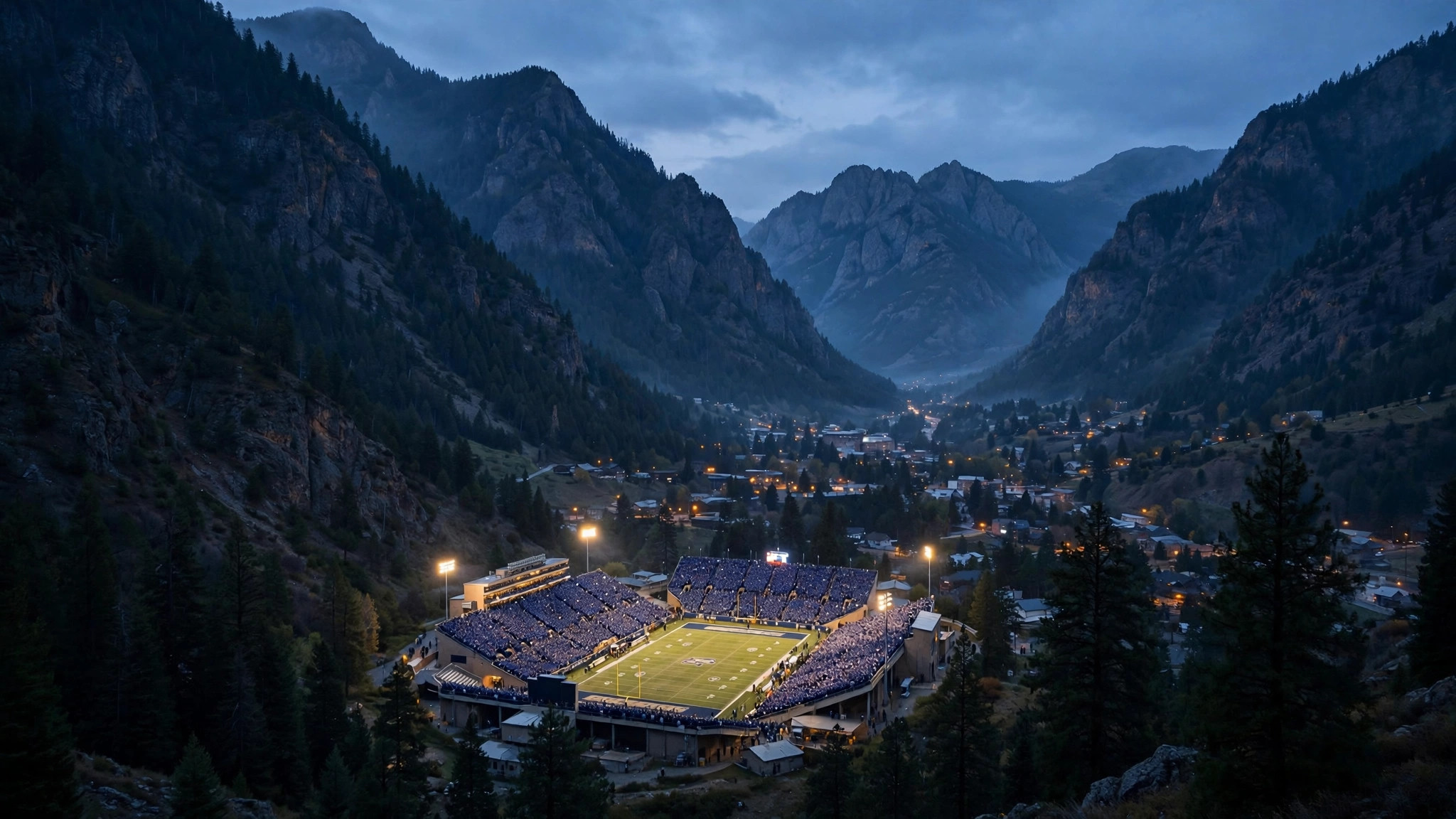
Cache Valley does not do anything halfway, including college football. Utah State football plays in one of the loudest small stadiums in America, in a mountain valley that treats the Aggies as its professional franchise, for a program with a Hall of Fame legend in its past and a conference leap in its immediate future. This guide covers the whole Aggies landscape: the Bronco Mendenhall era, the roster, Maverik Stadium and the HURD, the Merlin Olsen inheritance, the rivalries, the schedule’s shape, tickets and how to watch from Logan to anywhere.
If you only know Utah’s other two programs, this is the introduction you have been missing. The third program in the state has the loudest room of the three.
Utah State Football: The Program at a Glance
Utah State football plays at Maverik Stadium in Logan, a venue of about 25,000 seats pressed against the Bear River Mountains, in a city of roughly 55,000 people in the Cache Valley of northern Utah. The Aggies wear navy, white and pewter grey, and they compete — for one final season — in the Mountain West Conference: Utah State has accepted its place in the rebuilt Pac-12, which the Aggies join in 2026, a move that reshapes everything in this guide’s future editions.
The program’s history is spikier than its reputation. There are the Merlin Olsen teams of the early 1960s, when the Aggies were a national name; the long wandering decades that followed; and a modern era that has produced a Western Athletic Conference title, a Mountain West championship in 2021, and a string of bowl seasons that taught Logan to expect December football as a matter of annual routine. The fan base — students above all — supplies the volume that makes the small stadium a genuine problem for visitors, and the program’s story is best read as a loop: quiet years, a coach who fits the valley, a sudden team the whole state talks about.
The Bronco Mendenhall Era: A Homecoming With a Résumé
Utah State’s current chapter opened in December 2024 with one of the Mountain West’s most decorated coaches coming home to the state where his legend was made. Bronco Mendenhall — who built BYU into a consistent winner across eleven seasons, then took Virginia to an Orange Bowl, then spent a year at New Mexico — chose Utah State for the final act of one of the sport’s most distinctive careers.
Mendenhall’s programs run on a public operating system: “earned, not given,” a development culture borrowed from his BYU years and adapted to the portal era, and defenses that arrive at their standard faster than their talent says they should. His first season in Logan followed the pattern his career predicts — a competitive, organized team that kept the Aggies in the Mountain West race deep into November and restored the program’s expectation of itself after a turbulent stretch of coaching turnover.
For the valley, the fit is the story. Mendenhall is a Utah football institution coaching the state’s third program with the first two on the schedule across his tenure — the Battle of the Brothers against Utah and the Old Wagon Wheel against his own former school, BYU, now carry a personal subplot no marketing department could invent. Few coaching hires anywhere have ever come with this much built-in narrative, and Logan is enjoying every line of it.
USU Football: Roster Building in the Cache Valley
The USU football roster is assembled the way the valley requires: regional recruiting across Utah, Idaho and the Intermountain West; junior-college and portal additions at the scarce positions; and a development culture that expects the two-deep’s back half to outgrow its recruiting profiles. The program’s modern proof cases are famous in the league — quarterback Jordan Love, developed in Logan into a first-round NFL draft pick and the Green Bay Packers’ franchise passer, and linebacker Bobby Wagner before him, a second-round pick who became one of the defining defensive players of his NFL generation.
That lineage matters to the current rebuild because it calibrates belief: Aggies fans have watched this exact stadium turn overlooked players into professionals within living memory, twice, at the sport’s two most valuable positions. The official roster is maintained by the school, and the Ames-and-Bozeman rule applies here too — the names that decide November in Logan are usually the ones nobody circled in August, a pattern our Montana State football guide documents in the Aggies’ FCS neighborhood.
There is a second, quieter lineage the valley tracks just as closely: the coaches. Utah State has been a finishing school for the profession — Ralston to the NFL, and in the modern era a line of head coaches who used Logan as the proving ground for power-conference jobs — and Mendenhall’s arrival inverts the pattern in the most flattering way possible. The Aggies are no longer the place a rising coach leaves from. They are the place a legendary one chose to come to, and the roster’s recruiting pitch writes itself from that single fact: come play for the coach who could have worked anywhere, in the valley he picked on purpose.
Maverik Stadium and the HURD
Maverik Stadium — opened in 1968 as Romney Stadium and renamed in 2016 — is small by the numbers and enormous by the decibel. The bowl sits tight and steep against the mountainside, the Wasatch light does its evening work, and the student section, the HURD, has built a national reputation as the loudest per-capita crowd in the Group of Five: coordinated, funny and merciless, famous for rattling visiting offenses in a building a quarter the size of the stadiums those offenses usually visit.
The setting completes the argument beautifully. Logan in autumn is the American West in miniature — harvest fields, mountain walls on two sides, and a Friday-night-lights culture scaled up to a university. Add the pregame traditions the valley has accreted — the Scotsman, the Aggie fight song, ringing out since long before any current student was born — and a home game at Maverik becomes one of the sport’s great small-room experiences. The academy comparison in our Navy football guide is apt: another program whose home field functions as a shrine and a weapon in the same acreage.
The Merlin Olsen Inheritance
Every Aggies conversation stands in one shadow. Merlin Olsen — defensive tackle, Outland Trophy winner in 1961, the third pick of the 1962 NFL Draft, a fourteen-time Pro Bowler with the Los Angeles Rams’ Fearsome Foursome, a Pro Football Hall of Famer, and only then, somehow, a beloved broadcaster and actor — played his college football in Logan. He remains the program’s patron saint and the standard its linemen are still measured against, his name carried by the field itself at Maverik Stadium.
Olsen’s era, under coach John Ralston, put Utah State in the national polls and the Sun Bowl; his statue and legacy anchor the program’s memory the way few single players anchor any school’s. When Mendenhall’s staff talks to recruits about what can be built in the Cache Valley, they do not need to invent the proof. It is standing outside the stadium in bronze.
Game Day in Logan: The Aggie Saturday, Step by Step
For the first-time visitor, the Logan game day assembles like this:
- Morning in the valley: tailgates open early around the stadium, with the Bear River range turning gold and the whole town seemingly walking toward the same address.
- The HURD assembles: students arrive as a body, not a trickle — the section is full and organized well before the teams emerge, and its warm-up act is aimed at the visiting sideline.
- Kickoff altitude of the spirit: Maverik’s tight bowl traps every decibel; a 25,000-seat stadium produces a 60,000-seat sound, a fact visiting quarterbacks confirm annually.
- The Scotsman: the fight song rolls through the building with a confidence that suggests the valley has been singing it at opponents for a century, because it has.
- Fourth quarter in the cold: Cache Valley evenings drop fast; the crowd does not. Bring the coat you think is too much. It is not.
Stay after for the valley’s other ritual — the slow, happy dispersal into a small city that has nowhere else it would rather have been — and the Aggies’ whole proposition becomes clear: this is college football at its most concentrated, undiluted by scale.
Rivalries: The Wagon Wheel, the Brothers and the League
Utah State’s rivalry shelf is Utah-shaped. The Old Wagon Wheel goes to the winner of the BYU game, a series with a century of feeling in it; the Battle of the Brothers names the Utah game, the state’s internal hierarchy argument; and the Mountain West years built working grudges with Wyoming, Boise State and San Diego State, the last of whom the Aggies beat for the 2021 conference championship in the program’s modern signature win.
The Pac-12 move redraws the map without erasing it — the Wheel and the Brothers survive any conference arithmetic, because Utah’s schools schedule each other the way families gather: regardless of what the league office thinks. Fans comparing the Aggies’ resource model with a program at the other end of the spectrum can browse our Liberty football guide — the contrast is the sport’s whole economics in two chapters.
Schedule, Tickets and How to Watch the Aggies
The Aggies play the Mountain West’s framework in their farewell season — nine conference games is the Big 12’s number; the Mountain West runs eight — plus nonconference dates that usually include at least one of the in-state giants and one power-conference examination. Bowl eligibility at six wins is the valley’s annual baseline expectation, and the conference title game is the standard the 2021 team set for the era.
Tickets are the sport’s great bargain: Maverik Stadium inventory through official channels remains among the most accessible in the FBS, with BYU and Utah visits the premium dates. Television follows the Mountain West’s packages across the CBS and FOX families and streaming, moving to the Pac-12’s arrangements with the conference switch. The official home for schedules, tickets and roster news is Utah State Aggies athletics.
Utah State football is the reminder that the sport’s soul is stored in its small rooms — a valley, a bronze legend, a student section with a national reputation and a legendary coach writing his career’s final act at home. This guide is your seat in the HURD’s neighborhood. Dress warm; Logan in November is honest about winter, and the Aggies, increasingly, are honest about something else too: that a program this loved, in a valley this loyal, with a coach this proven, is done being anybody’s footnote in the state’s football story.
